

Institution Fall Graduate Enrollment Over Time
Research Analytics Menu
- 30/60/90 - Day Pre-Closeout
- Academic Analytics
- ARGO
-
ARGO - Sponsored Program Intake
- Approver Review Process
- Communication Section
- Compliance Section
- Funding Source Section
- How to Export a proposal as PDF
- Key/Senior Personnel Section
- Proposal Details Section
- Proposal Information Section
- Steps in the Key Personnel Review & Certifications Process
- Submit for OSP Review Section
- Subrecipient/Collaborator Section
- Upload Documents Section
- ARGO Dashboard
- Carnegie Classification
- Control Tower
- Data Pulse
- Data Storage and Computing
- Doctoral Insights Engine
- From Vision to Precision: UTRGV’s R1 Mission
- Glossary
- Graduate Course Demand Tracker
- Graduate Help Desk
- Graduate Services Portal
-
IPEDS
- Comparing Similar Institutions to UTRGV Based on Graduate Enrollment
- Geographical Institution Graduate Enrollment
- Institution Degree Awarded Over Time
- Institution Degree Awarded Profile
- Institution Fall Graduate Enrollment Over Time
- Institution Fall Graduate Enrollment Profile
- IPEDS data dictionary
- Research Degrees Awarded Comparison
- Institute for Research on Innovation and Science (IRIS)
- Limited Submissions
- NSF HERD
- Post-Award Request Portal
- Prompt Report Form
-
Reports
- Annual Report Dashboard
- Awards and Proposal Summary
- Expense Classification
- IDC Dashboard
- ORU Dashboard
- Project Burn Rate
- Project Listing
- Proposal Approvals
- Qualtrics DoR Survey Dashboards
- Research Pathways & SPI Questions
- Research Productivity
- Weekly OPS Report
- Space Utilization Dashboard
- Graduate Student Recruitment Dashboard
- Research Compliance Training
- Project Closeout
- IBS Salary Calculator
- Training and Support
Quick Links
Institution Fall Graduate Enrollment Over Time
The "Institution Fall Graduate Enrollment Over Time" section of the dashboard offers a longitudinal view of graduate enrollment patterns at the University of Texas Rio Grande Valley (UTRGV). This page helps stakeholders analyze how full-time and part-time graduate student enrollments have changed over recent years and provides a demographic breakdown of gender and ethnicity trends.
Relevant Variables:
- Graduate Enrollment Level: Separates students into Full-Time Graduate Students and Part-Time Graduate Students, allowing users to observe enrollment dynamics across these two categories.
Visualizations:
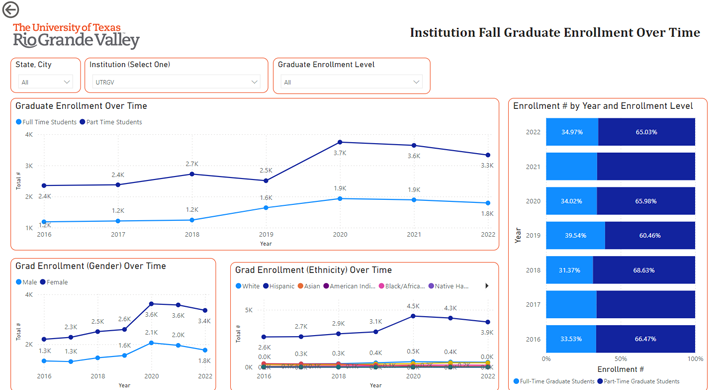
- Line Chart (Graduate Enrollment Over Time): This line chart visualizes trends in full-time and part-time graduate enrollments from 2016 to 2022. The lines show year-over-year changes, making it easy to spot growth or declines in each category. For example, users can see if there has been a shift in students opting for part-time or full-time enrollment over the years.
- Stacked Bar Chart (Enrollment # by Year and Enrollment Level): This stacked bar chart shows the percentage split between full-time and part-time graduate students each year. Each bar represents a year, with sections for full-time and part-time enrollment. This format allows users to observe whether the distribution between full-time and part-time students remains consistent or shifts over time.
- Line Chart (Graduate Enrollment by Gender Over Time): This chart breaks down the enrollment trends by gender (male and female) over time. Each line represents one gender, providing a clear view of enrollment patterns among male and female students from 2016 to 2022. Users can observe changes in gender representation within the graduate student population.
- Line Chart (Graduate Enrollment by Ethnicity Over Time): This chart tracks the enrollment of various racial/ethnic groups over the years. Each line represents a different demographic group, allowing users to see how enrollment among each group has evolved over time. This visual is particularly useful for understanding diversity trends within UTRGV's graduate programs.
Overall Functionality: This page offers a comprehensive view of how UTRGV's graduate enrollment has evolved over time, segmented by enrollment status, gender, and ethnicity. By providing these breakdowns, the dashboard allows administrators and stakeholders to monitor trends, assess the impact of demographic shifts, and make informed decisions about recruitment, retention, and diversity initiatives. This information is valuable for setting strategic goals to support graduate student growth and inclusivity at UTRGV.