

 rotate(10)'/%3E%3Cpath d='M.038.113v.15l.15.088.15-.088v-.15L.188.025l-.15.088Z' stroke='%23c44900' stroke-width='.0375' transform='rotate(10)'/%3E%3C/svg%3E)
About this guide
This guide contains selected publisher agreements negotiated by the UTRGV Library which provide fully waived or discounted Article Processing Charges (APCs) for corresponding UTRGV authors. Publishers use these waivers or discounts to encourage open access (OA) publishing.
While some journal submission systems may alert authors to the availability of APC support, some publishers do not apply waivers or discounts automatically. To ensure proper institutional affiliation and support, corresponding authors should use their @utrgv.edu email address to confirm the benefit during submission or acceptance. In addition, authors should list The University of Texas Rio Grande Valley as their institutional affiliation, followed by their respective college, school, department, or program (e.g., The University of Texas Rio Grande Valley, Robert C. Vackar College of Business & Entrepreneurship, Department of Information Systems).
Fully waived APC agreements are listed in the left menu. Discounted APC agreements appear in the section below. You can also view articles published under these agreements in ScholarWorks @ UTRGV.
The list of publishers is as comprehensive as possible. If a journal title is not found, it is likely not covered under a current agreement. Please contact william.flores01@utrgv.edu before submission to verify journal coverage or article type.
ACS:
- UTRGV corresponding authors qualify for a reduced APC rate to publish the final article as open access in ACS hybrid journals. The reduced APC rates are: $2,000 USD for articles published under CC-BY license and $1,500 USD for articles published with CC-BY-NC-ND license.
- UTRGV corresponding authors will receive a discount of 10% on Hybrid and 15% on fully OA Elsevier journals (except for Cell Press and Lancet journals, and some society journals who have opted out of the agreement).
MDPI:
- UTRGV corresponding authors are entitled to a 10% discount on all MDPI APC charges.
Frequently Asked Questions
ScholarWorks is the institutional repository for UTRGV. Faculty can deposit their work in the repository in accordance with the policies of the publisher or as a pre-print before a publisher has been approached.
The library now offers mediated deposit. Simply send an email to openscholarship@utrgv.edu with your paper(s) and we will do the rest! We will contact you if there are any questions about deposit rights.
If you prefer to self-deposit your work, you can go to the Faculty Publications and Presentations collection for your department and click the Submit Research link on the left sidebar.
Archiving your pre-print or accepted manuscript in the institutional repository will greatly enhance the impact of your work, particularly in parts of the world that rely on open access copies of new scholarship. Items in the repository are harvested by Google Scholar, Unpaywall, and other aggregation services.
Open Access (OA) literature is digital, online, free of charge to the reader, and free of most copyright and licensing restrictions. The definition is fluid and might not always encompass the open licensing aspects when used.
Open Access, as an option for wider dissemination of research, is entirely compatible with and insists on upholding standards of peer review, copyright, quality, prestige and research impact.
There are multiple models for supporting Open Access. These may include Article Publishing Charges (APCs) which ostensibly cover the production costs of the journal. Most OA journals do not have APCs and rely on institutional funding, but the largest volume publishers of OA articles do. Most established publishers like Springer and Elsevier provide APC-funded OA options as part of their business model.
The library now offers mediated deposit. Simply send an email to openscholarship@utrgv.edu with your paper(s) and we will do the rest! We will contact you if there are any questions about deposit rights.
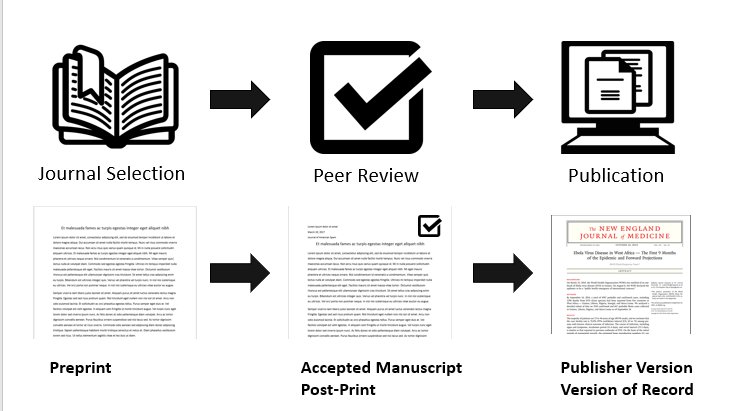
Be sure you understand what version of your article you're submitting to the Institutional Repository. Most journals only allow the pre-print and accepted manuscript (both formatted in typical double-spaced, 12 pt font). If you only have the publisher's version of an article you'd like to deposit, you might need to contact the publisher for permission.
You can check the self-archiving policies of any of your works by looking up the journal in Sherpa/Romeo.
The diagram below is to help you understand what versions are referenced in your journal's self-archiving policy.
Before you sign an agreement, take a moment to think about what you want to do with the work in the future. Will your publishing contract allow you to do those things?
As the author of a scholarly work, you are also the original copyright owner in that work. When it comes to how that work is reused by others (copied, distributed, etc.), you are in charge! You are free to make copies of your work and give them away, post them online in an institutional repository, or create derivatives based on the work. When you publish the work, however, this could change and you could lose the right to do some of these things freely depending on what you agree to in the publishing contract!
As an author you may face one of the following options when publishing you work:
1. Author assigns/transfers copyright to the publisher. Historically, this has been the most common option. Many academic publishers require that an author assign his copyright in a work to the publisher. In this scenario, when you want to reuse your article, such as by making copies to give to colleagues, distributing copies to students in a class, archiving it in an online repository, or even adapting the article into a conference presentation, you will face the same limitations on reuse that you would when you need to reuse someone else’s work. You will likely need to get permission to reuse the article from the publisher unless your proposed activity qualifies for a copyright exemption, like fair use.
The law allows for the termination of transfer during a certain period after publication, in order to give authors control over their early works that they may have signed away rights to. One tool is the website RightsBack.org.
2. Author retains some rights by:
Granting exclusive licenses: Not all publishing agreements involve the complete transfer of rights. In some cases, rather than asking for a transfer of rights, a publisher may request an exclusive license to exercise specific rights. For example, if a publisher asks for the exclusive right to publish a work, the author retains his copyright ownership, but grants the publisher the exclusive right to copy and distribute the work. Since the license is “exclusive,” the author cannot grant this license to anyone else and would need to get permission from the publisher to reproduce or distribute that work. Since this is not a complete transfer of the author's copyright, it is possible for the author may retain the right to do other things with the work, such as create derivatives based on the work.
Using an “Author Addenda”: It is also possible to customize your publishing agreement using an "Author Addenda". These addenda often grant the author a non-exclusive license to reuse a work. Licenses are usually limited to specific types of activities, such as allowing a copy of an article to be uploaded to an institutional repository. A license of this type may come with additional limitations such as specifying that only a “pre-print” version of the article that can be uploaded to the repository. There are model agreements available to help authors sort out the details. (See links below.)
3. Author keeps all copyright. Complete transfers or assignments of copyright ownership and exclusive licenses are not always necessary for publication. It is possible for you to maintain ownership over your copyright and give the publisher a non-exclusive license to publish your work instead. These types of arrangements are common among open access publishers, quite often using a Creative Commons License.
Take a look at SPARC's Author Addendum for more information on how addendums can preserve your rights over your work.
- Gold OA — The final published version is immediately free to read on the publisher’s website. Usually requires payment of an Article Processing Charge (APC).
- Green OA — The author self-archives a version of the article (preprint, accepted manuscript, or published version) in a non-commercial repository. Often subject to an embargo period.
- Diamond / Platinum OA — Free to read and free to publish (no APCs). Typically funded by institutions, societies, or grants.
- Hybrid OA — A subscription journal that allows individual articles to be made open access upon payment of an APC.
- Bronze OA — Free to read on the publisher’s site but without a clear open license (not fully open under stricter definitions).
The corresponding author is the person responsible for managing the manuscript and all correspondence throughout the publication process—from corrections and proofreading, through handling revisions and resubmitting revised manuscripts, until final acceptance. This author has the authority to act on behalf of all co-authors in all matters related to the publication of the manuscript, including any supplementary material.