
 rotate(10)'/%3E%3Cpath d='M.038.113v.15l.15.088.15-.088v-.15L.188.025l-.15.088Z' stroke='%23c44900' stroke-width='.0375' transform='rotate(10)'/%3E%3C/svg%3E)
Welcome to the Eco Wrangler Blog published by your campus team of writers to report and investigate sustainable impact, innovation and integrity happening on campus and across the Rio Grande Valley.
Aligning ourselves with the three pillars, we aim to spotlight efforts that amplify the cause of action-oriented sustainability impacts.
Do you have a spot that supports this cause, and you'd like for us to cover it? Fill out our form below!
Blogs
From a Job Application to a Sustainability Question
By Kevin Arevalo
OCTOBER 06, 2026
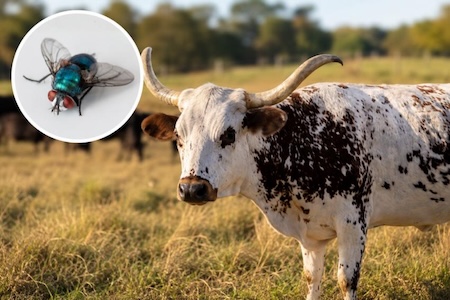
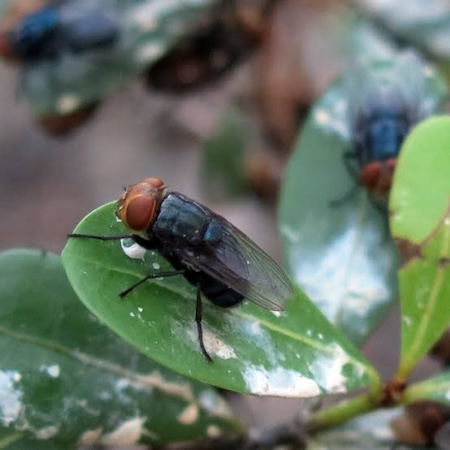
I first heard about the New World screwworm when someone sent me an application for a team involved in producing flies for a control effort here in Edinburg. Producing flies to fight a fly sounded strange to me, but through the application, I learned that the flies would be sterilized before being released. When they mate with wild flies, they do not produce offspring, helping reduce the population without relying solely on pesticides.
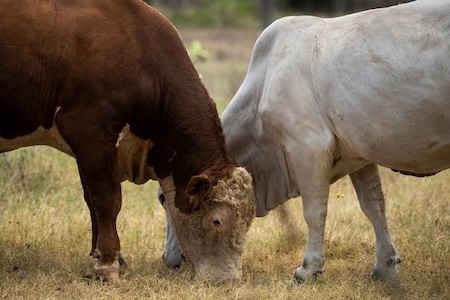
When the screwworm came up again in my agroecology class, I learned more about how its larvae infest wounds in animals and why a pest eliminated from the United States decades ago is a concern again. What had seemed like an unexpected application started to feel much closer to home, especially because USDA is building a sterile-fly production facility in Edinburg.
In my environmental regulations class, we studied the Mediterranean fruit fly as an example of how governments respond to a pest that threatens agriculture. At the end of an exercise, we were asked to choose an environmental regulation problem we might want to analyze later in the course. I chose the screwworm because it connected something I had encountered personally with questions I was exploring in both classes.
As an EcoWrangler, this has made me think about sustainability not just as protecting the environment, but as choosing thoughtful ways to respond when a problem affects animals, agriculture, and the communities around us.
Have a story to share?
Crisis at The Resaca
By Jesus Zavala
SEPTEMBER 16, 2026
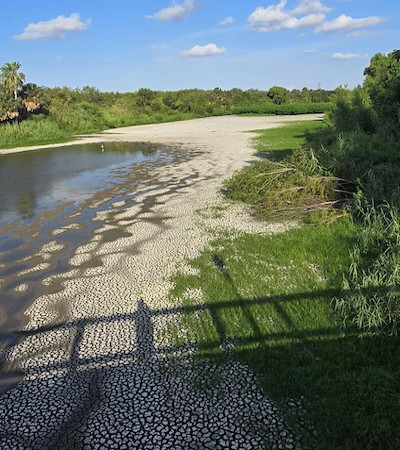
The UTRGV Brownsville campus remains so attractive for new students because of the installations, buildings, and natural environment surrounding the area. One of the staples of our southern campus is the wooden bridge that connects the Main Building to the Student Union and the Life Health Sciences Center. Underneath the bridge stands the resaca, a fountain of wildlife that when you walked the bridge just for a moment you could appreciate the ducks in the water and the small turtles sticking their neck out to catch a breath. The resaca wildlife is important to the ecosystem, but it has become a shell of its formal self.
Before summer, the resaca’s water levels were fine. It's difficult to believe that from late May to the beginning of September, the conditions of the resaca have changed so dramatically and become so deplorable.
How did we get to this situation?
The National Weather Service predicted that the Rio Grande Valley would experience extreme heat and drought from May through July, reaching their peak during July.
The City of Brownsville continued to monitor the water supply through the Brownsville Public Utilities Board's Drought Contingency Plan. Although Brownsville had previously been under Drought Stage 2, the city returned to Stage 1. However, this improvement doesn’t mean the drought ended. The region has remained vulnerable, and most natural ecosystems face extreme drought, including the resaca at UTRGV.
Yesterday, I walked to the same wooden bridge that I first crossed one year ago when I enrolled. I think about all the times I walked by without paying attention to what was underneath me. Sometimes I'd stop and appreciate the wildlife, while other times, I'd simply continue walking to class without giving it a second thought.
This time it was different.
There was a sense of sadness when I realized that many of the ducks that were usually there were now gone. The water levels changed, the environment looked different, and the resaca that had once been full of life now looked deserted.
There is a saying in Spanish: “Nunca sabes lo que tienes, hasta que lo pierdes,” and I can't help but feel that way after seeing the condition of the resaca. Perhaps we never realized how much the resaca meant to our campus until we started seeing it disappear. The wooden bridge will still be there; the students will continue to walk across the bridge every day, but the rich visual of our natural environment is now gone.
What can we learn from this situation?
This is a reminder that our environment can be rapidly affected, creating an impact on the local wildlife's survival. The ecosystem that was once there, that was part of our community, is now gone. Sometimes the biggest reminders about our environment are right in front of us, and we only begin to notice when they’re no longer there.
Archived Articles
The Weight of the Cloud
By Leslie Hurtado
AUGUST 17, 2026
The way we preserve data is a story of changing containers: from papyrus to paper, handwritten to printing press, floppy disks to USB flash drives, and eventually, the cloud. As our mediums evolved, so did our infrastructure. Computers shifted from room-sized calculators into compact, efficient devices. The physical space once required for a single machine has been repurposed to cram in thousands of them to form interconnected servers commonly referred to as data centers.
Every email we send, automated backup, and photo we store on the cloud feels like we are tossing data into thin air. In reality, that data lives on servers running 24/7 in facilities using millions of gallons of potable water for cooling and enormous amounts of electricity to stay online.
The Cloud Over the Valley

MCTX1 by 1547 Critical Systems Realty
The truth of the environmental impact of AI and the cloud is that the effects are felt strongest in the communities that house data centers. As the tech sector expands to meet rising demand, the RGV has the spotlight but lacks the resources due to prolonged drought.
- McAllen’s iconic Chase Tower is home to MCTX1, a major data center for the valley.
- Edinburg, the historic Echo Hotel got demolished to build a modern tech campus belonging to Austin/India-based company Zoho.
- Harlingen is being eyed as the next location for a massive, 1,800-acre data center as proposed by European developer Eneus energy.
All our digital actions carry a physical carbon footprint, but we can lighten that load by developing digital mindfulness.
Cleaning out your Inbox
A standard text e-mail produces 0.2-0.3g of CO2e emissions according to the Carbon Literacy Project.
Taking the time to unsubscribe from digital newsletters you don’t read and deleting old e-mails help reduce your inbox’s carbon footprint. Additionally, skip sending emails with one-word replies, and if a large attachment is going to be sent back and forth, consider uploading the asset to a cloud service and sending the link instead.
Avoid digital hoarding
Digital hygiene is just as important as physical hygiene. Automatic backups and redundant cloud storage from multiple services create clutter and are the digital equivalent of letting junk pile up in your room.
Practice digital decluttering. Purge blurry or duplicate photos, delete old device backups from the cloud, and try to only use one provider across the board to avoid duplicate files.
Rethink web search habits
According to Google’s sustainability report for the year 2025, emissions increased 18% compared to 2024. “We recognize that our climate impact has been growing alongside the unprecedented growth of AI.” Considering Google is the most popular search engine, accounting for over 90% of the global search market share, every prompt we run connects directly back to data centers.
With artificial intelligence searches taking over traditional searches on most browsers, consider bookmarking frequently used sites to reduce the amount of queries run on search engines. It saves time and reduces your carbon footprint. Go a step further and use eco-friendly search engines that have built-in sustainability practices.
The cloud, despite its name, is not weightless. It is steel, concrete, electricity, and water. The waste it produces, although invisible to us, adds up in a tangible way. The goal of digital sustainability isn’t to disconnect or abandon the tools we rely on every day. It’s choosing to shrink our digital waste through everyday choices.
Defining Sustainability Leadership
BY JEREMY SAN MIGUEL, ASSISTANT DIRECTOR, UTRGV OFFICE FOR SUSTAINABILITY
JUNE 17, 2026
In echoing the famous words of Abraham Lincoln “The best way to predict the future is to create it”
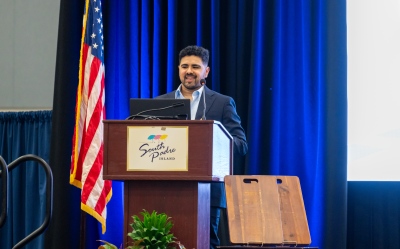
My name is Jeremy and I have had the privilege of being part of sustainability leadership at The University of Texas Rio Grande Valley for over 6 years. This role has come with endless opportunities to connect with various academic, operational, and sustainability leadership across the world, while getting to witness projects that impact communities, build sustainable development on campuses, improve food insecurity, target energy resiliency, and spark conversations of what defines the issue and solutions surrounding sustainability.
How do you define Sustainability?
I believe sustainability stops when we find boxes to put it in. Most notably, you might hear someone say, “sustainability is recycling”, “sustainability is water conservation”, or “sustainability is about addressing human rights”, or any other myriad of wonderful examples of what sustainability looks like in action, but the truth is, is that sustainability is a choice rather than an action; a choice to consider the betterment of humanity, prosperity, and environmental stewardship, before or in alignment with action. Sustainability is a tool for any novice or experienced wizard to wield, should they be daring enough to consider it.
Why is this important?
How do we view modern day news media if not without a touch of pessimism and worry? You see in an ever-changing world, we must ask ourselves… are we responsible to change with it? Drought, overpopulation, finite energy resources, hunger, copious record of mental health disparities, sickness, violence, and the growing gap in the education and social systems needed to address these issues. It is the belief that with sustainability at the front of modern intention, these issues can and will be addressed by examining all facets of the way we plan, operate, and live within society, and the role that each person, corporation, and government has toensure the betterment (and guarantee) of tomorrow.
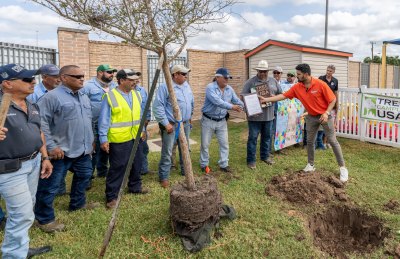
Whose torch is it to carry?
If the best way to predict the future is to create it, then it goes without saying that our job is find the best version of ourselves and help others find it as well. People who care, businesses who care, and governments that care, but to care also holds the responsibility to be aware; of the issues and what is needed for their solutions. Whose torch is it to carry? I would say you. If not you, then who?... The Office for Sustainability? A leader of some sorts? Then I turn the question around and ask what is a leader? Someone who takes ownership of a problem? Someone who guides others into understanding or towards a collective goal? If any of those are a yes, then you must do you best to become the type of leader you would follow. One that invests in themselves, makes conscious choices in what they buy and allow, and how they choose to see the world, or better yet how the world could be.
Welcome to the FLÜNCE Fashion Show
By Karla Averanga
JUNE 1, 2026
All eyes on the 956.
Fashion has always lived here in the Valley and FLÜNCE (pronounced “floo-ns”) proves the movement ignites passion for artistry through the voice of fabric. On May 16, their first dynamic show in San Benito, TX was surprisingly attended by 140 enthusiasts, creatives, and artists to watch a runway, showcase, and a panel pouring industry insights into the RGV.
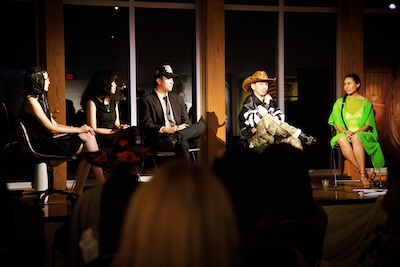
Designer panel inside the San Benito Cultural Heritage Museum
FLÜNCE became a symbol of how individuality can ripple the potential to what's next in any event calendar. Alejandro Fortunes, better known as the creator and designer Alejandro D. Bones, “DYEBONES” shares his desire “to find my own Valley in Brooklyn,” as he reflects the aerial view of the 4-hour scheduled agenda.
“There are so many pockets in Brooklyn, but it is beautiful to see artists see familiar faces here. That gets lost on a larger scale when growing city or numbers wise, community can become harder to hold onto."
What made this memorable night...different? New friends and connections were made. Many sleepless nights and hours of brainstorming make everything worth it. But, most importantly, a reminder that passion does not need to leave, it has been a growing comunidad in the Lower Rio Grande Valley.
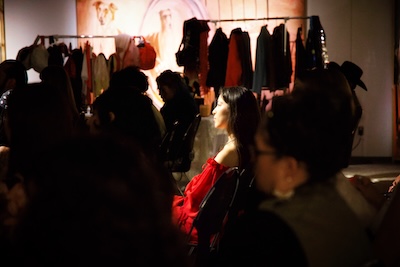
VIP Guests enjoy frontline seating to designer panel
ICYMI
- Art exhibitions by Jorbin and Elijah
- Final models selected since March took over a 1-hour runway
- Supportive showcase to purchase displayed clothing pieces like The Betty Head
- Signature drinks from Shaken & Stirred BTX
- Live atmospheric beats by DJ kAne
- Merch + Vendor Spotlights ft. 9INE 5IVE 6EIS
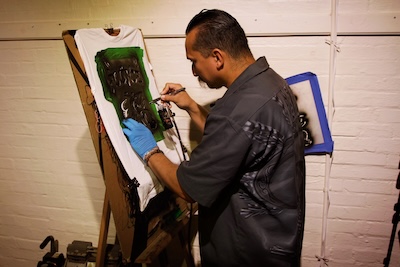
Customized airbrushing on t-shirts by Serkit Studios
CURIOSITY LIES AHEAD
None of this could have happened without the vision of Creative Director Raelyn Lopez, who hosted this ambitious show to allow a space for networking, entertainment, and imprinting courage to RGV’S creative scene for future generations.
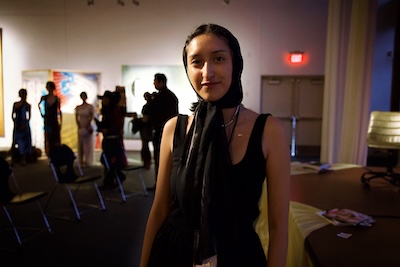
Creative Director and Visual Artist Raelyn Lopez
“Even in my absence, people now have the confidence to create something for themselves. This is a take on what it means to bridge friendship to professional business relationships," Raelyn states. "My father always told me, “It takes ganas!”. I'm hoping younger generations in the RGV take all the ganas they need through art education to pursue their dreams.”
MEET THE DESIGNERS
- ZOMBORAT by Arwen Perez-Baez demonstrates fashion as a form of personal expression, describing fashion as "existence" by "trusting yourself to the fullest".
- 37th Universe by Eliyas Cortes is a craft to communicate tough beginnings through his collection. Tunneling into the need for affordability in clothing pieces to amplify cultural beauty. "Everything is made with my heart and now, I can live my passion wholeheartedly for my grandmother."
- Azalia Martinez, the creator of FIBRA, expresses how her Mexican cultural background influences “fluidity and movement to always honor the craftsmanship that goes into bodily structure.”
Sustainability to Martinez matters most. Usually deriving from upcycled resources, where she finds enjoyment "traveling back in time when it comes to finding better quality than nowadays." Nonetheless, appreciating past designers and "migrating inspiration from older techniques" as a way of developing skillset into "interior weight and artistic process."
To learn more or support, follow @weareflunce on Instagram, YouTube, and TikTok or attend future events to make real connections with artists in designated spaces.
Composting: What I’ve Learned Along the Way
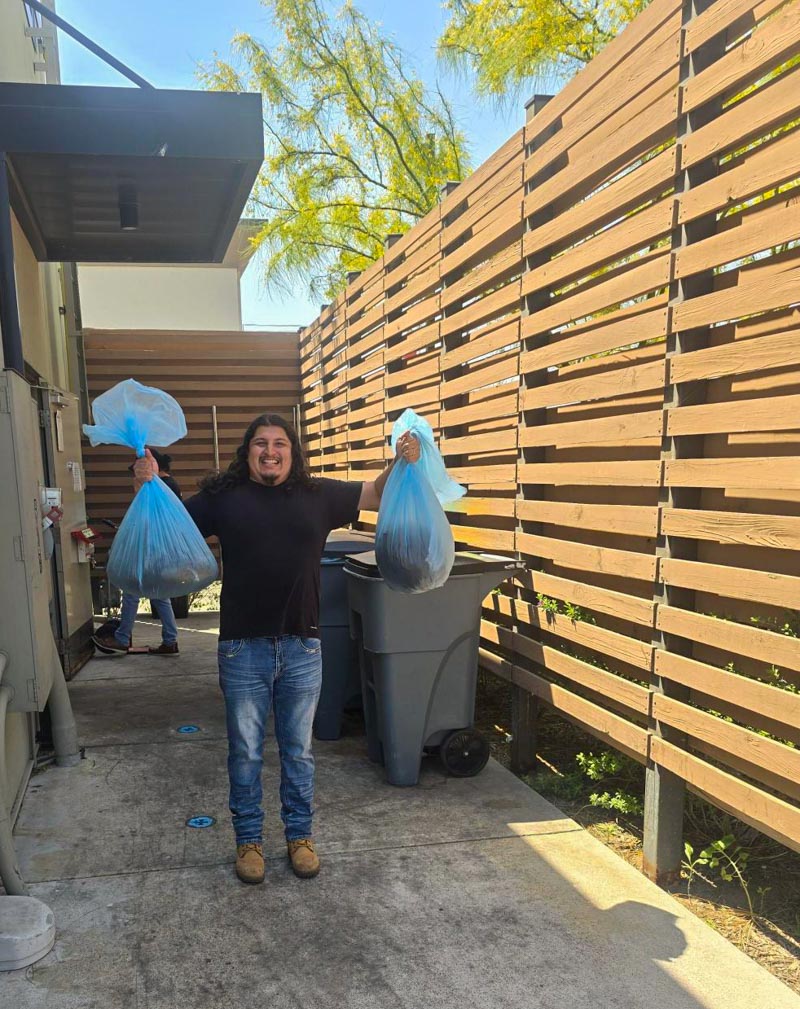
By Kevin Arevalo
MAY 1, 2026
Before I started my Sustainable Agriculture class, composting was one of those things I had heard about for years but never really understood. I knew it had something to do with food scraps and dirt, but I didn’t realize how much it could teach you about waste, patience, and giving back to the soil. Once I started learning more about it in class, composting became a lot more interesting to me because it felt like such a simple idea with a big impact.
What surprised me most is how much everyday waste can be reused instead of thrown away. Things like fruit peels, coffee grounds, and yard clippings can all become part of something useful again. That idea really stuck with me because it connects to sustainability in a way that feels practical, not just theoretical. It made me think more about how small choices add up, especially when it comes to reducing waste on campus and at home.
From an Eco-Wrangler perspective, I also like that composting shows how everyday habits can turn into something bigger. Even though it is not flashy, it still matters because it is one of those things where you take the right steps consistently, and over time you start to see results. In a way, composting reminds me of working behind the scenes on campus because the effort may not always be visible right away, but it still helps everything run better.
Learning about composting has made me see waste a little differently. Instead of thinking about what gets thrown away, I now think about what can be returned to the earth and used again. 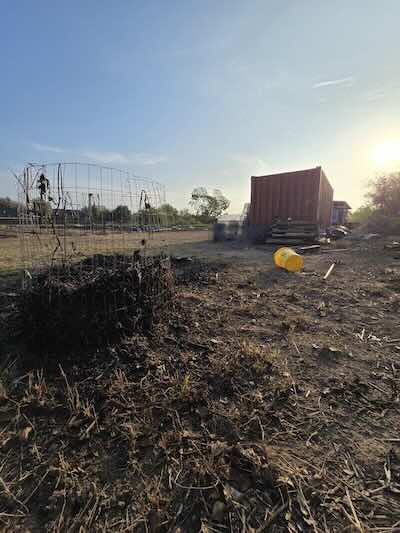
From Abuelos to the Future: Farming, Learning, & Community
By Karla Averanga
APRIL 10, 2026
As you travel around the RGV, agriculture surrounds backyards or plots of land. Today, the culture of farming is deeply tied to sustainable learning and community gathering, where generational knowledge about planting, harvesting, and maintaining healthy food systems continues to be shared. “My parents and grandparents from both sides were agricultural farmers in Matamoros,” an interviewee reflects.
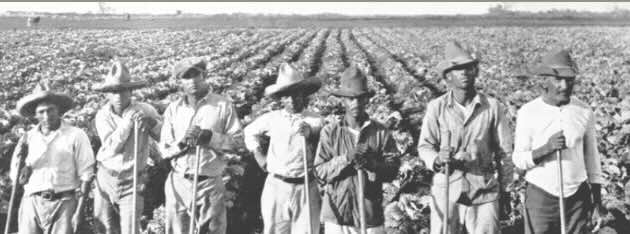
Farmworkers' Movement in the RGV Timeline
Operating since 2008, the Brownsville Wellness Coalition (BWC) has worked to expand local food systems. Community gardens like Esperanza and Tres Angeles, active since 2013, offer more than fresh produce, providing shared green spaces that support teamwork, mental well‑being, and neighborhood connection.
BWC Community Gardens Manager Clarissa Villareal describes how her family history shaped her path. She recalls stories of her mother helping her grandfather form planting rows and surviving off the harvest. “I wish to continue my family’s legacy and educate communities on how to enrich existing food systems,” she says.
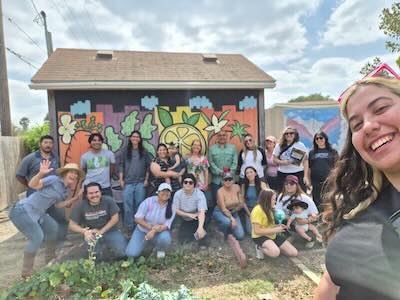
Conservationist Training Completion at Tres Angeles Community Garden
The growing partnership between BWC and the UTRGV Agroecology Program has expanded hands‑on learning opportunities. The program recently completed a 4‑week community conservationist training, led by Program Coordinator Mario Fierro. He notes that many participants share a desire to reconnect with their roots: “It’s because somebody in the past would do it,” he explains, emphasizing how conservation practices mirror generational skills. Workshops such as an organic certification module continue to strengthen the region’s sustainable agriculture efforts. Families are increasingly returning to backyard gardening to supplement farmers’ work and encouraging seasonal eating.
CELEBRATING CAMPUS INVOLVEMENT
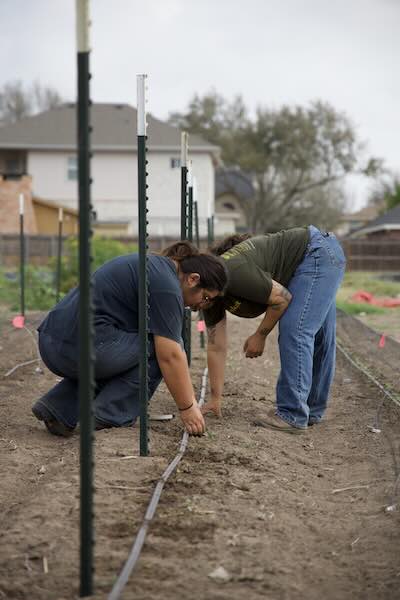
Maria Gonzales and Katy Amador planting tomato seeds at the HUB of Prosperity Farm
At the HUB of Prosperity Farm, manager Maria Gonzalez highlights the importance of hands‑on experience. She hopes visitors leave with a deeper appreciation for fresh food and loves to send off visitors with cucumbers or green beans. During tours, she points out edible plants and explains the difference between grocery‑store produce and naturally grown food. The Environmental Awareness Club hosted its farmer’s market on March 26, offering affordable produce, thrifted clothing, and more. The event’s popularity drew participation from organizations such as the UTRGV Geology Club and the Intersectional Feminist Student Organization.
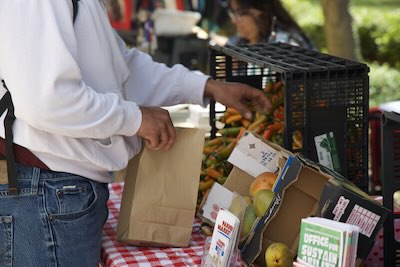
Student purchasing serrano peppers from the Environmental Awareness Club
NURTURING THE EARTH TO NOURISH TOMORROW
Founded in 2017, Terra Preta in Edinburg practices regenerative agriculture focused on soil health, biodiversity, and long‑term sustainability. Community events like “Pick‑N‑Pulls” allow visitors to harvest produce while supporting the farm’s income and mission.
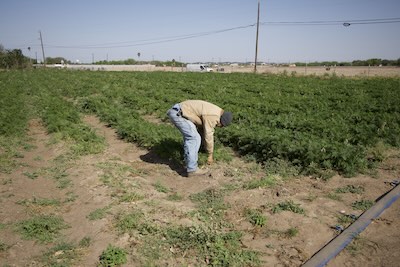
Juan Raygoza, owner of Terra Preta Farm, harvesting carrots
The upcoming 2026 Animal Behavior Meets Social Science Symposium will explore how livestock care intersects with social science. As Program Coordinator Misty Cornejo at UTRGV Center for Sustainable Agriculture and Rural Advancement (SARA), shares her childhood around farmers inspired her to study animal science and understand livestock behavior more deeply. To learn more about local agriculture, visit Terra Preta Farm or explore a community garden near you.
The Perfect Water Bottle
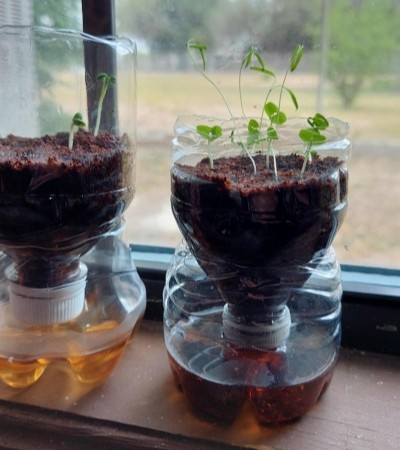
By Cindy Ruiz Zamundo
MARCH 31, 2026
Hello everyone, my name is Cindy Ruiz, and I am an Eco Wrangler in the Office for Sustainability at the University of the Rio Grande Valley. I am president of the Intersectional Feminist Student Organization, an organization that helps and educates students about their rights and fights for the improvement of said rights.
To be honest, I'm a little against mindless consumption. Sometimes I wonder how easily we carry accessories without overall ambition. In this case, I'm talking about water bottles. Water can be obtained everywhere. For example, here at UTRGV by means of fountains or some vending machine, but even then, I cannot understand the purpose, until we talk about ease. If I’m being direct, my favorite one is the one at the Interdisciplinary building due to the fact that it’s usually fresher than the rest (yet, I have to say, with my sensory issues I prefer to have water from home).
It's different to try to find a supplier when you can be your own supplier, after all you start with a water bottle made from plastic. Let's think about it a bit: There's only one vending machine in front of you, the other buildings are closed so you can't access the water fountains inside them, however, you can buy a single bottle and then recycle it and refill it with water at (for example) the gym's water fountain.
Here is a simple recycling method: Take the purchased bottle, consume all its contents before continuing your journey, and finally reuse the bottle to consume more content.
Let's say you have the machine in front of you, but in your backpack, you have a perfectly functional metal bottle, which helps you preserve the environment and the temperature of your water. Buying a plastic (sometimes not recyclable) water bottle when you already have a functional metal bottle is a bit paradoxical to a certain extent (unless of course the metal bottle you have is damaged, so it makes a little more sense).
My opinion of a perfect water bottle? Simple: If you can reduce your carbon footprint and reuse the bottle, for me, that already makes it more than perfect (And maybe if you throw so pastel blue or clear with flowers with a bamboo lid, oh, I love those).
Rooted Locally: An Eco-Wrangler's Journey in Volunteerism
By Karla Averanga
FEBRUARY 27, 2026
I convinced myself I had missed my moment. You know that FOMO in college when everyone seems to be securing opportunities. However, I’ve learned that as an Eco-Wrangler, service doesn’t expire because it waits silently for you to step in.
My moment arrived on MLK Day, spreading mulch around the Casa Bella dormitories. I volunteered at the event hosted by UTRGV Center of Student Involvement (CSI) in Brownsville to honor the legacy of Martin Luther King Jr. through action.
“From South Padre Island to Edinburg, we believe in coming together to serve our community,” said Assistant Director Ashley Guzman.
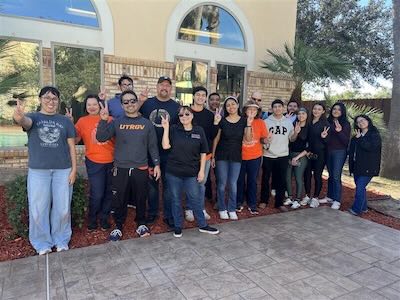
Figure 1. Volunteers attending MLK Day of Service in Brownsville, Texas on January 19th, 2026
BLACK FREEDOM IN THE RIO GRANDE VALLEY
When February came, I wanted to see how Black history was celebrated in presence, resilience, and transformation, locally. I visited Restlawn Memorial Park, the only burial site in Hidalgo County where African Americans were once laid to rest. Walking there made history feel nearby.
I spent time at UTRGV’s Special Collections and Archives, researching the preservation across human presence in the RGV. Almost a quarter of a millennium ago, generations of cultural evidence whisper lifetimes of existence.
The Rio Grande Valley wasn’t just farmland. It was a passage of protection and partnership.
During the Antebellum period, the Valley became a route to freedom along the Underground Railroad. Historical records estimate that approximately 20,000 enslaved people escaped through South Texas into Mexico, where slavery was abolished. Mexico and nearby regions offered refuge, where Black and Mexican communities built relationships rooted in shared survival. Many accounts note that Mexican people generally did not practice enslavement and often aided those seeking freedom (p. 100).
Kearney, M., Knopp, A., & Zavaleta, A. (Eds.). (2006). Further studies in Rio Grande Valley history. Illustrated by E. Ybarra. Publisher.
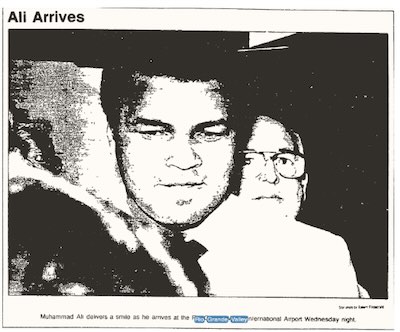
Figure 2. Page 15 of Valley Morning Star, published in Harlingen, Texas on Thursday, July 24th, 1986
BRIDGING THE GAP: PAST, PRESENT, & FUTURE | LOCAL CELEBRATION
On February 7, I attended the 2nd Annual Black History Month Festival at Lincoln Park, hosted by the Brownsville Parks & Recreation Department. Brooke Esparza, Special Events Coordinator for the City of Brownsville, calls Brownsville, “God’s Little Hidden Place,” noting that more Black families are choosing to call the Valley home.
I also met Cierra Thompson, who traveled from New Orleans to share her son Simeon’s story, ‘SIME the Sickle Cell Hero,’ inspiring other children to believe in their own strength. “I didn’t expect my first visit to be this uplifting,” she said. “Everyone was welcoming.”
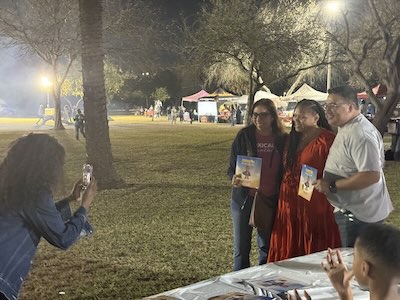
Figure 4. Book signing with author Cierra Thompson
Being rooted locally isn’t about being born somewhere, it’s about recognizing a region shaped by resilience. Don’t assume you’re too late, choose to grow where you are, and help keep stories alive.
To learn more about exploring a public resource that dedicates to preserving stories, visit UTRGV Special Collections & Archives. Visit Engagement Zone at UTRGV for volunteer opportunities.
Bridging Research & Public Understanding: Collaboration Between UTRGV and Gladys Porter Zoo
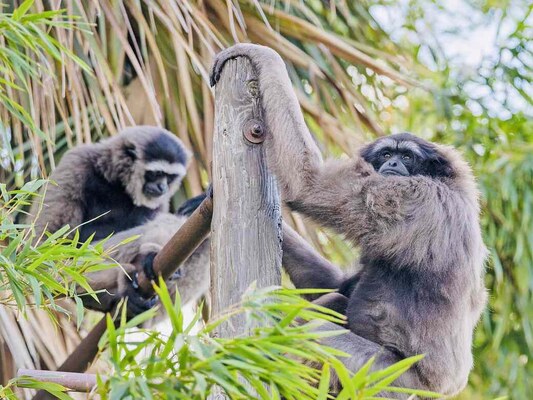
Mueller Gibbon at the Gladys Porter Zoo | Photo by Claudia Martinez
By Karla Averanga
JANUARY 22, 2026
Dr. Valerie James-Aldridge, Curator of Behavior Research and retired professor of UTRGV, alongside Lab Director and Professor, Claudia Martinez from the UTRGV Comparative Psychology Lab, are collaborating with the Gladys Porter Zoo (Accredited by the Association of Zoo & Aquariums (AZA)). To bridge research into public understanding of animal welfare through protocol.
In fall 2025, students in Advanced Specialization in Rhetoric, Composition, and Literacy Studies: Otherworldly Arguments (ENGL 4340) were asked to highlight the valuable efforts made by zoo professionals. Translating academic research into a public summary using the article, “How different zoo animals interact with each other: A Scoping Review,” published in the journal Applied Animal Behavior Science. Understanding primate dynamics, the students discovered patterns of interaction from: Claudia Martinez, Lecturer II of Psychological Science, Dr. Aldridge who brings 50+ years of expertise, and Todd J. McWhorter and Eduardo J. Fernandez from the School of Animal and Veterinary Sciences, University of Adelaide, Australia.
“The collaboration between our campus to the zoo is allowing public access to scientific research. There is potential to foster long-term cultural support for animal welfare and conservation,” responds Sergio Perez, the UTRGV Director of Sustainability, sharing the science behind animal behavior with the public can help advocate biodiversity.
FROM CLASSROOM TO PUBLISHED ARTICLE
Professor Martinez explains that the personal motivation behind the co-authored article, she “highlights how important the task of the zookeeper is. What we need to do is bridge the connection between experiences and make the best decisions for the animals. Every zoo should have a research center to combine insights in collaboration.” Her efforts in assisting primate research, reaction, and behavioral patterns are observed during transfers or deaths within primate groups. Including an exchange after the passing of one silverback that eventually inspired her to pursue an M.A. in Experimental Psychology. Ms. Martinez, who is currently pursuing her PhD in Veterinary Science views her choices “felt like everything fell into place on how she got to where she is but would like to be of help to all of the zoos and primates.”
BREAKING STEREOTYPES OF ZOOKEEPING
A major concern is the public’s belief in the disconnection of animals from their natural habitat. “Part of my conversation with visitors,” explains Dr. Aldridge, “is to reframe their perceptions. For instance, they may think animals are ‘doing nothing,’ but even stillness is behavior.” Zoo staff and researchers will act immediately using data-driven decision-making on certain animal behavioral issues. Holding the value of the Animal Welfare Act (AWA) that mental and physical well-being is important for the maneuvering of the animal under any human care.
The home to 377 animal species includes 20 primate species researchers using data aimed at improving ongoing animal welfare and conservation efforts where science behind observational research follows patterns of social interactions, the use of real ID sheets in fieldwork, and facing challenges to create solutions animals face within their exhibits.
To learn more, visit the UTRGV Comparative Psychology Lab.