
 rotate(10)'/%3E%3Cpath d='M.038.113v.15l.15.088.15-.088v-.15L.188.025l-.15.088Z' stroke='%23c44900' stroke-width='.0375' transform='rotate(10)'/%3E%3C/svg%3E)
Core Director
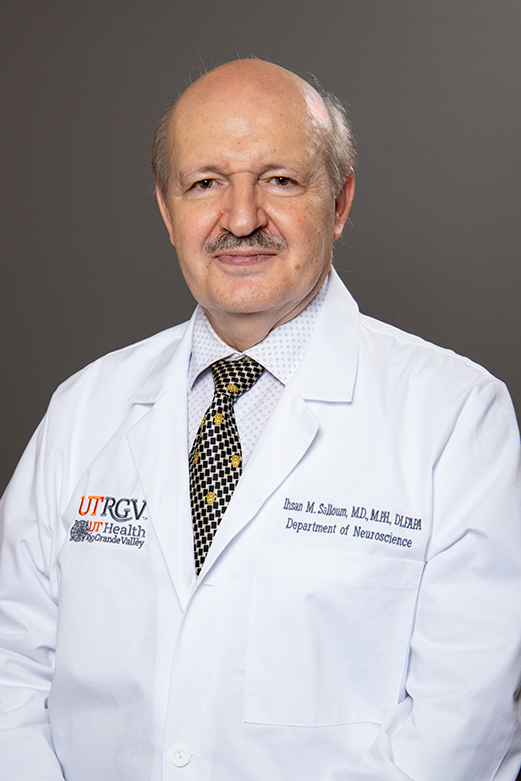
Ihsan Salloum, MD, MPH, DLFAPA
Core Director
Investigator Development Core
The Investigator Development Core (IDC) will assume a primary role in achieving the stated goals of the Center to foster and promote excellence in health disparities and cancer research for early-stage investigators (ESIs) and assist them in achieving independence as funded researchers. The IDC will further contribute to the RGV-CHDRC goals of enabling investigators at all levels to become more successful in obtaining competitive extramural support with a focus on health disparities and cancer conditions disproportionately impacting the population of the Rio Grande Valley (RGV). These communities are over 80% Hispanic and are among the nation’s most socio-economically disadvantaged, experiencing high degrees of health disparities. Our RGV-CHDRC and IDC core will also significantly contribute to the NIH mission of enhancing the pool of scientists in the biomedical sciences and cancer research. The academic environment at UTRGV and our diverse, multidisciplinary faculty are uniquely positioned to engage our communities on the US-Mexico border in culturally competent, measurable, and sustained innovative cancer-related research aimed at improving health outcomes. We propose 1. To develop Pilot and Collaborative Research Project Implementation in Health Disparities and Cancer Research. And 2. To effectively implement through the IDC scientific training, collaboration, and mentoring in Health Disparities and Cancer Research, incorporating social determinants of health and behavioral health.
Our consortium consultant, Dr. Brett Spear, is a Professor of Microbiology, Immunology, and Molecular Genetics at the University of Kentucky, where he has served on the faculty since 1989. He is also affiliated with multiple graduate programs, including the MD/PhD Program, Nutritional Sciences, and Toxicology. He brings decades of experience in supporting faculty across the U.S. in the development of competitive NIH grant applications. As a senior researcher with more than 30 years of experience and extensive service on multiple grant review panels, he provides valuable guidance that strengthens the Investigator Development Core’s efforts to recruit and mentor Early-Stage Investigators.