
Graduate College Guides
A1 - Supervising Committee
This guide explains the policies governing the formation and maintenance of supervising committees for theses and dissertations. This document serves as the Graduate College interpretation and application of the policy.A1.1 Who Does It Affect?
This guide is intended for use by:
- Graduate students
- Colleges and Schools
- Graduate program coordinators or directors
- Graduate faculty
- Graduate recruitment
- Graduate admissions
A1.2 The Policy - Degree Policies [2027 - Catalog]
A1.3 Forming the Supervising Committee
The supervising committee plays a vital role in guiding the student through the research project. Choosing the right committee ensures the student receives relevant support and increases the likelihood of completing the thesis or dissertation on time.
To begin, the student should consult with the faculty advisor to determine the most appropriate composition for the committee. The committee will support the student throughout the research journey by:
- Helping the student define the research topic;
- Advising on research design and methodology;
- Overseeing data collection and analysis; and
- Supporting the theoretical framing and writing process.
To form the supervising committee, the student should follow these steps:
- Select a committee chair with the mentor’s guidance;
- Develop the research idea in collaboration with the chair; and
- Choose additional committee members with the chair’s input, ensuring expertise aligns with the project’s goals and advising needs.
Once the student and the chair agree on the committee’s composition, the student must formally request its formation.
Submit Proposed Committee for Approval
The student initiates and submits the Application for Dissertation/Thesis Committee Form.
The form must include:
- The names of the chair and committee members. The committee may only have one chair. The committee may only have one co-chair (optional). All others are members of the committee;
- Proposed title of the thesis or dissertation;
- Expected defense term; and
- Indication of whether the research is likely to include regulatory research (e.g., human subjects, animals, biohazard agents, recombinant nucleotides, etc.).
After the form is submitted, it will be routed for approval to:
- Committee chair;
- Graduate program coordinator or director;
- Dean of the college or school, or designee; and
- Dean of the Graduate College, or designee.
Note that the thesis committee must include at least three members, inclusive of the chair and co-chair (if applicable). A dissertation committee must include at least four members, inclusive of the chair and co-chair (if applicable).
The student, the committee members, and all form approvers will receive a copy acknowledging the formation of the committee. If the application is denied at any level, a new application addressing any deficiencies must be submitted.
After the committee has been approved, the research proposal has been defended, and any additional regulatory approvals have been obtained, the student may begin the research project.
Who is Allowed to Serve on the Committee
Students are encouraged to take time to get to know the faculty in their program and those eligible to serve on thesis and dissertation committees. In all cases, the chair of the committee must be a tenured or tenure-track graduate faculty member of UTRGV. The committee may include an approved external member. Programs may have stricter requirements; students should consult the program handbook or graduate program. The following guidelines apply:
- All members must meet graduate faculty membership qualifications, including terminal degrees and current research or professional experience;
- Up to half of the members may come from outside the student’s program or college or school, provided they have relevant expertise;
- External member must have expertise in the student’s thesis or dissertation topic; and
- Only UTRGV faculty with assigned research effort may serve on a dissertation committee. These generally include tenured or tenure-track faculty, professors of practice, clinical professors, and professors of research at any rank.
An exception to any of the above requirements may be granted upon petition to the dean of the college or school and the Dean of the Graduate College. An exception may be requested for only one member of the committee.
When to Form the Supervisory Committee
Each college or school or program may have its own guidelines for the process and completion of the thesis or dissertation. Students should review the program handbook. The process of forming the supervising committee should begin as early as possible.- Thesis students are expected to establish their committee while in Thesis I - earlier is encouraged; Students should not begin Thesis II without a supervisory committee;
- Doctoral students are expected to form their committees by the end of their second year - earlier is encouraged; The student should not enroll in research or dissertation courses without an approved committee.
Establishing the student’s supervisory committee early is crucial for receiving timely faculty guidance during the proposal and research design phases. This support helps the student stay on track with important milestones such as candidacy and defense deadlines.
Process for Changing Committee Members
To make changes to the supervising committee, the student should consult with the program advisor or a faculty member for guidance. All committee changes must be submitted using the Change of Committee form.
Changes to the composition of the supervising committee must be made immediately after any of the following:
- The student and the chair determine that the committee composition needs to be adjusted to align with the needs of the research project;
- A committee member is no longer able or willing to serve;
- A committee member separates from UTRGV; or
- A committee member loses graduate faculty status.
When any of the above circumstances applies to the chair, all research activity must cease until a new committee and new committee chair are formally approved. If the student’s project involves human subjects research, the student must also update the IRB-approved protocol before resuming any research activities.
A1.4 Annual Reporting Requirements
The supervising committee is responsible for meeting with the student at least once per academic year and submitting a written annual progress report to the Graduate College.
Each year, beginning with the formation of the committee, the student must request a formal meeting with the supervising committee. The student initiates the request by completing the Annual Reporting Form. Upon receiving the student's request, the committee chair will coordinate and attend the meeting. After the meeting, the committee chair must upload or copy and paste the goals and expectations of work for the upcoming year.
Each subsequent annual report must address the progress the student made toward achieving the goals and expectations of the prior year. In addition, the committee must specify new or updated goals and expectations for the upcoming year.
Failure to have the annual reporting form on file may affect the student’s eligibility to receive Graduate College travel funds or to hold a graduate assistantship. Failure to initiate annual reporting requirements after formation of the supervisory committee may result in dismissal from the program.
A1.5 Making Satisfactory Progress Toward Degree Completion
A graduate student may be placed on academic probation and subsequently dismissed from their graduate program for failure to make satisfactory progress toward the completion of the degree. The student must receive a formal warning and a reasonable opportunity to address the identified deficiencies in making progress toward the degree. Deficiencies may include but are not limited to:
- Failure to enroll or complete the approved credit hours;
- Failure to maintain continuous enrollment (except when on an approved leave of absence);
- Earning unsatisfactory grades;
- Failure to keep visits with faculty advisor or chair when required;
- Failure to establish a supervisory committee by the graduate program’s specified timeline;
- Failure to initiate annual reporting requirements after formation of the supervisory committee; or
- Failure to meet other required program milestones set by the graduate program.
See the Graduate Student Dismissal Guide for details concerning the dismissal and appeals process.
Termination of Candidacy
The termination of doctoral candidacy is equivalent to dismissal from the doctoral program. The Graduate College, upon recommendation from the graduate program and the dean of the college or school, may terminate a doctoral student's candidacy. Prior to termination, the student must receive a formal warning and a reasonable opportunity to address the identified deficiencies in making progress toward the degree.
Termination of candidacy may occur for several reasons, including, but not limited to:
- Failure to demonstrate adequate progress within three years after admission to candidacy or within nine years of initial enrollment in the program, whichever occurs first; or
- Failure to possess qualifications appropriate for the degree, such as having outdated knowledge in areas assessed by the comprehensive, preliminary, or qualifying examination.
See the Graduate Student Dismissal Guide for details concerning the termination of candidacy and appeals process.
A1.6 Human Subjects Research
The Institutional Review Board (IRB) oversees all research involving human participants to ensure studies are conducted ethically, responsibly, and in compliance with federal regulations and university policies.Theses and Dissertations that make use of human subjects must apply for and have an approved IRB protocol before conducting research. The student should serve as PI of the project.
How to Initiate a UTRGV IRB Protocol Application
Students begin by requesting access to tick@lab, following the instructions provided on the IRB website. Access to tick@lab generally takes 2-6 business days. While waiting for access, the student completes the required CITI training. Register with UTRGV email and complete the two courses:
- Biomedical or Social/Behavioral Research Investigator and Key Personnel;
- Responsible Conduct of Research (matching your research track) and clinical research may require additional training.
Next, submit the Outside Activity Disclosure:
- For students not employed at UTRGV or external collaborators submit the paper form and attach it to the tick@lab protocol;
- UTRGV employees and student employees must complete this disclosure through the university portal.
Before starting the protocol, students must review the IRB resources under the Division of Research → Guidelines & Procedures → IRB section. These include:
- tick@lab manual;
- IRB templates and forms.
After these steps, students may begin thier IRB protocol in tick@lab, using the templates and manual to complete the application and attach all required documents. For questions or assistance, contact the IRB at irb@utrgv.edu.
A1.7 Animal and Biohazard Research
Students may not serve as a Principal Investigator (PI) on projects that require Institutional Animal Care and Use Committee (IACUC), Institutional Biosafety Committee (IBC), or Hazardous Biological Agents (HBA) approval. Students working on projects with approved IACUC, IBC, or HBA protocols must be listed as personnel on the protocol.A1.8 Thesis Milestones Guide
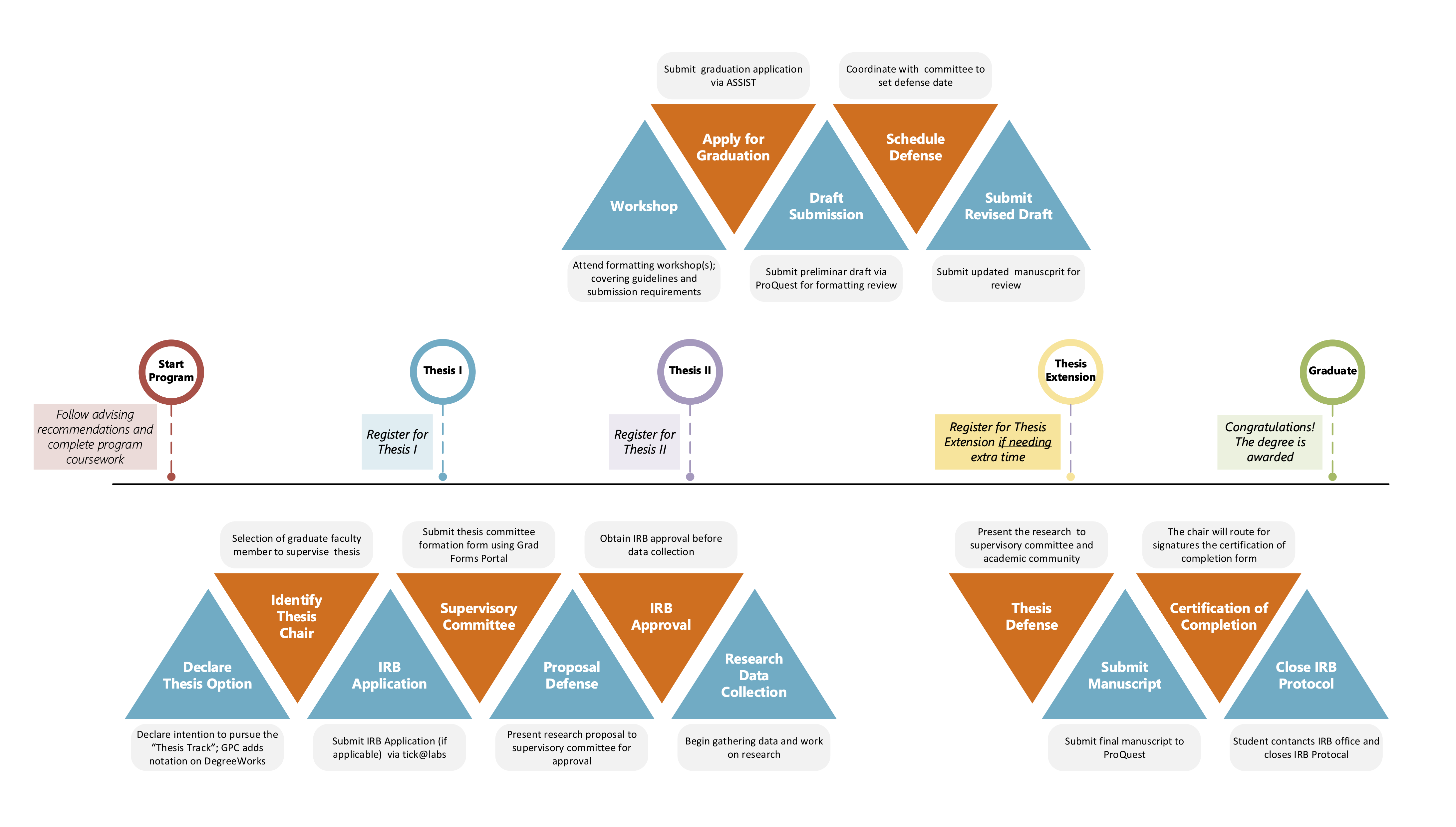
This guide provides a recommended sequence of steps for completing the thesis-track master’s program.
Step 1: Initiation of the Thesis Process — The student begins the thesis process by:
- Identifying a committee chair — The student selects a graduate faculty member to supervise the thesis; The student should declare the intention to pursue the “Thesis Track” as early as possible; The graduate program coordinator records the “Thesis Track” note in DegreeWorks;
- Registering for Thesis I.
Step 2: Early Research Planning and Committee Formation — The student begins formal research planning by:
- Forming the supervisory committee — The student submits the committee formation form. Committee approval is required before proposal defense or thesis research;
- Submitting an IRB application (if applicable) — Required for research involving human subjects; The student serves as Principal Investigator and submits the application via tick@lab;
- Defending the proposal — The student presents the research proposal to the approved supervisory committee;
- Securing IRB approval (if applicable) — The student must obtain IRB approval before beginning any data collection.
Step 3: First Semester of Research — After committee approval, proposal defense, and required regulatory approvals, the student may begin research. This semester includes:
- Data collection and analysis;
- Attending Graduate College workshop(s) — covering manuscript formatting and submission requirements.
Step 4: Annual Review and Transition to the Second Semester
- Requesting the annual committee meeting — The student initiates the Annual Reporting Form and meets with the supervisory committee to review progress and set goals.
- Registering for Thesis II — The student continues work on the thesis manuscript; An approved supervisory committee is required prior to enrollment.
Step 5: Preparation for Graduation — The student prepares for graduation by:
- Applying for graduation via ASSIST;
- Submitting the thesis draft via ProQuest for formatting review;
- Requesting the thesis defense; The student coordinates with the committee and places the defense date on the calendar.
Step 6: Thesis Defense and Revisions
- Defending the thesis — The student presents the research project to the supervisory committee for evaluation;
- Completing required revisions — The student incorporates all corrections requested by the supervisory committee and the Graduate College.
Step 7: Final Submission
- Submitting the final approved manuscript via ProQuest;
- Submitting the Certificate of Completion Form — initiated and routed by the committee chair.
Step 8: Graduation
- Upon completion of all requirements, the degree is awarded;
- If additional time is needed, the student must enroll in the Thesis Extension Course to maintain continuous enrollment;
- The student closes the IRB-approved protocol (if applicable).
Important Considerations
- Maximum time to completion: 7 years;
- Continuous enrollment is required until the degree is awarded;
- Annual committee meetings and reporting are required;
- Committee changes must be submitted immediately using the Change of Committee form;
- Students should consult their graduate program for any additional requirements.
A1.9 Dissertation Milestones Guide
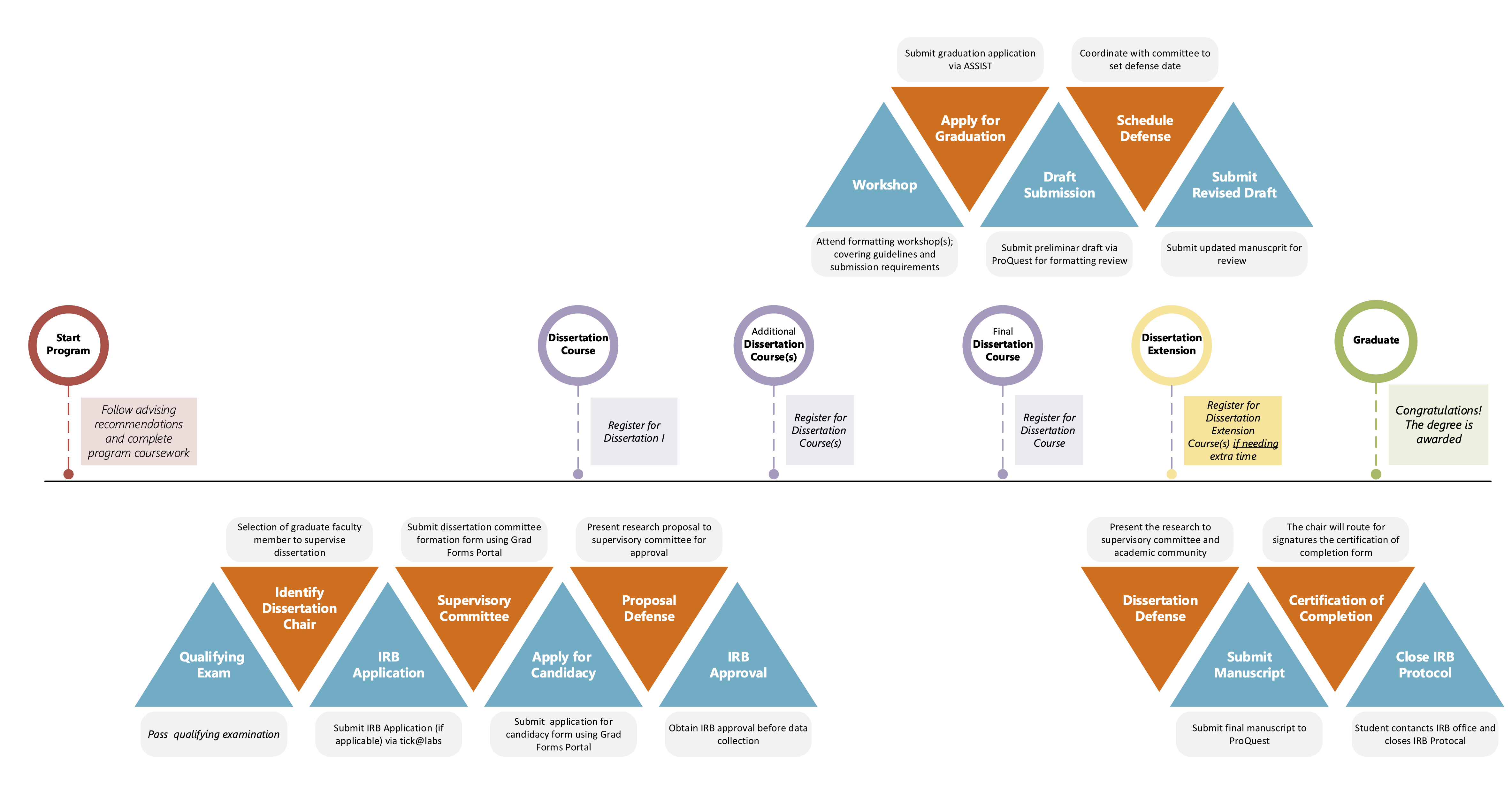
This guide provides a recommended sequence of steps for completing the dissertation. Before enrolling in dissertation courses or beginning dissertation research, the student must be admitted to doctoral candidacy.
Admission to candidacy requires that the student:
- Be in good academic standing;
- Pass all required qualifying, preliminary, or comprehensive examinations as defined by the graduate program;
- Complete all (or nearly all) coursework except dissertation or research hours; and
- Have an approved supervisory committee.
Step 1: Begin the Candidacy Process
The student initiates the candidacy process by:
- Passing the qualifying examination(s) according to program requirements;
- Identifying a supervisory committee chair — The chair must be a tenured or tenure-track graduate faculty member with assigned research effort;
- Forming the supervisory committee — The student submits the committee composition for approval; Committee approval is required before proposal defense and dissertation research;
- Initiating IRB planning (if applicable) — For research involving human subjects, the student serves as Principal Investigator and prepares to submit an IRB application via tick@lab.
Step 2: Admission to Candidacy and Early Research Preparation
The student progresses toward candidacy by:
- Applying for doctoral candidacy — The student submits the Application for Candidacy;
- Completing any remaining coursework required by the program;
- Finalizing the research design in consultation with the supervisory committee chair.
Step 3: First Dissertation Semester
After admission to candidacy, the student begins dissertation research:
- Registering for the first dissertation course — Continuous enrollment is required up until the degree is earned;
- Defending the dissertation proposal — The student presents the proposal to the approved supervisory committee;
- Obtaining IRB approval (if applicable) — IRB approval must be secured before any data collection begins;
- Beginning data collection — Research activities may start only after proposal defense and required regulatory approvals are complete.
Step 4: Annual Review and Ongoing Dissertation Enrollment (ABD)
Each academic year, starting with advancement to candidacy, the student must:
- Register for dissertation or approved dissertation extension courses, as required by the program;
- Request the annual supervisory committee meeting — The student initiates the Annual Reporting Form;
- Meet with the supervisory committee to review progress and establish goals for the upcoming year.
Step 5: Final Semester Preparation
As the dissertation nears completion, the student prepares for graduation by:
- Applying for graduation via ASSIST;
- Attending the Graduate College Formatting Workshop;
- Submitting a draft dissertation manuscript to ProQuest for formatting review;
- Scheduling the final dissertation defense in coordination with the supervisory committee; The student coordinates with the committee and places the defense date on the calendar.
Step 6: Dissertation Defense and Final Submission
The student completes degree requirements by:
- Defending the dissertation — The student presents the completed research to the supervisory committee;
- Completing all required revisions — All committee and Graduate College comments must be addressed;
- Submitting the final manuscript via ProQuest;
- Submitting the Certificate of Completion Form — initiated and routed by the committee chair;
- Completing the Survey of Earned Doctorates.
Step 7: Graduation
- Upon verification that all requirements are complete, the doctoral degree is awarded;
- The student may participate in the Doctoral Hooding Ceremony;
- The student closes the IRB-approved protocol (if applicable).
Important Notes
- Maximum time to completion: 10 years;
- Continuous enrollment is required until the degree is awarded;
- Annual supervisory committee meetings and reporting are mandatory;
- Committee changes must be submitted immediately using the Change of Committee Form;
- Programs may impose additional requirements; students should consult their program handbook.
A2 - Graduate Student Dismissal
This guide explains the process and procedures for the dismissal of graduate students for disciplinary or academic reasons.A2.1 Who Does It Affect?
This guide applies to all graduate students enrolled in programs overseen by the Graduate College. This guide is intended for use by:
- Graduate Students
- Colleges/Schools
- Graduate Advisors, Coordinators, and Directors
- Graduate Faculty
- Registrar
- International Office
- Graduate Recruitment
This guide covers disciplinary dismissal due to violations of the Student Code of Conduct and academic dismissal due to academic deficiencies.
A2.2 What Is Dismissal?
A dismissed student is withdrawn from their graduate program, is dropped from all courses, a registration hold placed on their account, and a notation of dismissal is entered on the student’s record and will be reflected on student’s academic transcript. There are no refunds for dropped coursework unless allowed under state or federal laws and regulations. The student is subsequently ineligible to reapply and return to the same program.
Dismissal is not expulsion. Expulsion is a permanent ban from UTRGV with no option to return (with rare exceptions). This guide does not cover expulsion.
A2.3 Purpose
This guide covers disciplinary dismissal due to violations of the Student Code of Conduct and academic dismissal due to academic deficiencies.Grounds for Dismissal
Graduate students may be dismissed for one or more of the following reasons:
- Disciplinary Reasons: Violations of the Student Code of Conduct.
- Academic Deficiencies: Failure to meet clinical and academic standards in academic and professional programs.
> Disciplinary Dismissal Criteria
One or more violations of the Student Code of Conduct as defined by the Handbook of Operating Procedures or the program handbook.
> Academic Dismissal Criteria
A student is subject to academic dismissal if any of the following occur:
- Failure to correct academic deficiencies: The student fails to remedy identified academic deficiencies within the established probationary period or is found to be in violation of professional or ethical academic standards as defined by the graduate program.
- Failure to pass required examination: The student fails a comprehensive, preliminary, or qualifying examination, and does not pass the retake examination (where permitted by program).
- Insufficient progress in the graduate program: The graduate program determines that the student is not progressing at the expected pace toward degree completion. This may result from an insufficient course load, delayed advancement to candidacy, or inadequate progress in developing the thesis/dissertation.
- Failure to meet clinical standards: The student fails to meet required clinical performance standards as defined in the graduate program.
- Denial of appeal for reinstatement: The student is placed on academic suspension and the Graduate College denies the appeal for reinstatement.
Examination-Related Dismissal
- Opportunity for Retake Examination
Students who fail a program‑required examination on the first attempt must be extended a second opportunity after a reasonable delay for additional preparation. A program that wishes to offer more than one retake opportunity to students must clearly state this policy in the program handbook. The program must also specify how many attempts will be permitted and the timeline before the exam must be taken before dismissal is enforced.
- Programs Without a Second Examination Option
A graduate program may request an exemption from the retake policy. The no-retake policy must be clearly defined in the program handbook. The program must inform students in writing prior to the examination if a retake attempt will not be permitted and that failure to pass the examination on the first attempt may result in dismissal from the program.
Doctoral Candidacy
All research doctoral students must advance to candidacy. Advancement to candidacy occurs once the student has completed all required coursework aside from dissertation hours, passed the qualifying examination, secured approval of the supervisory committee, and is in good academic standing. Programs may impose additional requirements. Students are expected to make consistent progress toward completion of the dissertation. Failure to demonstrate adequate progress within a specified timeframe, after receiving a formal warning outlining recommended actions, may constitute grounds for dismissal.
A2.4 Dismissal Action
The office responsible for dismissing the student will depend on the reason for dismissal.
- Failure to uphold Student Code of Conduct: The Dean of Students will issue a written decision of findings and sanctions to the student.
- Failure to correct academic deficiencies, Failure to pass required examination, Insufficient progress in the graduate program, or Failure to meet clinical standards: The graduate program coordinator or director issues a formal letter of dismissal to the student. The letter must address process for appealing the decision and the number of days the student has to submit the appeal. In cases where the graduate program coordinator or director is not a full time tenured or tenure track faculty member, the department chair or school director should be the one to issue the letter of dismissal.
- Denial of appeal for reinstatement: The Dean of the Graduate College will issue a formal letter of dismissal to the student following the denial of appeal for reinstatement. The decision of the Dean of the Graduate College is final.
In cases where a student is permitted to appeal a dismissal decision and submits an appeal, the Dean of the college or school shall be the final authority to render a decision on the appeal. The Dean’s decision is final. If the graduate program coordinator or director does not receive the appeal request by the specified deadline for appealing the dismissal decision, the original dismissal decision shall become final.
After the final decision to dismiss the student has been made, the following offices must be notified of the dismissal action:
- The graduate program coordinator or director or department chair or school director
- Dean of the college/school
- Dean of the Graduate College
- Office of the Registrar
- Office of Financial Aid (if applicable)
- International Student Services (if applicable)
Re-enrollment Eligibility
Academic Dismissal: A student dismissed for academic deficiencies is ineligible to reapply and return to the same program. This includes a different concentration or specialization in the same program. However, the student may apply to a different graduate program. The new program may review the student's academic records from the prior program.
The admitting graduate program coordinator or director must submit the Lift Enrollment Hold of Dismissed Student form to request the lift of registration hold on the student's record.
A2.5 Process
Failure to Uphold Student Code of Conduct
When the graduate program or college/school suspects that a student violated the Student Code of Conduct, it must adhere to the procedures outlined in the Handbook of Operating Procedures. In all cases involving violations to the Student Code of Conduct, the program must inform the Dean of Students. If the Dean of Students accepts the student's case it will proceed under the procedures outlined in the Student Code of Conduct. If the Dean of Student determines that the student's case is best handled by the program, the program may proceed with evaluating and deciding if a dismissal decision is appropriate under program handbook. The student must be given at least one opportunity to appeal the dismissal decision. The dean of the college/school must be the last appeal (if more than one is allowed) of the dismissal decision. All appeal procedures and decision‑making authorities must be clearly defined in the program handbook.
Denial of Appeal for Reinstatement
When a student earns an "F" grade or fails to correct academic deficiencies within the established probationary period they are placed on suspension. Suspended students are not permitted to register. If a student registered prior to the completion of the term in which they are suspended, the student will be dropped from all coursework. Suspended master’s students following an "F" grade must sit out one term (semester or module), while doctoral students suspended following an "F" grade must sit out one long term (fall or spring semester).
During the suspension period, a student may submit an appeal for reinstatement, access campus resources and facilities that do not require active enrollment, and complete any outstanding incomplete coursework, provided prior arrangements were made with the instructor of record.
The reinstatement appeal is made to the graduate program and dean of the college/school. The Dean of the Graduate College will review the appeal and the recommendation of the graduate program and dean of the college/school and determine if the student is eligible for reinstatement. The Dean of the Graduate College's decision is final.
All Other Dismissal Cases
The graduate program or college/school may dismiss the graduate student for failure to correct outlined academic deficiencies, pass the required examinations, or meet professional/ethical standards or meet clinical standards. In all cases, the policies must be clearly specified in the program's handbook. In general, programs must provide at least one appeal of the dismissal decision. Appeal procedures and decision‑making authorities must be clearly defined in the program handbook. Once all college/school appeals have have been exhausted, the decision of the dean of the college/school is final.
> Termination of Candidacy
The termination of doctoral candidacy is equivalent to dismissal from the doctoral program. The Graduate College, upon recommendation from the graduate program and the dean of the college/school, may terminate a doctoral student's candidacy. Prior to termination, the student must receive a formal warning and a reasonable opportunity to address the identified deficiencies in making progress toward the degree.
Termination of candidacy may occur for several reasons, including, but not limited to, failure to demonstrate adequate progress within three years after admission to candidacy or within nine years of initial enrollment in the program, whichever occurs first. Termination may also occur if the student no longer possesses qualifications appropriate for the degree, such as having outdated knowledge in areas assessed by the comprehensive, preliminary, or qualifying examination.
In addition, failure to maintain continuous enrollment constitutes grounds for dismissal unless the student is on an approved leave of absence.
> Clinical Standards
The program handbook must specify the required clinical standards. In general, clinical standards include, but are not limited to, unprofessional or unethical behavior in practicum or field placements, falsification of clinical records, and the mishandling of patient or client information. When the failure to meet clinical standards takes place at an off-campus location, the partner institution must notify the program in writing of the alleged violation, the nature of any investigation, any legal action taken, any law enforcement involvement, and any conclusions reached.
The program is responsible for tracking and documenting student activities at offsite facilities. All reports of misconduct, even if unproven, must be kept. The program may investigate and render a dismissal decision on all documented violations of clinical standards.
A3 - Continuous Enrollment Guide
This guide discusses institutional policy governing continuous enrollment for degree seeking graduate students. Its purpose is to ensure consistent enrollment practices across programs, prevent gaps in enrollment, and clarify program, department, or school responsibilities.A3.1 Who Does It Affect?
This guide is intended for use by:
- Graduate degree-seeking students
- Colleges and Schools
- Graduate program coordinators and directors
- Graduate faculty
- Registrar
- Degree Audit Systems and Support
A3.2 The Policy - Graduate Registration and Enrollment [2027 - Catalog]
A3.3 The Policy - Graduate Graduation Requirements [2027 - Catalog]
A3.4 Continuous Enrollment
All degree-seeking graduate students are required to enroll every fall and spring including the term the degree is earned. Students in programs that require enrollment in an exit option course or extension course, as applicable, must enroll and maintain continuous enrollment until the requirement has been completed.
Students should be advised that not making adequate progress toward the completion of the degree can lead to dismissal. See the Graduate Student Dismissal Guide for details concerning the dismissal and appeals process.
A3.5 Exit Options
To be eligible for a graduate degree, students must successfully complete all program requirements in their program of study. Programs may require the successful completion of an approved exit option, listed below.
Coursework Only
Coursework Only - These programs do not require a specific course or other culminating experience to be completed at the end of the program. Accelerated Online Programs (AOP) and some non-thesis programs follow this model.
In these programs students are awarded the degree upon successful completion of all required coursework in the program of study.
Capstone Course
Capstone Course - These programs require that one or more capstone courses be completed at the end of the program. A capstone course is designed to integrate knowledge across the curriculum.
Some programs may require the completion of a project as part of a capstone course. If it is possible to successfully complete the capstone course without completing the project, then the exit option falls under the Comprehensive Examination or Project, defined below.
In these programs students are awarded the degree upon successful completion of all required coursework, including the capstone course(s) in the program of study.
Comprehensive Examination or Project
Comprehensive Examination or Project - These programs require that the student pass a comprehensive examination (demonstrating mastery of the program's learning objectives) and/or complete a project (demonstrating the application of disciplinary knowledge) at the end of the program. The timing of when this exit requirement must to be attempted should be specified in the program of study or program handbook.
A project may include, but is not limited to, a research project, professional report, portfolio, performance, or exhibition.
All research doctoral programs must require a comprehensive examination.
Students must be required to attempt the comprehensive examination or project while actively enrolled in program coursework and after eligibility requirements for attempting the exit option have been met.
If the student does not successfully complete the exit requirement before finishing their coursework, the student must enroll in the program's extension course, if applicable, each term until the requirement is satisfied.
In these programs students are awarded the degree upon successful completion of all required coursework and required comprehensive exam or project in the program of study.
Experiential Work
Experiential Work - These programs require that the student complete supervised work as a requirement for program completion. This may include, but is not limited to, clinical experiences, internship, practica, or rotations. The student must enroll in the appropriate course designated to fulfill this requirement. The program should specify the expected scope of work, including field hours, contact hours, laboratory hours, or equivalent measures where applicable.
If the required work extends beyond a single term, the student must enroll in the appropriate course each term until the requirement is completed. If the requirement is not completed within the timeframe specified in the program of study, the student must enroll in the program's extension course, if applicable, to finish the requirement.
In these programs students are awarded the degree upon successful completion of all required coursework and required experiential work in the program of study.
Thesis
Thesis - These programs require that the student conduct research under faculty supervision, have a formal defense, and publish manuscript through ProQuest. Once a master's student enrolls in thesis coursework, the student must continue to enroll in the appropriate thesis course each fall and spring semester until the thesis is completed. Summer enrollment is not required unless the student is graduating during the summer term.
If the thesis is not completed after taking the Thesis II course, in order to continue working on the thesis the student is required to enroll in the program's thesis extension course, if applicable. Each program must have on inventory a one-hour and a three-hour thesis extension course.
Use of a one-hour thesis extension course should be limited to situations in which the student:
- Is not expecting to make substantive progress toward the completion of the thesis; or
- Has completed all thesis requirements except the final defense; or
- Needs additional time after having made the final defense to address committee recommended changes and submission of the final manuscript to ProQuest.
In these programs students are awarded the degree upon successful completion of all required coursework and thesis in the program of study.
Dissertation
These programs require that the student conduct an extensive original research project under faculty supervision, have a formal defense, and publish manuscript through ProQuest. All research doctoral programs must require a dissertation. Once the doctoral student enrolls in a dissertation course, or has advanced to doctoral candidacy, the student must continue to enroll in dissertation coursework each fall and spring semester until the dissertation is completed. Summer enrollment is not required unless the student is graduating during the summer term.
All doctoral programs must specify the minimum number of dissertation hours required for the degree. If the dissertation is not completed after taking the final dissertation course, in order to continue working on the dissertation the student is required to enroll in the program's dissertation extension course, if applicable. Each program must have on inventory a one-hour and a three-hour dissertation extension course.
Use of a one-hour dissertation extension course should be limited to situations in which the student:
- Is not expecting to make substantive progress toward the completion of the dissertation; or
- Has completed all dissertation requirements except the final defense; or
- Needs additional time after having made the final defense to address committee recommended changes and submission of the final manuscript to ProQuest.
In these programs students are awarded the degree upon successful completion of all required coursework and dissertation in the program of study.
A3.6 Extension Course
If a student does not complete the dissertation, thesis, capstone, or other approved exit requirement during the term of original enrollment, the student must enroll in the appropriate program-specific extension course every fall and spring term until the requirement is completed.
Each graduate program must have on inventory a designated program-specific extension course(s) for students who require additional time to complete the exit requirement. These courses should use Credit/No-Credit or Satisfactory/Unsatisfactory grading. Enrollment in extension courses will count toward a student's total attempted credit hours. Students approaching the 99-hour threshold may face financial implications. In addition, these courses may not be eligible for financial aid or count toward part-time/full-time status where needed for resource eligibility.
If the program does not permit extensions, it must inform students that failure to complete all degree requirements, including any required thesis, dissertation, comprehensive examination, project, or other exit requirement, within the specified timeframe after completion of the prescribed program of study coursework will result in dismissal from the program. This should be documented on the program's handbook.
A3.7 Incomplete Grade in Final Course
The assignment of a grade of Incomplete in a dissertation, thesis, capstone, or other exit requirement course, including the final course in a program of study, should be avoided. If such a grade is assigned, it must be resolved within two weeks after the end of the term.
If the Incomplete grade is unavoidable and cannot be resolved within two weeks after the end of the term, the student must maintain continuous enrollment by registering in the appropriate program-specific extension course each fall and spring term until the grade is resolved. If the Incomplete grade is not resolved, it will automatically convert to a Failed grade after one long semester.
In such cases, the program must maintain documentation of:
- the reason the Incomplete grade was assigned;
- the faculty member responsible for the course in which the Incomplete grade was issued; and
- the student's subsequent enrollment in extension course(s). The instructor of record for the extension course must be the instructor who issued the Incomplete grade.
A3.8 DegreeWorks Notation
Special notation on DegreeWorks is required if the exit requirement is not confined to a course. Upon successful completion of the exit requirement, a completion notation must be recorded in DegreeWorks. Programs offering multiple exit options must record the appropriate notation for each option. Failure to record the required notation may prevent degree conferral.
Below is the notation requirement for each exit option.
- Coursework only - No notation required;
- Capstone course - No notation required;
- Comprehensive Examination or Project - Notation required;
- Experiential Work - Notation required only when completion of field work or assessment of work are mandated by an accrediting, licensing, or other external body recognized by UTRGV;
- Thesis - Notation required;
- Dissertation - Notation required.
A3.9 Instructor of Record
All exit coursework, including extension courses, must list at least one faculty member of record. The faculty must be a member of the graduate faculty and eligible to teach, supervise, and/or advise graduate students.
Programs are encouraged to list all faculty members who substantially participate in the administration, supervision, evaluation, or advising associated with the exit coursework during the term in which the course is offered. Faculty effort allocations should reasonably reflect each individual's level of participation and responsibility. For supervisory committees, effort may be distributed among committee members in proportion to their contributions, including assignment of a majority or all effort to the committee chair.
A3.10 Graduate Program of Study Structure
The following outlines the Graduate College's recommended structure for a graduate program of study.
Leveling
Some graduate programs may permit admission to students whose undergraduate degree is in an unrelated field of study. These programs may require students to complete foundational (leveling) courses as a condition of admission. It is strongly recommended that these foundational courses be offered at the graduate level. If undergraduate courses must be used, the program must create corresponding graduate courses for cross-leveling. These cross-listed courses should use 5000-level numbering.
Core Requirements
All graduate programs should include a set of core courses that define the discipline. These courses should be recognizable as foundational (core) by external reviewers (e.g., accreditation teams). The competencies acquired in these courses should align with the program's assessment of student learning outcomes.
Methods
Programs may require methodological coursework appropriate to the discipline, including but not limited to qualitative methods, quantitative methods, theory, creative research methods, studio methods, performance practice, laboratory methods, clinical methods, or other forms of scholarly, creative, or professional inquiry. These courses support students’ ability to conduct analysis, develop original work, draw inferences, interpret evidence, and apply disciplinary standards of inquiry and practice.
Professional and Scholarly Development
Programs may require research seminars, colloquia, or other professional development activities designed to prepare students for academic, creative, or professional careers.
Concentrations, Areas, and Electives
Programs may allow or require students to select one or more concentrations or focus areas. Alternatively, students may be asked to choose coursework from an approved list. Programs should clearly specify any requirements, restrictions, or advising expectations related to these choices.
Exit Requirements
Programs must specify any exit requirements, as defined in Exit Options. Some programs may require more than one exit requirement.
A4 - Advancement to Doctoral Candidacy
This guide discusses institutional policy governing doctoral students' advancement to candidacy.
A4.1 Who Does It Affect?
This guide is intended for use by:
- Students pursuing a research doctoral degree
- Colleges and Schools
- Graduate program coordinators and directors
- Graduate faculty
- Degree Audit Systems and Support
A4.2 The Policy - Degree Policies - Admission to Doctoral Candidacy [2027 - Catalog]
A4.3 Advancement to Doctoral Candidacy
Formal admission to doctoral candidacy marks a significant academic milestone in a research doctoral program. Students should achieve candidacy status prior to enrolling in their final 12 credit hours of dissertation coursework, defending the dissertation, and being conferred the doctoral degree.
Advancement to candidacy recognizes that the student has the academic preparation and readiness to proceed to the dissertation stage. It requires that the student:
- Be in good academic standing;
- Successfully complete or pass the qualifying or comprehensive examination;
- Have an approved supervisory committee;
- Successfully defend the dissertation proposal, if required by the program; and
- Satisfy all other program candidacy requirements.
Only students with a notation in DegreeWorks of “Doctoral Candidate” are recognized as doctoral candidates. All other students will be noted as “Pending Advancement to Doctoral Candidacy.”
Good Academic Standing
To maintain good academic standing, students must carry a cumulative and program GPA of 3.0 or higher. An individual program may require a GPA higher than 3.0 to maintain good academic standing.
Qualifying or Comprehensive Examination
Each doctoral program creates and administers its own qualifying or comprehensive examination in accordance with disciplinary standards and program requirements. The examination may consist of one or more components, including written and/or oral examinations, research papers, portfolios, a series of papers, or other program-approved assessments.
The examination should provide evidence that the student has acquired the knowledge and scholarly skills necessary to proceed to dissertation research.
To be eligible to take the qualifying or comprehensive examination, the student must:
- Have completed at least 18 credit hours of degree-applicable graduate coursework at UTRGV, or have completed all required or core courses in the examination area or areas;
- Be in good academic standing; and
- Have satisfied any additional program pre-examination requirement.
The examination is passed only when the examining faculty members determine that the student has demonstrated adequate command of the assessed subject areas.
Programs must have written procedures governing examination administration, evaluation criteria, notification of results, retake opportunities, and consequences of failure. Ordinarily, a student may be allowed no more than two attempts to pass the qualifying or comprehensive examination. Failure to pass after the maximum number of permitted attempts may result in dismissal from the doctoral program, subject to applicable university policies. See the Graduate Student Dismissal Guide for details concerning the dismissal and appeals process.
Dissertation Proposal
A doctoral program may require successful defense of the dissertation proposal as a condition for advancement to candidacy.
The proposal should demonstrate that the student has identified a field-appropriate research question or problem, is familiar with the relevant literature, has selected an appropriate theoretical, methodological, or analytical framework, and has developed a feasible plan for completing the dissertation.
Programs may require that the dissertation proposal defense be conducted in writing, orally, or both.
Approval of the dissertation proposal does not constitute approval to begin research involving human subjects, animals, or other regulated research activities. Such research may not begin until all required institutional approvals, including Institutional Review Board (IRB), Institutional Animal Care and Use Committee (IACUC), Institutional Biosafety Committee (IBC), Hazardous Biological Agents (HBA), or other compliance approvals, have been obtained.
Supervising Committee
An approved supervising committee is required before advancement to candidacy. The supervising committee is responsible for guiding the student's dissertation research, evaluating progress toward completion, and determining whether the dissertation meets scholarly standards of the discipline.
The dissertation supervising committee consists of one chair and at least three additional members. See the Supervising Committee Guide for details concerning composition, formation, and faculty eligibility.
Additional Program Requirements
The student must fulfill all additional requirements specified by the doctoral program. These may include, but are not limited to:
- Demonstrating competence in one or more foreign languages;
- Completing required research methods, statistics, laboratory, clinical, internship, or fieldwork requirements;
- Preparing a research paper, essay, portfolio, or other scholarly product; and/or
- Completing ethics, compliance, or professional development training.
Programs must list all candidacy requirements in the program handbook.
A4.4 Process to Advance to Candidacy
The student should submit the application for admission to candidacy for the doctoral degree on the Graduate College website immediately after satisfying all candidacy requirements.
The application includes a checklist of eligibility criteria. The student must indicate whether the dissertation involves human subjects, animal subjects, biosafety review, or any other regulated research activity. If regulated research is involved, the student must indicate the status of required institutional approvals.
No regulated research activity may begin until all required institutional approvals have been obtained.
The student must provide a self-assessment of academic accomplishments over the past year. These should focus on the tasks, goals, or milestones identified by the advisor and supervisory committee. Examples may include completing required coursework, applying for a graduate assistantship, identifying supervisory committee members, conducting a literature review, submitting an IRB application, or collecting data.
Each accomplishment should indicate whether the goal was completed, any challenges encountered, and any adjustments made to address them.
After the student submits the form, it is routed to the supervising committee chair and program coordinator for review and approval. Once the application is finalized, a notation of “Doctoral Candidate” is entered in DegreeWorks. At that moment, the student is considered a candidate for the doctoral degree.
Reviewer 1 - Chair
After the student submits the form, it is routed to the supervising committee chair for review and approval.
The supervising committee must meet with the student, review the student's research goals, and agree on the work the student is expected to complete and advance over the upcoming year.
The committee must provide concrete actions, goals, and milestones for the upcoming year. Examples may include enrolling in specific courses, collecting data, completing a dissertation chapter, reviewing specific books or scholarly articles, submitting an IRB application, conducting data analysis, scheduling the final defense, or securing an internship.
Each measurable goal must be numbered with detailed expected outcomes, target completion dates, and any resources or support the student should utilize.
Reviewer 2 - Program Coordinator
After the chair submits their review, the form is routed to the Graduate Program Coordinator or Director.
The program coordinator must review the student's academic accomplishments over the past year and assess whether the information is accurate and complete. The program coordinator should incorporate feedback and identify the goals and actions the student should focus on in the upcoming year.
The program coordinator must provide concrete actions, goals, and milestones for the upcoming year. Examples may include enrolling in specific courses, applying for graduation, or securing an internship.
Each measurable goal must be numbered with detailed expected outcomes, target completion dates, and any resources or support the student should utilize.
A4.5 Progress of Doctoral Candidates
All doctoral students must complete an annual progress review. The purpose is to document progress toward completion of the dissertation and degree requirements, identify obstacles to timely completion, establish expectations for the upcoming year, and provide written feedback to the student.
The doctoral candidate must meet annually with at least two members of the supervising committee, one of whom must be the committee chair. To initiate the annual review, the student must submit the annual reporting form found on the Graduate College website.
In the form, the student must summarize progress made toward the degree during the previous year and identify expected milestones for the upcoming year. Progress may include completion of coursework, proposal development or defense, data collection, data analysis, conference presentations, publications, grant or fellowship applications, and completing a dissertation chapter.
After submission, the form is routed to the supervising committee chair, who is responsible for convening a meeting with the student and at least one additional member of the dissertation committee.
During the meeting, committee members review progress, provide feedback, discuss goals and objectives for the upcoming year, and identify concerns that may affect timely completion. The chair must document the committee's assessment in the annual progress report and submit the report to the student for review.
The annual progress review must indicate whether progress is satisfactory, satisfactory with concerns, or unsatisfactory.
If progress is satisfactory with concerns or unsatisfactory, the committee must identify specific deficiencies, establish a written improvement plan, and specify a timeline. Unsatisfactory progress may result in additional program review and may lead to termination of candidacy and dismissal from the doctoral program.
Copies of the finalized annual progress review are sent to the graduate program director and the Graduate College.
A4.6 Termination of Candidacy
The Graduate College, upon the recommendation of the graduate program and the college or school dean, may terminate a doctoral student's candidacy under the conditions described below.
Time Limits
A student's candidacy may be terminated if all degree requirements are not completed within the required time limits. Termination based on time limits may occur either three years after admission to candidacy or nine years after first enrollment in the doctoral program, whichever comes first.
Students who need more time may request an extension according to Graduate College and program policies. Requests must include a valid reason, a timeline for completing the degree, and support from the dissertation or supervising committee chair and the graduate program.
Graduate programs should consider limitations on the use of coursework close to expiring at 10 years. There are also limits to the number of hours that can be revalidated. See the Graduate Catalog for more details.
Academic Grounds
Candidacy may also be terminated on academic grounds if the student:
- No longer possesses qualifications appropriate for the doctoral degree, including cases in which knowledge in areas assessed by the qualifying or comprehensive examination is outdated or insufficient;
- Demonstrates continued lack of progress toward completion of the dissertation or remaining degree requirements;
- Fails to meet expectations established in the annual progress review or remediation plan;
- Fails to correct significant deficiencies in the dissertation within the timeframe established by the supervising committee;
- Fails to maintain good academic standing; or
- Fails to comply with applicable university policies, research compliance requirements, or professional standards.
Before recommending termination, the program must provide written notice of deficiencies, an opportunity to respond, and, when appropriate, a reasonable opportunity to remedy the deficiencies.
Other Grounds for Termination
Candidacy may also be terminated for grounds outlined in the program handbook.
Termination of candidacy will result in dismissal from the doctoral program. See the Graduate Student Dismissal Guide.
A4.7 DegreeWorks Notation
All research doctoral programs require that the student maintain the program's minimum GPA, complete all required coursework, advance to doctoral candidacy, and complete a dissertation.
DegreeWorks will reference the following notation:
- “Minimum x.x GPA Met” when true, “Minimum x.x GPA Not Met - please contact your Graduate Program Coordinator” when false, or “GPA Not Calculated - An institutional GPA will be calculated once grades are recorded for your first term of attendance at UTRGV” when there is no grade history;
- “Major Requirements” when true or “Major Requirements - Still Needed: See PROGRAM_NAME section”;
- “Doctoral Candidate” when true or “Pending Advancement to Doctoral Candidacy” when false;
- “Exit Requirements Met” when true or “Pending Exit Requirements” when false.
The Graduate College will enter the notation “Doctoral Candidate” after approval of the advancement to doctoral candidacy form.
DegreeWorks' “Doctoral Exit Requirements” section will list all exit requirements and milestones. Most doctoral programs will only require the qualifying exam and dissertation. DegreeWorks will reference them as follows:
- “Comprehensive Exam Satisfied” when true or “Comprehensive Exam Required” when false;
- “Proposal Defense Satisfied” when true or “Proposal Defense Required” when false;
- “Certification of the Completion of Dissertation required from Graduate College” when true or “Certification of the Completion of Dissertation required from Graduate College - Still Needed” when false;
- “Doctoral Project Satisfied” when true or “Doctoral Project Required” when false, if applicable;
- “Experiential Work Requirement Satisfied” when true or “Experiential Work Requirement Required” when false, if applicable.
The dissertation requirement “true” statement is achieved only after the dissertation has been successfully defended, the final manuscript has been submitted to ProQuest, and the committee has approved the Certificate of Completion form. The Graduate College is responsible for recording completion of the dissertation requirement.
The graduate program enters a notation in DegreeWorks when the student successfully completes the comprehensive examination, proposal defense, doctoral project, if applicable, and experiential work, if applicable, requirements.