

 rotate(10)'/%3E%3Cpath d='M.038.113v.15l.15.088.15-.088v-.15L.188.025l-.15.088Z' stroke='%23c44900' stroke-width='.0375' transform='rotate(10)'/%3E%3C/svg%3E)
College of Fine Arts Policies and Procedures
The policy below pertains only to College of Fine Arts full-time faculty of all ranks. Regarding merit salary raises for staff, the College of Fine Arts follows annually published institutional guidelines.
1. How will eligibility for merit be determined?
- Eligibility for merit will follow School or Department guidelines and UTRGV Eligibility Criteria.
Typically, eligibility for a merit pay increase includes the following criteria:
- Overall Annual Review Performance Ratings: Ratings of Meets or Exceeds Expectations for the period of review under consideration are typically required by UTRGV. Note that some Schools or Departments also require Meets or Exceeds Expectations ratings for all areas of review (Teaching, Research/Scholarship, and Service). Consult Department or School Guidelines for more specific eligibility information.
- Faculty rank and date of hire. Typically, faculty must have been hired into a tenured or tenure-track position or multi-year budgeted non-tenure track position by the beginning of the previous fiscal year (i.e., a faculty member would need to be hired on or before September 1, 2022 to be eligible for a merit raise for the 2023-2024 fiscal year).
- Completion of annual outside activities and interest disclosure and mandatory compliance trainings required by UTRGV.
- Faculty must have no formal disciplinary action in their file since the beginning of the previous academic year, and no formal disciplinary action that precludes consideration for the relevant time period.
- Timely completion by the faculty member of the previous year’s annual review process.
- Faculty who are on approved leave are eligible to receive merit if all other criteria are met.
- The following faculty are typically not eligible for merit pay increases:
- Short-term non-tenure track faculty
- Visiting faculty appointments
- Adjunct faculty on a semester appointment basis
- These criteria are subject to change. Consult yearly UTRGV Faculty Merit Guidelines for updated policies.
2. How will the merit pool be distributed in the College of Fine Arts?
- When merit funds are available, all eligible faculty will receive a percentage increase to their base salary. The increase will be calculated using a base percentage which will increase or decrease to match the available merit pool.
- The base percentage will be determined by the percentage of faculty salaries used to determine the merit pool by the UTRGV Faculty Merit Guidelines for that year. Merit increases for faculty receiving a performance rating of Exceeds Expectations will start at the percentage used to compute the merit pool. Merit increases for faculty receiving a performance rating of Meets Expectations will start at 0.5% less than the percentage used to compute the merit pool.
- For example, if the merit pool for the College of Fine Arts will be 2% of all faculty salaries, then the base percentage increase for faculty with Exceeds Expectations would be 2%, and the base percentage increase for faculty with Meets Expectations would be 1.5%.
- If UTRGV and/or the UT System mandate a minimum merit increase, and this methodology does not meet that minimum for certain faculty, those faculty affected will receive the minimum allotment that is mandated.
- If, after the above methodologies are applied, there are remaining funds, or a lack of funds, in the merit pool, the merit increases will be adjusted using the same fixed difference of 0.5% until the merit increases are covered and the pool has been exhausted.
- Merit increases will be capped at the Maximum Adjustment limit set for that fiscal year.
3. How will overall performance ratings be determined?
- For departments which require a period of review including the previous three annual reviews to determine eligibility, the performance rating for purposes of merit will be determined by the following rules:
- Exceeds Expectations: Faculty must have an overall rating of Exceeds Expectations for two of the three years under review.
- Meets Expectations: Faculty must have an overall rating of Meets Expectations for two of the three years under review.
- For departments which require a period of review including the previous year’s annual review to determine eligibility, or if the school or department guidelines do not specify a period of review to determine eligibility for a merit pay increase, the performance rating for purposes of merit will be determined by the overall performance rating of the faculty member’s most recent annual review.
- If faculty receive a performance rating of Does Not Meet Expectations or Unsatisfactory in any area of review (Teaching, Research/Scholarship, or Service) over the period of review, their eligibility will be determined by their School or Department’s guidelines for merit eligibility.
- In the event that UTRGV has not awarded a merit increase to the faculty at large in an extended amount of time (predating the period of review mandated by the department or school guidelines), merit eligibility and award will be based on performance reviews from the end of the last merit award cycle. The performance rating used to determine merit will be the overall rating most frequently given to the faculty member over the period of review.
- In all cases, the performance rating given at the highest level of administrative review will be used.
The purpose of this document is to provide School Directors and Department Chairs guidelines in operationalizing HOP Workload policy and revision of departmental guidelines. Additionally, this document contains procedures as to how the College of Fine Arts will make workload decisions.
Table of Contents
Workload Percentages
Enrollment
Course Type Equivalencies
Large Sections
Instructional Overload Assignments
Summer School
Appendix A: Large Section Request Form
Appendix B: Instructional Overload Assignment Request Form
Appendix C: Collaborative Piano
Workload Percentages. The standard workload for “research” tenure-track and tenured faculty is 60% Teaching, 20% Research/Creative Activity, 20% Service. The standard workload for “teaching” tenured faculty is 80% Teaching, 10% Research/Creative Activity, 10% Service. Variations from this workload are allowed with the approval of the Director/Chair and the Dean.
Non-tenure track faculty (Lecturers and Professors of Practice) should have workload percentages that align with their contract and/or duties. Variations from this workload are allowed with the approval of the Director/Chair and the Dean.
In alignment with the HOP, 10% teaching is equivalent to one appropriately enrolled 3-credit undergraduate lecture (see Enrollment below). Course type equivalencies, in accordance with the HOP, can be found below. In creating the course schedule, School Directors and Department Chairs should assign courses to faculty based on the agreed upon workload, the needs of students in completing their degree in a timely manner, and to maximize student credit hour production.
Because research/creative activity and service differs among CFA units, Schools and Departments should define expectations for workload percentages in these areas in their departmental guidelines, using the teaching standard (10% teaching is equivalent to one 3-credit undergraduate lecture) as a guideline in determining these expectations.
School Directors and Department Chairs meet with individual faculty members in the spring semester to discuss workload percentages. At this meeting the faculty member should communicate expected research/creative activity projects and service expectations. If applicable, the Director/Chair will request a deviation from the “standard” workload (as described above) to the Dean, considering the instructional needs of the School/Department. Factors that the Director/Chair should consider include:
- Student needs, in particular specialty capacities, to ensure timely graduation.
- Extramural funds from faculty grants that could be used to hire an adjunct or pay an instructional overload (see below).
- Research/creative activity projects and service expectations as they compare to departmental guidelines.
- Support for junior tenure-track faculty in developing a research/creative activity portfolio.
- Service for established leadership roles, such as graduate program coordinator, and/or temporary leadership needs. Standard leadership roles across the college include, but are not limited to:
- Graduate program coordinator receives 20% administrative assignment.
- Faculty sponsor of department-sponsored publications receives 10% service reassignment from teaching.
Enrollment. Standard minimum enrollments for sections in the College of Fine Art, regardless of course type, are 10 students for undergraduate courses and 5 students for graduate courses (exceptions for single enrolled sections such as private lessons, thesis, and independent studies). Enrollments that fall below these minimum thresholds should be cancelled, unless approved by the Director/Chair and the Dean. Although enrollments may be unstable in the weeks leading up to the start of classes, Directors/Chairs should cancel courses in time before the start of classes (two weeks prior to the first day of classes) so that students can register for an alternative course and so that a faculty member’s instructional assignment can be revised.
Course Type Equivalencies. The College of Fine Arts offers a variety of course types and sizes. Using the HOP standard that one 3-credit hour undergraduate lecture that is appropriately enrolled equals 10% of workload, the following table should be used to calculate instructional workloads:
|
3-credit hour graduate lecture |
15% |
|
Lab courses (undergraduate)* |
2.2% per contact hour up to a maximum of 10% |
|
Lab courses (graduate)* |
3.3% per contact hour up to a maximum of 15% |
|
Applied music lessons |
2.2% per contact hour |
|
Student teaching internship supervision |
3.3% per student |
|
Thesis Supervision |
0.55% per credit hour |
|
Individual undergraduate course instruction/Undergraduate research supervision/Honors undergraduate program project supervision |
0.33% per credit hour |
|
Individual graduate course instruction |
0.66% per credit hour |
*Lab courses are all courses designated as Lab, including, but not limited to:
- Studio Art
- Dance Techniques
- Sight-Singing and Ear-Training
- Class Piano
- Music Ensembles
Individual course instruction (undergraduate or graduate) should be limited to specialized instructional or research topics. In some rare cases (reducing time to graduation or small enrolled courses), it is necessary to offer a lecture or lab course as an independent study for an individual or small number of students. If a course is enrolled at less than the enrollment standard (see above), school directors and department chairs should work with faculty to determine whether the course should be offered. Workload calculation will be at the individual course instruction rate. For example, if a 3-credit undergraduate course is offered for two students, the faculty would receive 1.98% workload credit (3 x 2 x .33) regardless of whether these students are taught as individuals or together. In circumstances where students need the course for timely graduation, school directors and department chairs may request for the dean to approve a faculty member to receive full workload credit for a course that is approaching full enrollment.
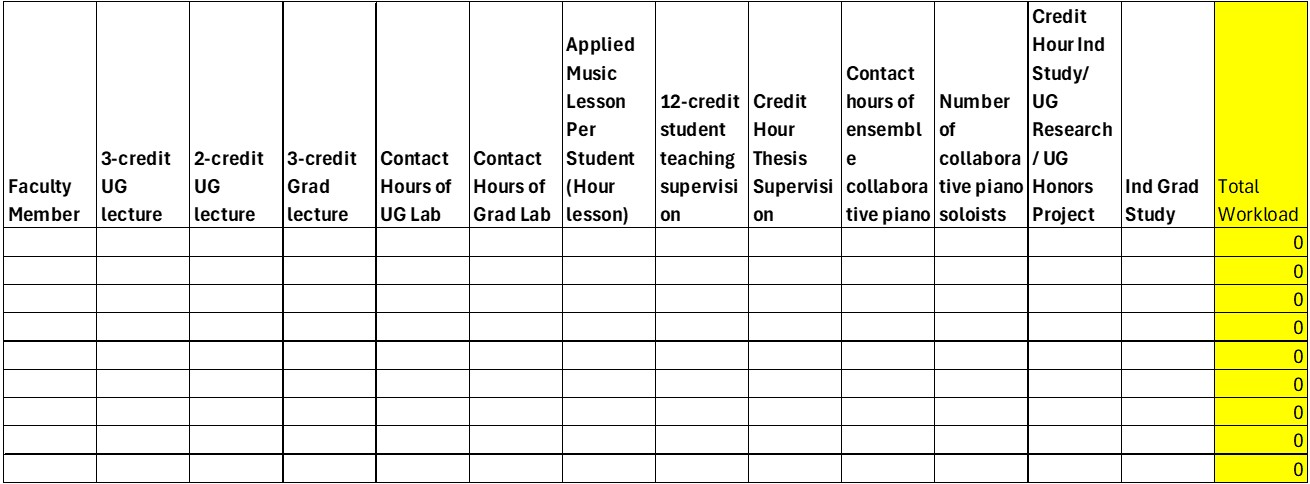
See attached “Instructional Calculator” as a guide for Chair/Directors and faculty to calculate their workload.
Collaborative pianist workload. In the performing arts, collaborative pianists are integral to the instructional mission of the College of Fine Arts. Collaborative pianist duties, however, differ from instructors and, therefore, have a different workload calculation. Collaborative piano that involves students is always considered an instructional activity and will therefore contribute to the instructional workload percentage. Collaborative piano loads are divided into two categories: ensemble loads, where a collaborative pianist attends the class of a musical or dance ensemble or a dance techniques class, or soloist load, where a collaborative pianist meets with a student soloist individually and/or in their lessons in preparation for a jury, recital, or other performance (the number of times that a collaborative pianist meets with a student is delineated in the School of Music handbook).
|
Ensemble Load per contact hours per week |
1.67% |
|
Solo Load per student |
1% |
Large Sections. To meet student needs, it may become necessary to increase the enrollment of a section, assuming that it is pedagogically sound to do so. Faculty members may receive a stipend or an equivalent course release to teach large sections.
Regarding large sections, it is stated in HOP ADM 06-501, D, 2, c:
Workload credit may be proportionally increased for teaching a large class that requires extensive grading or evaluation of students' work by the faculty member according to the following weighing factors:
|
Large Class Weights |
|
|
Class Size |
Weight |
|
|
|
|
<59 |
1.00 |
|
60 - 69 |
1.10 |
|
70 - 79 |
1.20 |
|
80 - 89 |
1.30 |
|
90 - 99 |
1.40 |
|
100 - 124 |
1.50 |
|
125 - 149 |
1.60 |
|
150 - 174 |
1.70 |
|
175 - 199 |
1.80 |
|
200 - 249 |
1.90 |
|
250< |
2.00 |
Graduate assistant or grader. To increase the workload credit as stated above, a faculty member must communicate how increased enrollment in the section “requires extensive grading or evaluation of students' work by the faculty member” (HOP ADM 06-501). Chair/Directors should consider the use of graduate assistants or graders to support faculty who teach large sections in determining whether a faculty member meets this standard even with a graduate assistant or grader.
Eligibility. Full-time faculty members are eligible for a large section stipend or course release if they are fulfilling research/creative activities and service obligations that align with their agreed upon workload percentages. If a faculty member is not meeting workload expectations in research/creative activity and service, the chair/direction should meet with a faculty member to reconsider workload percentages before requesting an instructional overload.
Course Type. Large section assignments are intended for lecture courses. Other course types, such as laboratory courses, are not eligible for large section consideration.
Assignment outside of the college. Faculty are encouraged to fulfill instructional, service, or administrative duties outside of the college as it creates collaborations across the university. In some cases, these assignments are developed through an agreement between colleges to “buyout” a faculty member’s time so that the college can hire an adjunct to fulfill instructional needs. In cases where a faculty member has an outside assignment that includes such an agreement, this faculty member is eligible for consideration of a large section stipend or course release. In the case where no such agreement exists and the outside assignment is factored into the workload calculation, it is assumed that the instructional overload is caused by this outside assignment for which the college does not have the funding to cover; therefore, faculty who have an assignment outside of the college are not eligible for a large section stipend or course release.
Rotation of assignments. Part of the responsibility of the Chair/Director in working with departmental colleagues in creating the course schedule is to ensure that opportunities for a large section stipend or course release are equitably rotated among faculty. This may not be possible in all cases because of the specialty of the course and/or faculty member, but every effort should be made to rotate opportunities.
Enrollment. For a faculty member to be considered for a large section request, all sections taught by that faculty member in the academic year must meet minimum enrollment requirements.
Stipend. It is important that departments/schools make efforts to increase retention, lower time to graduation, and increase student credit hour production by increasing course enrollments. Stipends for large sections, therefore, are paid to incentivize faculty to meet these needs. Funding large section stipends is paid from faculty reserves accrued through unfilled faculty vacancies. Since these vacancies are temporary, the available funding varies from year to year. While the college is committed to compensating faculty for teaching large sections, the college cannot guarantee that a stipend will be available in all cases. Chairs/Directors should consider other incentives, such as a course release in a subsequent semester or revising the course schedule. For full consideration for a stipend, large sections requests should be made for the entire academic year at least one month prior to the start of fall classes.
If approved, faculty will receive a large section stipend according to the formula below (assuming a 3-credit, lecture course*). To ensure that faculty meet workload and course enrollment minimums, stipends for fall and spring semester large section stipends will not be paid until the spring semester.
|
Large Class Weights |
||
|
Class Size |
Weight |
Compensation |
|
<59 |
1.00 |
$0 |
|
60 - 69 |
1.10 |
$300 |
|
70 - 79 |
1.20 |
$600 |
|
80 - 89 |
1.30 |
$900 |
|
90 - 99 |
1.40 |
$1,200 |
|
100 - 124 |
1.50 |
$1,500 |
|
125 - 149 |
1.60 |
$1,800 |
|
150 - 174 |
1.70 |
$2,100 |
|
175 - 199 |
1.80 |
$2,400 |
|
200 - 249 |
1.90 |
$2,700 |
|
250< |
2.00 |
$3,000 |
*Sections that vary in credit hour will be adjusted accordingly (see Course Equivalency above).
Instructional release. A faculty member may opt for an instructional release in the spring semester for a large section taught in the fall semester. Chairs/Directors should work with a faculty member to consider what course should be released, considering other instructional options, such as, reassigning a course to another faculty member, GAI, adjunct or not offering the course for that semester.
Large Section Consideration Term. Large section requests do not carry over into subsequent academic years. If the college is unable to compensate a faculty member for teaching a large section due to budgetary constraints or course scheduling limitations, a faculty member cannot be compensated in subsequent academic years for past large sections. In this instance, the Chair/Director will clearly communicate the situation with the faculty member and allow the faculty member to limit enrollment. At no time should a faculty member ever be coerced into teaching a large section and a faculty member’s opting out of teaching a large section should never be noted in evaluations.
Large Section Request. The faculty member’s department Chair or school Director should make any large section request to the College Administrator. These requests should be made for the entire academic year at least one month prior to the start of fall classes for full consideration. As funding is limited, a request made after this deadline may not be able to be funded. In making a request, the Chair/Director should consider the following factors:
- Does the faculty member have an assignment outside of the College of Fine Arts? For example, a faculty member teaches or has an administrative assignment in a unit outside of the college.
- Does the Chair/Director expect that the faculty member will fulfill research/creative activities and service obligations that align with their agreed upon workload percentages?
- If a course that is being requested to be taught as a large section assignment were offered in a subsequent semester or academic year, would there be a significantly negative impact on retention, time to graduation, and/or student credit hour production?
If the answer is “yes” to the first question or “no” to the last two questions, the Chair/Director should consider alternative course assignments prior to submitting a request for approval to the Dean.
Instructional Overload Assignments. At certain times, it may be necessary for a faculty member to teach an instructional overload. An instructional overload occurs when a faculty member is assigned an instructional load that exceeds the agreed upon workload for the faculty member. Faculty members may receive a stipend or an equivalent course release to teach instructional overloads.
Eligibility. Full-time faculty members are eligible for an instructional overload assignment if they are fulfilling research/creative activities and service obligations that align with their agreed upon workload percentages. If a faculty member is not meeting workload expectations in research/creative activity and service, the Chair/Director should meet with a faculty member to reconsider workload percentages before requesting an instructional overload.
Assignment outside of the college. Faculty are encouraged to fulfill instructional, service, or administrative duties outside of the college as it creates collaborations across the university. In some cases, these assignments are developed through an agreement between colleges to “buyout” a faculty member’s time so that the college can hire an adjunct to fulfill instructional needs. In cases where a faculty member has an outside assignment that includes such an agreement, this faculty member is eligible for consideration of an instructional overload assignment. In the case where no such agreement exists and the outside assignment is factored into the workload calculation, it is assumed that the instructional overload is caused by this outside assignment for which the college does not have the funding to cover; therefore, faculty who have an assignment outside of the college are not eligible for instructional overload consideration.
Rotation of assignments. Part of the responsibility of the Chair/Director in working with departmental colleagues in creating the course schedule is to ensure that opportunities for instructional overload assignments are equitably rotated among faculty. This may not be possible in all cases because of the specialty of the course and/or faculty member, but every effort should be made to rotate opportunities.
Enrollment. For a faculty member to be considered for an instructional overload, all sections taught by that faculty member in the academic year must meet minimum enrollment requirements.
Stipend. It is important that departments/schools make efforts to increase retention, lower time to graduation, and increase student credit hour production by offering additional sections of certain courses. Stipends for instructional overload assignments, therefore, are paid to incentivize faculty to meet these needs. Funding for instructional overload assignment stipends is paid from faculty reserves accrued through unfilled faculty vacancies. Since these vacancies are temporary, the available funding varies from year to year. While the college is committed to compensating faculty for teaching additional courses, the college cannot guarantee that a stipend will be available in all cases. Chairs/Directors should consider other incentives, such as a course release in a subsequent semester or revising the course schedule, in consultation with the Assistant Dean. For full consideration for a stipend, instructional overload requests should be made for the entire academic year at least one month prior to the start of fall classes.
If approved, faculty will receive an overload stipend of $1,000 per student credit hour (or the equivalent depending upon course type (see above)) of overload. For example, a faculty member teaching a 3-credit course as an overload will be compensated 3,000 with the appropriate enrollment rate. To ensure that faculty meet workload and course enrollment minimums, stipends for fall and spring semester instructional overloads will not be paid until the spring semester.
Instructional release. A faculty member may opt for an instructional release in the spring semester for an instructional overload taught in the fall semester. Chairs/Directors should work with a faculty member to consider what course should be released, considering other instructional options, such as, reassigning a course to another faculty member, GAI, adjunct, or not offering the course for that semester. Chairs/Directors should still complete an instructional overload request even if a faculty member is seeking an instructional release rather than a stipend.
Instructional Overload Consideration Term. Instructional overload requests do not carry over into subsequent academic years. If the college is unable to compensate a faculty member for teaching an instructional overload due to budgetary constraints or course scheduling limitations, a faculty member cannot be compensated in subsequent academic years for past instructional overloads. In this instance, the Chair/Director will clearly communicate the situation with the faculty member and allow the faculty member to choose not to teach the instructional overload. At no time should a faculty member ever be coerced into teaching an instructional overload and a faculty member’s opting out of overload teaching should never be noted in evaluations.
Instructional Overload Request. The faculty member’s department Chair or school Director should make any instructional overload request to the College Administrator. These requests should be made for the entire academic year at least one month prior to the start of fall classes for full consideration. As funding is limited, a request made after this deadline may not be able to be funded. In making a request, the Chair/Director should consider the following factors:
- Does the faculty member have an assignment outside of the College of Fine Arts? For example, a faculty member teaches or has an administrative assignment in a unit outside of the college.
- Does the Chair/Director expect that the faculty member will fulfill research/creative activities and service obligations that align with their agreed upon workload percentages?
- If a course that is being requested to be taught as an overload assignment were offered in a subsequent semester or academic year, would there be a significantly negative impact on retention, time to graduation, and/or student credit hour production?
If the answer is “yes” to the first question or “no” to the last two questions, the Chair/Director should consider alternative course assignments prior to submitting a request for approval to the Dean.
Summer School. The process described below is based on the institution's distribution model from Summer 2022. If the institution revises this model, the College of Fine Arts will revise the process as well.
The primary goal for summer is to increase student retention and four (4) year graduation rates; reduce time to degree; and offer required undergraduate and graduate classes needed for degree completion. To incentivize colleges and faculty to offer summer classes, faculty receive compensation equivalent to 1/36 of their base salary per undergraduate or graduate semester credit hour. Faculty supervising thesis or teaching applied lessons will be compensated at the rate of $200 per credit hour.
Additionally, UTRGV colleges share in a distribution of some of the tuition based on the college’s student credit hour production. In the College of Fine Arts, these funds will be distributed to the department to fund operational expenses, including student scholarship and GA, GTA, GIA positions; student and faculty travel; and equipment and instructional needs. The formula for distributions to the department is based on the institution’s distribution formula to the colleges. The departmental formula will include a base amount:
|
Base Amount |
||
|
Range of SCHs |
|
|
|
start |
up to |
amount |
|
1 |
249 |
$1,000 |
|
250 |
499 |
$1,500 |
|
500 |
999 |
$2,000 |
|
1,000 |
1,499 |
$2,500 |
|
1,500 |
1,999 |
$3,000 |
|
2,000 |
2,499 |
$3,500 |
|
2,500 |
2,999 |
$4,000 |
|
3,000 |
and above |
$5,000 |
Remaining funds will be allocated to each department by the same percentage as the department’s percentage of college student credit hours.
Summer school course assignments should be made to ensure an equitable rotation of opportunities among faculty. This may not be possible in all cases because of the specialty of the course and/or faculty member, but every effort should be made to rotate opportunities. To that end, faculty should teach no more than two summer sections over all summer terms. Directors/Chairs should make a request to the Dean for a faculty member to teach more than two sections. Regarding Assistant Professors teaching summer school, the balance between teaching and building a research/creative activity portfolio must be considered.
II.a. Instructional Calculator
In order to meet UT system contact hour guidelines and SACSCOC instructional modality standards, we are creating a reporting mechanism for faculty to notify their school director/department chair of absences from course meeting times for research and creative activity travel or absences for personal reasons, including illness.
If a faculty member must be absent from campus for any reason (university business, research/creative activity, personal, or due to illness), the faculty member should complete a Leave Notification, which can be found on the faculty resources page of the College of Fine Arts website. In the request, faculty will list days that they will not be on campus, a description of the reason for the request, and an instructional plan for missed classes. When possible, non-emergency requests should be made 30 days prior to the absence. Every effort should be made to minimize absences during the first and last two weeks of each semester.
The purpose of this document is to bring procedures and timelines in one place to support faculty and department chairs/school directors in navigating and managing the promotion and tenure process.
IV.a. Tenure-Track Tenure and Promotion to Associate Professor Timeline
| March 1 or sooner of 5th year: | Candidate must submit a list of at least 8 to 10 external reviewers (can be ranked) to the department chair/school director. The department chair/school director should advise the candidate of any reviewers on the list that do not meet appropriate qualifications (see External Reviewers below).[1] |
| May 1 or sooner: |
Any alternations to make-up of Tenure Evaluation and Advisory Committee (TEAC). Department chair/school director provides the candidate’s external reviewer list to the TEAC. Department chair/school director, in collaboration with the TEAC, creates a list of 5 to 10 external reviewers (can be ranked) that meet appropriate qualifications and shares it with the candidate. This list may contain reviewers from the candidate’s list. |
| May 15 or sooner: |
The candidate may submit to the department chair/school director a brief rebuttal for any prospective reviewer, explaining why a reviewer should not be contacted. |
| May 31 or sooner: |
Department chair/school director creates a “composite” list, consisting of the candidate’s and TEAC lists with any reviewers removed at the discretion of the department chair/school director based on any rebuttal from the candidate. The list, containing at least 12 prospective reviewers, will be sent to the Dean using the [Prospective External Reviewer] spreadsheet. |
| June 15 or sooner: |
Department chair/school director sends out the “UTRGV External Reviewer Email Template for Candidates Under Consideration for Tenure/Promotion” (See Appendix A) to every prospective reviewer approved by the Dean. If the reviewer accepts, the department chair/school director sends:
|
| August 15 or sooner: | Deadline for external reviewer letters. Department chair/school director should track all external reviewers using the [Candidate External Review Summary] spreadsheet. When completed this spreadsheet should be sent to the FPT liaison. A candidate must have 5 external reviewers.[2] If it appears that there will be less than 5 external reviewers by August 1, the school director/department chair should identify additional prospective external reviewers. After consulting with the candidate and the TEAC, the school director/department chair should contact these new external reviewers. |
| August 15 or sooner: | Department chair/school director sends two copies of each external reviewer response to the Associate Dean for Academic Affairs: an original and a version that the school director/department chair has redacted removing any identifying reference. The Associate Dean for Academic Affairs will approve the redacted version and send both versions to the College of Fine Arts FPT liaison who will create SharePoint files for the TEAC. |
| Fall of 6th year: |
Candidate will apply for tenure and promotion by submitting a dossier (typically due September 15).[3] |
| Fall: |
TEAC evaluates the dossier and meets with the candidate to answer any questions that they may have before submitting an evaluation into their SharePoint file, including a vote of TEAC members. If the vote is not unanimous, a minority report should be included in the SharePoint file. The College of Fine Arts FPT liaison will copy and paste the evaluation into FPT. After the school director/department chair completes their evaluation, the candidate may ask for reconsideration, adding an additional narrative and/or additional documents, including any documents requested by the TEAC and/or school director/department chair. |
| [1] Candidates requesting a deferral of their evaluation, foregoing years of credit or an extension, or requesting an extension of the probationary period in the next academic year must submit their request to the department chair no later than March 1. |
|
| [2] Academic Policy Memorandum (2025-005): External Reviewer Selections for Faculty Promotion and Tenure. “In the event that five reviewers cannot be located, the department chair or dean must explain in writing why” (p. 1). |
|
| [3] See ADM 06-503 Tenure-Track Faculty Evaluations, Reappointments, and Tenure Application for information regarding variations on a six year probationary period, including start of the “tenure clock,” credit of service, and early application for tenure and promotion. | |
IV.b. Promotion to Full Professor Timeline
| Fall one year prior to application: | Faculty should discuss with department chair/school director their plan to apply for promotion to full professor. |
| March 1 or sooner: |
Candidate must submit a list of at least 8 to 10 external reviewers (can be ranked) to the department chair/school director. The department chair/school director should advise the candidate of any reviewers on the list that do not meet appropriate qualifications (see External Reviewers below). |
| May 1 or sooner: |
Department chair/school director forms a Promotion to Full Evaluation and Advisory Committee (PFEAC). Department chair/school director provides the candidate’s external reviewer list to the PFEAC. Department chair/school director, in collaboration with the PFEAC, creates a list of 5 to 10 external reviewers (can be ranked) that meet appropriate qualifications and shares it with the candidate. This list may contain reviewers from the candidate’s list. |
| May 15 or sooner: |
The candidate can submit to the department chair/school director a brief rebuttal for any prospective reviewer, explaining why a reviewer should not be contacted. |
| May 31 or sooner: |
Department chair/school director creates a “composite” list, consisting of the candidate’s and PFEAC lists with any reviewers removed at the discretion of the department chair/school director based on any rebuttal from the candidate. The list, containing at least 12 prospective reviewers, will be sent to the Dean using the [Prospective External Reviewer] spreadsheet. |
| June 15 or sooner: |
Department chair/school director sends out the “UTRGV External Reviewer Email Template for Candidates Under Consideration for Tenure/Promotion” (See Appendix A) to every prospective reviewer approved by the Dean. If the reviewer accepts, the department chair/school director sends:
|
| August 15 or sooner: |
Deadline for external reviewer letters. Department chair/school director should track all external reviewers using the [Candidate External Review Summary] spreadsheet. A candidate must have 5 external reviewers.[4] If it appears that there will be less than 5 external reviewers by August 1, the school director/department chair should identify additional prospective external reviewers. After consulting with the candidate, the PFEAC, and dean, the school director/department chair should contact these new external reviewers. Department chair/school director sends two copies of each external reviewer response to the Associate Dean for Academic Affairs: an original and a version that the school director/department chair has redacted removing any identifying reference. The Associate Dean for Academic Affairs will approve the redacted version and send both versions to the College of Fine Arts FPT liaison who will create SharePoint files for the PFEAC. |
| Fall: |
Candidate will apply for promotion by submitting a dossier (typically due September 15). PFEAC evaluates the dossier and meets with the candidate to answer any questions that they may have before submitting an evaluation into their SharePoint file, including a vote of PFEAC members. If the vote is not unanimous, a minority report should be included in the SharePoint file. The College of Fine Arts FPT liaison will copy and paste the evaluation into FPT. After the school director/department chair completes their evaluation, the candidate may ask for reconsideration, adding an additional narrative and/or additional documents, including any documents requested by the PFEAC and/or school director/department chair |
| [1] Candidates requesting a deferral of their evaluation, foregoing years of credit or an extension, or requesting an extension of the probationary period in the next academic year must submit their request to the department chair no later than March 1. |
|
| [2] Academic Policy Memorandum (2025-005): External Reviewer Selections for Faculty Promotion and Tenure. “In the event that five reviewers cannot be located, the department chair or dean must explain in writing why” (p. 1). |
|
| [3] See ADM 06-503 Tenure-Track Faculty Evaluations, Reappointments, and Tenure Application for information regarding variations on a six year probationary period, including start of the “tenure clock,” credit of service, and early application for tenure and promotion. |
|
| [4] Academic Policy Memorandum (2025-005): External Reviewer Selections for Faculty Promotion and Tenure. “In the event that five reviewers cannot be located, the department chair or dean must explain in writing why” (p. 1). |
|
IV.c. External Reviewers.
All promotion processes must include input of a “candidate’s research, scholarship, and/or creative activity.” These external reviewers must have the following qualifications:
- At the rank or higher with tenure status than the candidate or hold an equivalent international position.
- Experts in the research/creative area of the candidate as demonstrated through scholarly accomplishments.
- Work at peer institutions, aspirational institutions with Carnegie R1 status, or are from prominent departments/institutions in the candidate’s area of expertise (see institutions below). If the reviewer is not affiliated with a university, then the reviewer must be affiliated with a research/creative activity organization of the “highest caliber.” [5]
- No previous personal or collaborative relationship with the promotion candidate that may create the perception of bias or conflict of interest.
- No more than one reviewer from the same university and department may be included in the application. In some circumstances, two reviewers from one institution may be selected if they are at a large institution and in different departments.[6]
Peer/aspirational institutions. The department chair/school director must obtain permission from the dean to request a letter from any external reviewer who does not work at an institution with Carnegie R1 status. This request should include a narrative describing the “prominence” of the external reviewer and/or their department/institution.
[5] External Reviewer Selection Guidelines: Faculty Tenure and Promotion, p. 1.
[6] Academic Policy Memorandum (2025-005): External Reviewer Selections for Faculty Promotion and Tenure.
Appendix A: UTRGV External Reviewer Email Template for Candidates Under Consideration for Tenure/Promotion
Dear __________,
Hope this email finds you well.
Professor ___________, <insert rank> of <insert department name>, will be going up for <insert tenure and promotion or promotion to full professor> this Fall. We have identified you as a leading professional in the field and would like to request your evaluation of the candidate’s research and impact on the field.
If you agree, we will send you copies of Professor _____________’s vitae, three publications, and a summary of their research/scholarship during their time in rank. We will ask you to assess the significance and quality of their work along with how the candidate compares to others in the field.
We recognize that, as a leading scholar in your field, you are already very busy but your assessment is a crucial component of our evaluation process. If you are willing, I will send you the materials and request that you return your evaluation by August 15th.
Thank you for considering this important service. Please let me know if I can provide any additional information.
Sincerely,
Appendix B: UTRGV External Reviewer Letter Template for Candidates Under Consideration for Tenure/Promotion
Date
Name
Address
Dear Professor ,
(NAME), who is an (Assistant/Associate) Professor, is being considered for (promotion/tenure and promotion) to the rank of (Associate/Full) Professor in the Department of at The University of Texas Rio Grande Valley. Given your expertise, you have been identified as a potential external referee to help us evaluate their credentials. I have, therefore, asked you to make an assessment of Professor ’s scholarship. You will find enclosed a copy of Professor ’s self assessment, curriculum vitae and copies of representative publications.
In particular, we want your opinion on the importance of Professor ’s scholarly work, its range and depth, and the quality of its presentation relative to the rank being sought. Your frank evaluation of this candidate is essential for the review process. Please provide the following in your assessment of Professor ___________.
- A statement describing the nature of the external reviewer’s relationship with the candidate, if any type of relationship exists.
- An assessment of the quantity, quality, significance, and impact of the candidate’s research, scholarship, and/or creative works.
- An assessment of the recognition and reception of the candidate’s work in the field or discipline.
- An assessment of the reputation, prominence, and/or appropriateness of the outlets publishing or hosting the candidate’s work.
- An assessment of the anticipated trajectory of the candidate’s work, which should include a judgement about the candidate’s ability to sustain productive and obtain prominence in the field (or has obtained this prominence if applying for full professor).
- An assessment of whether the candidate compares favorably to others in the field at a comparable stage of their career.
UTRGV is a public university in the University of Texas System, with more than 30,000 students and is one of the largest Hispanic Serving Institutions in the United States. UTRGV is an Emerging R1 institution with aspirations of moving to R1 status in the next ten years. UTRGV also has a Carnegie Foundation Community Engagement Classification. The annual workload allocations for this faculty member were: _______ Candidates will receive a redacted version of all evaluations in their file, with identifying information removed. Review committees and administrators will receive un-redacted versions.
***For candidates who have received tenure clock extensions, please add the following paragraph:***
Please note that Professor received a one year interruption of their tenure clock by virtue of University policy. Under these circumstances, the criteria for promotion and tenure are no different than for faculty whose tenure clock has not been interrupted. We, therefore, request that this situation not be a factor in your evaluation.
We would very much appreciate your letter by (DATE). Please do not hesitate to contact me (phone , email )if you have any questions or are in need of additional information. Thank you very much for your time and effort in helping us review (NAME)’s credentials for tenure and promotion.
Sincerely,
One of the most important service activities of faculty is serving on a faculty search committee to help the institution recruit colleagues into the university. The purpose of this document is to provide guidance to school directors/department chairs and faculty search committee members as they engage in this process.
Process. The search committee process is as follows:
- Position Approval
- Search Committee Formation
- Job Posting
- Recruitment
- Candidate Review
- Virtual Interviews
- On-Campus Interviews
- Survey
- Search Committee Report
- School Director/Department Chair Recommendation
- Verbal Offer
- Other Steps
Position Approval. Positions are approved by the Dean and come either from new positions that are granted to the college by the Office of the Provost or by vacant positions due to a faculty resignation.
New Positions. School director/department chairs work with their colleagues to identify faculty needs that are tied to a variety of factors, including enrollment growth and student interest in new programs. School director/department chairs collaborate with the dean to advocate for funding from the Office of the Provost for these new positions.
Vacant Positions. A faculty vacancy is an opportunity to examine student needs and to determine how best to use resources that are made available. Replacement in the same area as the vacated faculty member is not always the best option for schools/departments and the college. The school director/department chair should discuss a variety of possibilities with faculty and collaborate with the dean to determine the best use of these available resources. At the discretion of the dean, vacant positions may not be returned to a school/department if the need for that position in the school/ department has diminished and/or if a greater need exists elsewhere in the college.
A position that becomes vacant early in the fiscal year can be searched for if there is sufficient time to recruit a robust candidate pool. Otherwise, temporary faculty (part-time or full-time, one-year appointment instructors) may be hired to meet any instructional needs in the school/department until a search can be undertaken.
Search Committee Formation. Once a search has been approved, the school director/department chair will consult with the dean on potential search committee members and chair of the committee. A search committee should consist of an odd number of members. Five members, including the chair, is a typical number, but three members are acceptable in small departments. Search committee members should represent academic and research/creative activity areas similar to the position being sought, however, voices from outside this area to represent other interests in the school/department are also recommended.
The search committee chair will be appointed by the school director/department chair. The search committee chair is responsible for coordinating all search activities, collaborating with the school director/department chair in creating a schedule for the on-campus visit, and ensuring that all search committee guidelines are followed by all search committee members.[7] Finally, the search committee chair will collaborate with fellow search committee members in writing reports to the school director/department chair.
All search committee members must complete training prior to the beginning of a search process or as soon as training becomes available.
Job Posting. Using a template provided by the College Administrator, the school director/ department chair will draft a job posting in collaboration with the search committee. The draft posting is sent to the College Administrator. It is recommended that job postings remain “open until filled,” with a clearly communicated “date of review” so candidates know when to submit application materials.
Recommended application materials include:
- Curriculum Vitae
- List of 3 references.
- Letter of interest.
- Unofficial transcripts.
- Artefact(s) that demonstrate excellence in teaching and research/creative activity, such as statement of teaching philosophy, links to teaching or performance videos or digital portfolio or website.
If approved by the dean, the job posting will be posted in “standard” sites, including:
- UTRGV Careers website (https://careers.utrgv.edu/).
- Inside Higher Ed.
- Chronicle of Higher Education.
School directors/department chairs may request the College Administrator to post the job in discipline-specific venues. This request should include the URL to post, associated costs, and the expected audience, including estimated size.
Recruitment. One of the most important jobs of the search committee is to actively recruit potential candidates to the position by contacting and sharing the job posting with members of their professional network. Additionally, search committees can recommend candidates for the search committee chair or the school director/department chair to contact.
Candidate Review. All members of the search committee can access candidate application files through the “PeopleAdmin” application found in “myUTRGV.” In the top right corner of the PeopleAdmin interface, search committee members will select “Search Committee Member” under the “User Group” drop down menu and then select the search. Each application should be thoroughly reviewed by every search committee member. If the position is listed as “open until filled,” applications that are submitted after virtual and/or on-campus interviews should still be reviewed by the search committee and given full consideration.
Within a week after the “review” date listed in the job posting, the search committee should meet to narrow the field. Depending upon the size and scope of the position and candidate pool, the search committee should determine which of the candidates they would like to interview. Typically, the field is narrowed to six to eight candidates for virtual interviews through Zoom. Regardless of the next step, the search committee chair should send a list of candidates to be interviewed to the school director/department chair who will provide feedback and confer with the dean for approval to the search committee to proceed.
In Academic Policy Memorandum (2025-001): Hiring Doctoral Graduates to Tenure Track, UTRGV colleges and schools are “not permitted to hire UTRGV doctoral graduates immediately following graduation” into tenure-track positions. Per this policy, UTRGV colleges and schools may hire doctoral graduates “after many years have passed since they graduated, and the graduate has shown considerable success in their fields.” Since the Master of Fine Arts is the primary terminal degree in art, creative writing, dance, and theatre, this policy will apply to MFA graduates from UTRGV. For an MFA alumnus to be considered for a tenure-track position, the school director/department chair must send a request to the dean confirming that the alumnus graduated at least three years prior to the hiring date and a narrative describing how the candidate has “shown considerable success in their field.”
Virtual Interviews. The search committee chair will lead the search committee in writing a slate of questions in advance of the virtual interviews. To ensure that all candidates are given equitable consideration, each candidate should be asked the same questions and follow-up questions should only be asked if a member of the committee perceives that a candidate did not ask a question that was asked. Typically, virtual interviews consist of 20-30 minutes of questions and answers and 5-10 minutes of questions from the candidates to members of the search committee with 5-15 minutes of transition between virtual interviews, if conducted on the same day. To maximize the time, each committee member is encouraged to ask at least one question, introducing themselves when they ask their question.
Although candidates may communicate personal situations, such as marital status, children, or living situation, search committee members must not ask any questions or make any comments regarding personal situations. Additionally, search committee members should avoid questions or comments associated with race, gender identity, or other diversity topics.
On-Campus Interviews. The college is only provided funding by the Office of the Provost for tenure-track searches; however, all searches for budgeted positions (i.e., tenure-track and three-year professional track) must include an on-campus interview. This funding is distributed by the college to schools/departments based on the number of searches (tenure-track and professional track), including additional funding from the college. On average, schools/departments should expect an average cost of $1,000 for each U.S. candidate requiring air travel. In most cases, funding from the college will have to be supplemented by departmental funding. The number of candidates invited for on-campus interviews is at the discretion of the school director/department chair based on available funding.
Depending upon the number of viable candidates, the search committee will make a recommendation to the school director/department chair who will consult with the dean on a list of candidates to be invited for campus interviews. A minimum of two candidates that must be brought to campus for an interview. The search committee should narrow the field to the most viable candidates for on-campus interviews.
The search committee chair will develop a draft schedule in consultation with all search committee members. Once approved by the school director/department chair, the search committee chair will work with departmental staff in arranging for the campus visit. Per Academic Policy Memorandum (2025-009): Faculty Candidates’ Campus Visits, “campus visits for faculty positions and their job talks be arranged primarily on the campus for which the college or school is hiring.” While “all faculty are expected to teach on both campuses and attend meetings on the campus where the meetings are scheduled. . .campus interviews should start and end” on the position’s primary campus, “including airport and hotel arrangements.” A visit to another teaching site where the successful candidate may teach can be visited if time allows, but it is not mandatory.
Below are some recommendations for on-campus interview activities in which candidates may engage in some or all:
- Interview with the search committee.
- Meals with two committee members.
- Interview with the school director/department chair.
- Interview with the dean.
- Interview with the area faculty.
- Meeting with students.
- Presentation of research and/or teaching philosophy.
- Teaching demonstration.
- Performance.
- Tour of facilities/campus.
- Tour of area with real estate agent.
All candidates must engage in the same activities, including modality (i.e., if the dean can only meet with one of the candidates via Zoom, he should meet with all candidates via Zoom, if feasible). Special events, such as performances or gallery openings, should be avoided unless these same events occur during the campus visit of other candidates.
Survey. The Search Committee should create an anonymous survey for all students and faculty to provide their input for each candidate. Surveys should solicit qualitative responses and not ask respondents to rank or vote for candidates. The search committee should take survey data into account when preparing their report.
Search Committee Report. Upon completion of on-campus interviews, the search committee chair will facilitate the writing of a search committee report. The report, submitted to the school director/department chair, should include strengths and weaknesses of each candidate with the search committee chair soliciting the evaluation of all members of the committee. It should be a composite report where the evaluation of each committee member is synthesized, rather than the individual evaluation of each committee member. The search committee should not take a vote on a preferred candidate, nor should the report contain a ranking of candidates. The only exception is if a majority of the committee evaluate that a candidate is “unacceptable,” meaning a candidate does not meet the job requirements or has displayed significant concerns that could be detrimental to the school/department.
School Director/Department Chair Recommendation. Using the Search Committee Report, the school director/department chair will provide a recommendation for hire to the dean, including a rationale for the recommendation. If approved by the dean, the dean will give the school director/ department chair a salary range, start-up package, and other negotiables.
Verbal Offer. The school director/department chair will arrange for a phone call or Zoom meeting with the recommended candidate to verbally offer the position, and if applicable, negotiate compensation or other terms. Candidates are typically given up to one week to consider the offer. Upon acceptance, the school director/department chair will notify the dean and the college administrator to initiate the written offer.
If a candidate declines the offer, the school director/department chair will submit a recommendation for another acceptable candidate to the dean.
Other Steps. If the position is not filled with any of the candidates who participated in on-campus interviews, the school director/department chair should meet with the search committee to determine if other candidates in the pool should be invited to an on-campus interview. If so, the school director/department chair will make the recommendation to the dean for approval.
If no viable candidates remain, the school director/department chair may recommend to the dean that the search be failed. A failed search does not result in the loss of the position, and no inferior candidate should be hired because of this concern. If the instructional and/or research/creative need continues into the future, the school/department will be allowed to conduct a future search.
In the case of a failed search, a temporary instructor(s) may be hired to fill the instructional need and a new search can be scheduled in the future. Anyone participating in the search, including search committee members and administrators, should reflect on why the search was unsuccessful in hiring a candidate and apply “lessons learned” to future searches.
Regardless of whether the search is successful or not, the Search Committee chair must “disposition” every candidate in the PeopleAdmin application found on “myUTRGV.” In this system, the chair will choose the action taken for each candidate (e.g. interviewed not hired, not interviewed not hired, interviewed recommend for hire) and the reason for the action.
[7] The role of EEO is no longer a part of search committees. It is the responsibility of the search committee chair to ensure that no EEO violations occur during the search. If any concerns arise, the search committee should bring it to the attention of the school director/department chair immediately.
Definitions, Funding, and Reporting
This document applies to all formal performing groups (e.g., ensembles, dance companies, respective theatre play companies) that meet and perform as performing organizations sponsored by UTRGV and the respective home departments in the College of Fine Arts (CFA). By definition, these performing groups are comprised primarily of students and/or faculty and therefore may solely be student performing groups, faculty groups, or a mixture of both.
The director or representative of all performing groups reports directly to the chair/director of the home department and by extension to the Dean of the College of Fine Arts in all matters. It’s understood that these relationships are collaborative, requiring consultation and ample notice in advance of decisions being made by the ensemble director or chair. No CFA department performing organizations are independent nor can operate independently of the home department as represented by the chair/director of that department.
All revenues created by an individual performing group flow through the home department regardless of whether these revenues are generated on or off campus. Distribution of such revenues is at the discretion of the department chair/director of the home department who, while making determination through collaborative discussions, must view funding distribution in the context of other department needs and equitable treatment for all ensembles. Income earned outside UTRGV by any ensemble should generally be designated for scholarships, student travel, and other educational opportunities for majors and non-majors. It’s understood that priority and preference must be given to the income-generating ensemble whenever possible, particularly as a means for “start-up funding” to roll over into the next fiscal year. Any agreement to distribute funding to the performing group must be made and agreed to at least a month in advance of any performance date when the performance date has been secured and approved over a month in advance. All performance opportunities away from the UTRGV campus must be approved at least a month in advance by the department chair/director. The College of Fine Arts Dean must also approve in situations where performance opportunities arise at the last minute and an exception to the one-month deadline is necessary. All on campus performance dates must be approved by the chair-director at least a week in advance of a performance group’s acceptance of any performance opportunity.
State funding cannot be used to support non-students in travel or scholarships. Therefore, the College of Fine Arts adheres strictly to this policy regardless of the source or location of the income earned in any ensemble performances. Discretionary funding earned on tour will not be allowed to support non-students. All funding must be reconciled through the home department and College of Fine Arts administration.
Student Performing Groups
The primary purpose of all CFA student performing groups is curricular, whether there is a course associated with the performance or not. Thus, preference for participation must be given to majors in the department with the understanding that an audition process may affect the placement of the student major. Second priority will be given to non-major students.
Part-Time students may only participate in an ensemble or performing group if they are registered for the class, are making progress toward a degree program, and are enrolled in a minimum of 6 credits of coursework per semester. All part-time student participation must be approved by the chair/director of the home department in the CFA and, when the part-time student is not majoring in the area of the performing group, with the consultation and approval of the chair/director of the part-time student’s home department.
All non-students must be formally registered in the ensemble’s continuing education course each semester and their participation approved each semester by the department chair/director. Guest artist performers, as non-students, must be approved by the chair/director of the department and must possess the experience expected of any guest soloist, as evidenced in a submitted vita, in order to be hired to perform with the ensemble.
Every student ensemble/company/organization performance should be documented in a program that identifies by name the participants with a required identification for non-students as non-students (e.g., non-student-RGV Community Member) or guest artists along with the affiliation of that guest artist. In cases where the performance venue doesn’t print programs or won’t allow this specificity, short-term documentation should still be made for the purposes of historical verification. All programs must be submitted to the chair/director in the week following any performance. Such documentation is standard for Arts Accreditation bodies and must be kept and preserved as a matter of public record.
Interaction with Minors
At times, CFA ensembles will want to collaborate with other ensembles or schools in sponsoring joint performances, workshops, visitations, or other types of events that would involve the participation of minors. All such events must be approved by the home department director a month in advance of the event and must adhere to all policies pertaining to minors on campus.
A. Purpose
The purpose of this policy is to set forth The College of Fine Arts rules and procedures regarding student travel in compliance with The University of Texas Rio Grande Valley HOP POLICY, Section: STU 01-300 and The University of Texas System policy and state law (Texas Education Code, §51.950) relating to student travel.
B. Persons Affected
UTRGV students, pre-college University program participants, and approved adult participants in travel, as defined in the UTRGV College of Fine Arts Ensemble/Company/Performing Group Policy.
C. Definitions
- Appropriate Administrator – a Dean, Department Chair, or Director of an administrative unit, or their delegate.
- Organized Event – event that is initiated, planned and arranged by a member of the UTRGV’s faculty or staff, or by the members of a registered student organization, and is approved by an appropriate administrator.
- Sponsored Event/Activity – event or activity that the UTRGV endorses by supporting it financially, or by sending students to participate in it as official representatives of UTRGV. Students must be registered in a UTRGV class/ensemble or student organization.
- Travel Coordinator – organizer of student travel, typically a faculty advisor, ensemble or other program director.
D. Policy Scope
It is the policy of The College of Fine Arts at UTRGV to promote the safe travel of students and pre-college University program participants. Accordingly, travel to an organized or sponsored event by a student(s) or pre-college University program participant(s) and located more than 25 miles from the UTRGV campus from which the travel originated, must be approved and comply with the requirements of this policy.
Examples of UTRGV student travel include, but are not limited to, class field trips; attendance at scholarly or professional conferences; university-funded student organization travel; class trips for educational or cultural enrichment; athletic, student publication, dramatic, music, or forensic competition or performances; and student leadership conferences.
This policy does not apply to students traveling from one UTRGV campus to another, unless a faculty member or CFA unit is arranging the travel between those campuses. Arrangement by CFA units is defined as facilitating the means of transportation, such as chartering a bus, organizing students into carpools, or renting university vehicles. If students are making their own arrangements to travel between campuses or using university transportation (e.g., Vaquero Connector), this policy does not apply.
E. Mode of Travel
Faculty coordinators (see Letter F. below) who are organizing student travel, including faculty advisors of student organizations, must adhere to the HOP: Student Travel (STU 01-300).
It should be noted that the use of personal vehicles by students for travel to events covered by this policy is strongly discouraged. Faculty should arrange, when financially feasible, to use chartered buses and/or air transport, particularly for long-distance travel, including within the state.
F. Travel Coordinator
Each group must designate a travel coordinator, who is responsible for submission of all travel documents, as well as for carrying all necessary documents on the trip. The travel coordinator is typically a faculty member serving as the faculty advisor or ensemble/program director.
When possible, the advisor or group sponsor should travel with the group and serve as travel coordinator. All students who travel with a group are required to stay with that group throughout the duration of the trip, unless approved by the travel coordinator. The most common exception to this policy is when a student travels with to or meets family at the destination.
In case of accident, the travel coordinator or designee will contact the UTRGV Police Department, who will notify appropriate personnel. All students involved in a vehicle accident are required to visit Student Health Services upon their return to UTRGV regardless of the extent of any injury incurred.
G. Budget
In planning student travel, the travel coordinator needs to communicate expected expenses and funding source for all aspects of travel, including but not limited to:
- Means of Transportation
- Lodging
- Food
- Registration fees
- Equipment rentals
Students should only be expected to fund a portion of the trip (including food and lodging, but not necessarily personal purchases such as souvenirs) if the trip is not required as a course requirement. In the case of required travel or as a part of travel associated with an athletic band, students should be given per diem for food. It is recommended that per diem be distributed through gift or debit cards or reimbursement, rather than cash.
While the College of Fine Arts will support all student travel within its means, students who are participating in voluntary travel (i.e., not a course requirement) may have to pay some or all of their travel expenses in order to participate.
H. Student Absences
Student travel is an important component of a student's education, and the College of Fine Arts encourages faculty to lead student travel opportunities. Faculty who have travelling students in their classes should work with students to ensure that students can participate in student travel opportunities but also continue to be successful in their classes. Students are responsible for all missed assignments and course activities that they may miss while traveling. It is the traveling coordinator’s and student's responsibility to communicate student absences due to travel to faculty who teach traveling students, as soon as travel details are known. This will allow faculty to make adjustments to their class, as necessary.
Student Excused Absences:
Schools and departments in the College of Fine Arts will excuse students from attending courses for the purpose of performing or presenting with official university ensembles for which they are registered or as invited guests of these ensembles; to participate in academic conferences or symposia relevant to their discipline; and to pursue professional or artistic activities that advance their education and the visibility of the UTRGV College of Fine Arts.
Students may not miss more than the equivalent of two weeks of coursework during a Fall or Spring semester due to officially excused absences. Exceptions to this number of absences may be approved by the Dean at least two weeks in advance of when the official absence will happen.
Students who are struggling in a class or who have missed a class multiple times, whether for travel related or other absences, should consider whether participating in this student travel will diminish their ability to be successful in the course. When faculty are notified of an approved excused absence due to travel and are concerned that the absence will lower the student's success, they should share their concerns with the travel coordinator and/or School Director/Department Chair, and if applicable, ask for a reconsideration of approval for that particular student.
Travel Coordinator Responsibilities
- Notify the students of the required absences in the first week of the semester. Preferably, this information will be included in the course syllabus.
- Complete the travel request survey to receive approval from their respective School Director/Department Chair.
- If a faculty member must require students to miss more than the equivalent of two weeks of coursework, they must first obtain the approval of the Dean of the College of Fine Arts at least two weeks before the excused absences take place. The faculty member must communicate to the Dean the total number of absences they are requesting for the student and a justification describing how such absences will benefit students, their school or departments, and the University.
- Even when no one faculty member is requiring students under their instruction to miss more than the equivalent of two weeks of classes, students may still find themselves in that position if they participate in several courses, each requiring officially excused absences. In this case, students should consult with their academic advisors. If the academic advisor deems that the student is in good standing, the academic advisor may obtain approval for these absences from the dean. The advisor will communicate the total number of days of instruction their advisees will miss, and the justification for why the student must do so.
- Travel coordinators members requiring officially excused absences must provide students with official documentation of the official absence (a letter or email) to be given to all of the student’s instructors (a copy of this communication will be uploaded by the faculty member in their online request to their school director/department chair):
- The reason for the student absence.
- The times and dates of the required officially excused absence.
Student Responsibilities
Students must check their schedules and calendars and review all their officially excused absences. If a student notices that the combined number of the excused absences from all their courses and ensembles will cause them to miss more than the equivalent of two weeks of instruction, they must communicate this conflict to their academic advisor and seek a resolution.
Students and their advisors may seek resolution of these situations in the following ways:
- In consultation with their academic advisor, the student may drop a course that puts them over the limit of officially excused absences.
- In consultation with their academic advisor, the student may ask a faculty member to request an exception from the Dean of the College of Fine Arts to provide an official absence beyond the equivalent of two weeks of instructions allowed.
- The student may request that the School Director/Department Chair excuse them from participating in activities that will require absences that exceed the equivalent of two weeks from instruction. If the School Director/Department Chair excuses the student, the director will share the student documentation with the relevant faculty members.
School Director/Department Chair Responsibilities
- Will evaluate requests for official absences when faculty members request student travel (see procedures below).
- May excuse students from participating in activities that will cause them to miss more than the equivalent of two weeks of instruction.
Dean Responsibilities
The Dean of the College of Fine Arts will evaluate justifications for any student missing the equivalent of more than two weeks of instruction in a Fall or Spring semester and determine whether the additional absences are warranted. If the Dean approves absences exceeding the equivalent of more than two weeks of instruction, the Dean will provide written documentation to the student, the student’s academic advisor, travel coordinator, and the School Director/Department Chair.
I. Procedures
- Travel coordinators will complete a travel request survey that will be directed to their respective School Director/Department Chair no later than 30 days before the beginning of the student travel. Any travel less than 30 days but no more than 7 days prior to the beginning of student travel must be approved by the Dean. Requests made less than 7 days prior to the beginning of student travel will not be granted, unless the short notice is due to travel associated with athletic tournaments or playoffs (in this instance, the Director of Athletic Bands should include these possible contingencies in their initial request). In this survey, faculty will communicate:
- Roster of all students, including their status as defined by the UTRGV College of Fine Arts Ensemble/Company/Performing Group Policy.
- Communication (letter or email) provided to students to give to their professors, if the trip is approved.
- Budget for the trip, including funds requested from centrally managed funds at department/school, college, or university levels. Faculty should note language related to funding of non-majors found in the UTRGV College of Fine Arts Ensemble/Company/Performing Group Policy.
- Registration and Prior Approval: Each participant in student travel, as described above, must be registered with the Office of the Dean of Students at least two weeks prior to the trip, in accordance with procedures established by that office. The Dean of Students or his or her designee must approve all student travel prior to the date of travel in order for the trip to proceed. Students must complete these forms (Student Travel | UTRGV):
- Authorization for Student Travel Request Form.
- Release and Indemnification Agreement for each student attending.
The travel coordinator should keep these forms with them during the trip.
- Students give their instructors the approved letter as soon as the excused absence has been approved but no less than seven days before the trip.
- Prior to leaving, each group must receive a pre-trip orientation, which will include:
- Applicable rules of conduct as per UTRGV’s Student Conduct Code and the Student Travel Policy (Student Travel | UTRGV).
- Itinerary and contact information.
- Safety issues while traveling and while at the destination point.
J. Enforcing the Policy:
The College of Fine Arts faculty will honor officially excused student absences when all the procedures above have been followed. If the processes above are not followed, faculty are under no obligation to excuse students from attending class and may enforce any attendance policy they have stipulated for their courses.
In an effort to manage the many requests that the College of Fine Arts receives for student performers, the college is implementing a standard practice across the college for UTRGV standing ensembles. This process is only for requests from entities outside of UTRGV. The College of Fine Arts will continue to provide performers to offices and departments within UTRGV whenever possible without an expectation of a monetary donation, including off-campus events that are sponsored or supported by a UTRGV office or department (for example, the President’s Office requests an ensemble to perform at Qunita Mazatlán).
Procedures.
- Information about the program can be found at https://www.utrgv.edu/cofa/resources/faculty-resources/index.htm. Requestors can complete a request at the link provided (https://utrgv.co1.qualtrics.com/jfe/form/SV_aUZUEBF6m8uQk9U ) at least two weeks prior the event.
- The Qualtrics survey results will be routed to the respective department chair/school director.
- The department chair/school director will work with the ensemble director, if applicable, to see if the request and date is feasible. If approved by the department chair/school director, the ensemble director will be in direct contact with the external entity in determining the details of the request. If these details change the nature of the event, the ensemble director should update the department chair/school director.
- Any travel necessary for the event, if in a location outside of UTRGV facilities, must follow the “Student Travel Policy” found in the CFA Policies and Procedures Manual.
- If the ensemble is not available, the department chair/school director will inform the external entity but information about the event can be shared with individual students who may be able to make an appearance at the event. In this case, this student is not representing UTRGV and can individually work out compensation with the external entity.
- Any donation for the appearance will be deposited in the department donations cost center and will be earmarked to use as scholarships or travel support for members of the ensemble or the department at the discretion of the department chair/school director.
- If a faculty member receives a request directly from an external entity for their ensemble to perform (e.g., email or phone), the faculty member should ask the entity to make a request through the “External Request for Performers” portal. Faculty should not accept a performance at an external event that is not sponsored by UTRGV without the approval of their respective department chair/school director.
Performances cannot be done as a part of a “political activity” in adherence to ADM 02-300.
Ensemble directors who have a long-term relationship with an external group (e.g., performing multiple times during an academic year) are encouraged to work with that organization to create a “Cooperation Agreement” that articulates the benefits of the relationship to both parties. These benefits may or may not include a donation to the university, depending upon the relationship. Until such an agreement has been approved by the department chair/school director, dean, and signed by the Provost, performances should go through the external request process articulated above.
Collaboration with the Division of Institutional Advancement
- The Division of Institutional Advancement provides a monthly report at the close of every month to confirm when donations are made.
- If a department chair/school director approves a request for an external performance, they should notify the Director of Development assigned to the College of Fine Arts so the IA team may look for a donation should any donors elect to make a contribution in advance.
A. PURPOSE
- This document outlines the policies and procedures for the review and approval of curriculum proposals within the Departments and Schools of the College of Fine Arts, ensuring alignment with the requirements described in the UTRGV HOP and UT System Regents’ Rules and Regulations, as well as the mission and strategic priorities of UTRGV, the College of Fine Arts, and each respective academic unit and program.
- Fundamentally, this document is guided by the SACSCOC Principles of Accreditation: Foundations for Quality Enhancement, which states:
The institution (a) publishes and implements policies on the authority of faculty in academic and governance matters, (b) demonstrates that educational programs for which academic credit is awarded are approved consistent with institutional policy, and (c) places primary responsibility for the content, quality, and effectiveness of the curriculum with its faculty. (Academic governance) [Section 10.4. – Educational Policies, Procedures, and Practices, page 23]
B. PROCEDURES
- Shared Governance of Academic Policies – As per UT System Regents’ Rule 40101, faculty members have a major role in the governance of their respective institutions in important matters of academic policy. This is further reinforced in UTRGV HOP ADM 06-101, which states that the Faculty Senate (through its appointed Academic Committees and Councils) is responsible for reviewing, developing and proposing, or recommending policies in the areas of:
- General academic policies and welfare
- Student life and activities
- Requirements for admission and graduation
- Honors and scholastic performance
- Approval of candidates for degrees
- Faculty rules of procedure
- Curriculum Review and Approval is one of the foundational elements of shared governance at UTRGV. In creating, reviewing, and approving proposals for curriculum changes, it is the responsibility of the faculty of the College of Fine Arts to actively participate in this process, guided by their disciplinary expertise and the mission, vision, and strategic priorities of the university, College of Fine Arts, and respective Departments.
- Department Curriculum Committee – The purpose of the Department Curriculum Committee is to provide a thorough review of all curriculum proposals and to make a recommendation to the full faculty of the Department. Each Department within the College of Fine Arts must develop its own guidelines and form its committee based on the following requirements:
- Curriculum Committee members must be elected by the Department faculty; all full-time faculty are eligible to vote.
- The committee must have three or more members.
- Full-time faculty of all titles and ranks with three or more years of service at UTRGV are eligible to serve on the committee. At least one member of the committee must be tenured. The Department should also specify any requirements related to committee members representing a variety of academic programs within the Department. Non-tenure track faculty members are eligible to serve on the committee, however, they may only vote on graduate curriculum changes if they teach graduate courses.
- The committee chair is elected by the members of the committee and must be a tenured member of the Department faculty. The committee chair (or their representative, when necessary) is responsible for presenting curriculum proposals at the scheduled meetings of the University Undergraduate Committee and the University Graduate Committee.
- It is recommended that the chair of the Department Curriculum Committee regularly communicate with Department faculty to inform them of relevant timelines for the curriculum proposal processes.
- Department guidelines must specify the term length for serving on the Curriculum Committee and any additional requirements for serving as chair of the committee.
- It is recommended that committee members serve multi-year terms and that the chair of the committee have served as a committee member before serving as chair.
- Due to their roles in the approval process, the Department Chair and Associate Dean for Academic Affairs of the College of Fine Arts are not eligible to serve on the Curriculum Committee.
- It is typical that the Department Curriculum Committee meet once per month unless there are no proposals under review.
- Evidence of Faculty Governance Processes – All finalized proposals require the submission of evidence of faculty governance processes. For this purpose, each proposal submission must attach a single document that includes the following:
- Name of faculty member who initiated the proposal and the date the proposal submission was received by the Department Curriculum Committee for review.
- Motion, discussion summary, and vote tally of the Department Curriculum Committee and the date of the vote.
- The date the proposal submission was distributed to the Department faculty for review.
- Motion, discussion summary, and vote tally of the Department faculty and the date of the vote.
- Proposals that are returned by higher levels of review must include updated evidence of faculty governance to demonstrate that changes to the proposal were reviewed and approved by the faculty.
- Impacted Programs – Additionally, for proposals that impact other Departments, Schools, or Colleges, the proposal must include evidence of communication with impacted departments and evidence that the proposal has been routed through the impacted unit’s governance processes.
- Curriculum Proposal Requirements – Detailed information regarding the required information, forms, and timelines for different types of curriculum proposals can be accessed through the Curriculum Strategy System page of the Office of Curriculum and Institutional Assessment. It is highly recommended that the Curriculum Committee Chair seeks guidance from this office as they prepare proposal submissions.
- Curriculum Proposal Procedures within the College of Fine Arts
- All full-time faculty members may submit curriculum proposals to the Department Curriculum Committee.
- The Department Curriculum Committee will review and discuss all proposals; the committee shall present all proposals to the full Department faculty with a recommendation for approval or denial, based on a vote of the Curriculum Committee.
- The Department faculty will review, discuss, and vote to approve a proposal before it is submitted to the Office of Curriculum and Institutional Assessment. It is particularly important that weight be given to the input from faculty in specialized areas affected by the proposal. Non-tenure track faculty members are only eligible to vote on graduate curriculum changes if they teach graduate courses.
- The chair of the Department’s Curriculum Committee is responsible for submitting all required information for the proposal, including evidence of the faculty governance process, through the designated workflow system.
- It is expected that the calendar deadlines set by the Office of Curriculum and Institutional Assessment will be enforced. Faculty involved in the curriculum approval process must keep track of pending deadlines and allow sufficient time for review, submission, and approval of all proposals.
- The undergraduate catalog is on a two-year cycle for changes to majors with new catalogs adopted in the fall of even years. Exceptions can be made for changes related to accreditation issues or for changes designed to address retention and graduation problems.
- It is recommended that the chair of the Department Curriculum Committee also send a summary of the proposal to the Associate Dean for Academic Affairs of the College of Fine Arts via email.Specific requirements for each type of proposal can be found through the Office of Curriculum and Institutional Assessment.
- The Department Chair will review and approve the proposal once it is submitted through the designated workflow system. Chair approval of a proposal indicates that all departmental committee processes have been followed. Proposals should be approved by the Department Chair at least three weeks prior to the preferred meeting date of the respective university-level committee.
- The Dean of the College of Fine Arts or their proxy (i.e., the Associate Dean for Academic Affairs) will review and approve the proposal once it is approved by the Department Chair, through the designated workflow system. Dean approval of a proposal indicates that all college and department approval processes have been followed. Proposals must be approved by the Dean at least two weeks prior to the preferred meeting date of the respective university-level committee.
- Additional Curriculum Proposal Procedures – Once approved by the Dean of the College of Fine Arts, all curriculum proposals require review and approval by an appointed standing committee of the Faculty Senate, either the Undergraduate Committee or the Graduate Committee, as appropriate. Additionally, some proposals will also require review and approval by the Provost and President of UTRGV, the University of Texas System Board of Regents, the Texas Higher Education Coordinating Board, and/or the Southern Association of Colleges and Schools Commission on Colleges (SACSCOC). [UTRGV HOP ADM 06-202, section D.]
C. DEFINITIONS
- Curriculum change – refers to, but is not limited to, any additions, deletions, or revisions to courses, programs, degrees, majors and certificates including the requirements for admission, progression and completion. [UTRGV HOP ADM 06-202, section E.2.]
D. RELATED POLICIES
UT System Regents’ Rule 40101: Faculty Role in Educational Policy Formation
UT System Regents’ Rule 40307: Academic Program Approval Standards
UTRGV HOP ADM 06-101 – The Faculty Role in Shared Governance
UTRGV HOP ADM 06-106 – Faculty Rights and Responsibilities
UTRGV HOP ADM 06-201 – Academic Program Standards and Approval Process
UTRGV HOP ADM 06-202 – Curriculum Challenges
SACSCOC Principles of Accreditation, Section 10 – Educational Policies, Procedures, and Practices
E. RELEVANT RESOURCES
UTRGV Office of Curriculum and Institutional Assessment
X.a. FY27 COLLEGE OF FINE ARTS TRAVEL GRANTS support faculty who engage in travel for research and creative activity. $500-1,000 per award
Criteria.
- All full-time faculty, regardless of rank are eligible and encouraged to apply, but priority will be given to tenure-track faculty (i.e., an assistant professor).
- Grant will support faculty travel for (but not limited to):
- Presenting, performing, or exhibiting at academic or professional conferences/meetings.
- Performing or exhibiting at national or international venues, with a priority given to peer-reviewed performances or exhibitions.
- Conducting research or creative activities that are site specific (i.e., fulfilling a commission or collecting data).
- Before applying, faculty should first have expended the $800 departmental travel distribution.
- Faculty may receive funding from multiple travel grants throughout the fiscal year.
- Travel grants will be distributed by the Dean’s Office. Any unused funds from a travel grant cannot be used by applied to another travel opportunity. Faculty must submit additional travel grant requests for support for additional travel.
Timeline. The timeline for the Faculty Travel Grant is:
|
Date |
Activity |
|
Friday before monthly scheduled College Leadership Council Meeting (see CFA website for meeting schedule) |
Faculty apply online. CFA Dean’s Office will forward application to the College Leadership Council to review at their monthly meeting. |
|
Subsequent CLC meeting |
College Leadership Council will confer and make decisions regarding the application. |
|
Following CLC meeting |
CFA Dean’s Office will notify faculty member of the CLC’s decision and will make arrangements for use of the grant funds. |
|
April/May |
Grant recipients will be announced at the College of Fine Arts Awards Reception |
X.b. FY27 COLLEGE OF FINE ARTS AWARDS
The College of Fine Arts will recognize the outstanding work of its faculty and staff and the achievement of college alumni and external partners. Awards will be recognized at the College of Fine Arts Awards Reception with invitations to members of the college and supporters and stakeholders internal and external to UTRGV. Funding will come from college funding but there is an opportunity for College of Fine Arts supporters to name awards in their honor/memory through an endowed gift.
Additionally, the College of Fine Arts encourages award winners to compete for similar awards at the institution level. So, when applicable, the application process is similar at both the college and the institution levels. The awards are in two categories: excellence awards and achievement awards.
EXCELLENCE AWARDS The following awards celebrate the work of faculty and staff in the College of Fine Arts. These awards require a nomination or self-nomination. Upon acceptance of the nomination, the nominee will submit an application packet described in this document.
CFA Excellence in Teaching Award recognizes, encourages, and rewards outstanding faculty’s contributions to the development and delivery of effective teaching and learning experiences. $500 research/travel award
CFA Excellence in Research/Scholarship/Creative Work Award recognizes, encourages, and rewards scholarly contributions to the body of knowledge in their field. $500 research/travel award
CFA Faculty Emerging Scholar Award recognizes and rewards tenure-track faculty for their contributions and demonstrated excellence in research or creative works. $3,000 summer stipend
CFA Excellence in Community Engaged Scholarship recognizes, encourages, and rewards faculty contributions to advancing community engagement through research/creative works and experiential learning opportunities. $500 research/travel award
CFA Distinguished Career Award recognizes and rewards a senior faculty (tenured or non-tenure track) who has set themselves apart in teaching, service, and contributions to the scholarly community over a 20+ year career at UTRGV and its legacy institutions. Particularly, contributions to student and/or faculty success are of high regard. $500 research/travel award
CFA Staff Excellence Award recognizes and rewards staff for their contributions to the success of the College of Fine Arts. $500 stipend
CFA Dean’s Partner Award recognizes an institution external to UTRGV that partners with the College of Fine Arts in supporting the mission of the college and promoting the success of the Arts. Presentation of plaque at Awards Event (travel expense funded).
The awards listed above will be decided by the College Leadership Council.
COLLEGE OF FINE ARTS AWARDS
The College of Fine Arts will recognize the outstanding work of its faculty and staff and the achievement of college alumni and external partners. Awards will be recognized at the College of Fine Arts Awards Reception with invitations to members of the college and supporters and stakeholders internal and external to UTRGV. Funding will come from college funding but there is an opportunity for College of Fine Arts supporters to name awards in their honor/memory through an endowed gift.
Additionally, the College of Fine Arts encourages award winners to compete for similar awards at the institution level. So, when applicable, the application process is similar at both the college and the institution levels. The awards are in two categories: excellence awards and achievement awards.
EXCELLENCE AWARDS The following awards celebrate the work of faculty and staff in the College of Fine Arts. These awards require a nomination or self-nomination. Upon acceptance of the nomination, the nominee will submit an application packet described in this document.
CFA Excellence in Teaching Award recognizes, encourages, and rewards outstanding faculty’s contributions to the development and delivery of effective teaching and learning experiences. $500 research/travel award
CFA Excellence in Research/Scholarship/Creative Work Award recognizes, encourages, and rewards scholarly contributions to the body of knowledge in their field. $500 research/travel award
CFA Faculty Emerging Scholar Award recognizes and rewards tenure-track faculty for their contributions and demonstrated excellence in research or creative works. $3,000 summer stipend
CFA Excellence in Community Engaged Scholarship recognizes, encourages, and rewards faculty contributions to advancing community engagement through research/creative works and experiential learning opportunities. $500 research/travel award
CFA Distinguished Career Award recognizes and rewards a senior faculty (tenured or non-tenure track) who has set themselves apart in teaching, service, and contributions to the scholarly community over a 20+ year career at UTRGV and its legacy institutions. Particularly, contributions to student and/or faculty success are of high regard. $500 research/travel award
CFA Staff Excellence Award recognizes and rewards staff for their contributions to the success of the College of Fine Arts. $500 stipend
CFA Dean’s Partner Award recognizes an institution external to UTRGV that partners with the College of Fine Arts in supporting the mission of the college and promoting the success of the Arts. Presentation of plaque at Awards Event (travel expense funded).
The awards listed above will be decided by the College Leadership Council.
EXCELLENCE AWARDS celebrate the work of faculty and staff in the College of Fine Arts. These awards require a nomination or self-nomination. Upon acceptance of the nomination, the nominee will submit an application packet described in this document.
Timeline. The timeline for excellence awards is:
|
Date |
Activity |
|
1st Friday of November by 5:00 p.m. |
Deadline to submit nominations and self-nominations for CFA Awards and Grants via online form. |
|
2nd Friday of November |
Nominees will be informed of their nomination by the CFA Dean’s Office. |
|
3rd Friday of January |
Nominees will be sent the deadline reminder by the CFA Dean’s Office. |
|
2nd Friday of February |
Deadline for completed application packets to be submitted to the CFA Dean’s Office via email to cofa@utrgv.edu. CFA Dean’s Office will forward to the College Leadership Council. |
|
Scheduled March meeting |
College Leadership Council will confer and make decisions regarding CFA Awards and Grants. |
|
March 30 or earlier |
CFA Dean’s Office will send invitations to College of Fine Arts Awards Reception, including to all award candidates. |
|
April/May |
Award winners will be announced at the College of Fine Arts Awards Reception |
Nomination and Evaluation Process
- Faculty will be identified for consideration through a nomination process.
- Nominations must be submitted by the deadline via the online form.
- All UTRGV faculty, staff, and administrators (full-and part-time) may make a nomination.
- Nominators should check with the nominees prior to putting their name forward to ensure they are willing and eligible to accept the nomination.
- If individuals are nominated for an award, they must recuse themselves from all aspects of that category’s review process.
- Eligibility is reviewed and confirmed by CFA Dean’s Office.
- CFA Dean’s Office will notify nominated faculty and staff and provide details for the next steps of the application process via email.
- Nominees will submit their application packet to CFA Dean’s Office via email (cofa@utrgv.edu) by the deadline.
- CFA Dean’s Office provides all application packets to the College Leadership Committee who conduct the evaluation process as outlined in this document.
- All applicants will be invited to the College of Fine Arts Awards Reception where winners will be announced.
Eligibility Requirements
- All full-time UTRGV faculty and staff who, at the time of nomination, have completed at least two consecutive years of service at UTRGV (with the exception of the Emerging Scholar Award). Part-time faculty and staff and faculty with 50% or more workload dedicated to administration are not eligible for nomination.
- Nominated faculty and staff should NOT have been a recipient of a CFA excellence award in the same category as current nomination within the last five years.
- Nominated faculty should NOT have been a recipient of any CFA excellence award within the last three years.
- In order to be eligible for the Distinguished Career Award, faculty nominees must have at least 20 years of full-time service to UTRGV and its legacy institutions.
Preparing the Application Packet
Each candidate should assemble a single PDF file that includes all items listed below. The candidate’s name and award category should be clearly identified in the file’s name (e.g., JaneVaquero_Teaching). Packets should be submitted via email to the CFA Dean’s Office at cofa@utrgv.edu no later than the identified deadline. All documents are expected to adhere to the page limits specified in these instructions. Candidates that do not follow the guidance outlined in the instructions below are subject to disqualification.
Application Packet Contents
- Cover Page (Max. length: One (1) page) containing the following information:
- Excellence award category
- Full name of candidate
- Current position of candidate (title, rank, department/school, and college)
- Number of years in current position as well as total number of years at UTRGV and legacy institutions
- UTRGV email address
- Phone number
- Narrative of Achievements (Max. length: Two (2) pages). The narrative should summarize the candidate’s achievements and address the impacts of those achievements as they pertain to the area of the Excellence Award.
- List of Recent Achievements/Activities The list of achievements should only include work done at UTRGV and span no longer than the past five years except in the case of applications for the Distinguished Career Award, in which case candidates should provide a summary of their achievements over the course of their career at UTRGV and its legacy institutions. A specific emphasis should be placed on sharing the achievements and activities within the award’s category.
- Letters of endorsement (Max. length per letter: One (1) page). Up to five (5) letters of endorsement may be included per packet. Letters may be written by any individual who can speak to the excellence award criteria. Letters from students who may be advised or evaluated by the faculty candidate are discouraged, however, those from former students/graduates are appropriate. The role/position of the letter’s author should be clearly identified either within the letter’s content or denoted by the candidate on behalf of the author.
CFA Excellence in Teaching Award recognizes, encourages, and rewards outstanding faculty’s contributions to the development and delivery of effective teaching and learning experiences. $500 travel award
Criteria. Applications will be evaluated based on the following criteria:
- Applicant’s implementation of teaching methodologies that are appropriate to the discipline with noteworthy innovation in teaching, including use of new technology as available.
- Applicant has demonstrated continuous improvement of course material and assessment tools to enhance student learning outcomes.
- Applicant creates a positive learning environment and ensures academic rigor.
Helpful Tips.
- The members of the Committee are likely to be from different disciplines than the candidate, meaning that clear and simple prose (rather than discipline-specific jargon) is helpful.
- Applicants should encourage individuals writing supporting letters to clearly identify their professional status, vantage point, or area of expertise.
- Summaries of the candidate’s student evaluations and peer-reviews of their teaching are recommended.
- Applicants are highly encouraged to provide materials in their packet that address assessment of student learning outcomes.
CFA Excellence in Research/Scholarship/Creative Work Award recognizes, encourages, and rewards scholarly contributions to the body of knowledge in their field. $500 travel award
Criteria. Applications will be evaluated based on the following criteria:
- The applicant’s research/scholarly or creative work is/has been recognized for its impact locally, regionally, or nationally.
- The applicant’s research/scholarly or creative work expanded the body of knowledge in the faculty member’s discipline.
- The applicant’s research/scholarly or creative work has distinctly impacted the academic discipline.
Helpful Tips.
- The members of the Committee are likely to be from different disciplines than the candidate, meaning that clear and simple prose (rather than discipline-specific jargon) is helpful.
- Applicants should encourage individuals writing supporting letters to clearly identify their professional status, vantage point, or area of expertise.
- All supporting letters should address the significance and impact of the research/creative work in its theoretical, practical, and/or artistic aspects, as well as how it has advanced/contributed to the knowledge in the field/discipline.
- Supporting letters from peers outside of UTRGV are especially useful.
NOTE: A copy of the research/creative work itself (e.g., book, journal article, artwork, etc.) will not be shared with the committee.
CFA Faculty Emerging Scholar Award recognizes and rewards tenure-track faculty for their contributions and demonstrated excellence in research or creative works. $3,000 summer stipend.
Criteria. Applications will be evaluated based on the following criteria:
- Applicant must currently be tenure-track (i.e., an assistant professor).
- Applicant’s accomplishments reflect innovative research and scholarship.
- Applicant’s scholarly contributions to the field are making a notable influence and attracting recognition.
- Applicant’s pattern of scholarly work demonstrates great potential for impact in the discipline.
Helpful Tips.
- The members of the Committee are likely to be from different disciplines than the candidate, meaning that clear and simple prose (rather than discipline-specific jargon) is helpful.
- Applicants should encourage individuals writing supporting letters to clearly identify their professional status, vantage point, or area of expertise.
- All supporting letters should address the significance and impact of the research/creative work in its theoretical, practical, and/or artistic aspects as well as how it has advanced/contributed to the knowledge in the field/discipline.
- Supporting letters from peers outside of UTRGV are especially useful.
NOTE: A copy of the research/creative work itself (e.g., book, journal article, artwork, etc.) will not be shared with the committee.
CFA Excellence in Community Engaged Scholarship recognizes, encourages, and rewards faculty contributions to advancing community engagement through research/creative works and experiential learning opportunities. $500 travel award
Criteria. Applications will be evaluated based on the following criteria:
- The impact of the applicant’s contributions to community engaged scholarship have gained local, regional, and/or national recognition.
- The applicant has demonstrated leadership through infusion of community engagement in research, creative works, or experiential learning opportunities.
- Reciprocal community partnerships have flourished through the applicant’s engagement.
Helpful Tips.
- The members of the Committee are likely to be from different disciplines than the candidate, meaning that clear and simple prose (rather than discipline-specific jargon) is helpful.
- Applicants should encourage individuals writing supporting letters to clearly identify their professional status, vantage point, or area of expertise.
- The supporting materials should clearly articulate how the faculty member infuses community engagement in their research/creative works or through experiential learning opportunities.
- Letters of endorsement from community members who can attest to the impact of the activities are highly recommended.
CFA Distinguished Career Award recognizes and rewards a senior faculty member (tenured or non-tenure track) who has set themselves apart in teaching, service, and contributions to the scholarly community over a 20+ year career at UTRGV and its legacy institutions. Particularly, contributions to student and/or faculty success are of high regard. $500 travel award
Criteria. Applications will be evaluated based on the following criteria:
- Full-time service to UTRGV and legacy institutions exceeds 20 years.
- Applicant has had significant impact on student/faculty success.
- Applicant’s contributions have made a notable influence on the institution and attracted recognition for their work.
- Applicant has demonstrated continuous excellence in numerous areas over the course of a career.
Helpful Tips.
- The members of the Committee are likely to be from different disciplines than the candidate, meaning that clear and simple prose (rather than discipline-specific jargon) is helpful.
- Applicants should encourage individuals writing supporting letters to clearly identify their professional status, vantage point, or area of expertise.
- The supporting materials should clearly articulate the impact the faculty member has had in multiple areas over the course of their time at UTRGV and its legacy institutions.
- It is highly recommended that applicants provide letters from former students, colleagues, or administrators, in addition to current peers/students, that can demonstrate the longevity of excellence.
NOTE: A copy of the research/creative work itself (e.g., book, journal article, artwork, etc.) will not be shared with the committee.
CFA Staff Excellence Award recognizes and rewards staff for their contributions to the success of the College of Fine Arts. $500 stipend
Criteria. Applicants will be evaluated based on the following criteria:
- The applicant demonstrates leadership, commitment, and dedication to the college, university, community, and/or profession.
- The applicant’s service significantly impacts the college, university, community, and/or profession.
Helpful Tips.
- The members of the Committee are likely to be from different disciplines than the candidate, meaning that clear and simple prose (rather than discipline-specific jargon) is helpful.
- Applicants should encourage individuals writing supporting letters to clearly identify their professional status, vantage point, or area of expertise.
- All supporting materials, including letters of endorsement, should clearly articulate the impact or results of the candidate’s activities.
- It is highly recommended that applicants provide letters from current and former students, faculty, staff, or administrators, in addition to current peers/students.
CFA Dean’s Partner Award recognizes an institution external to UTRGV that partners with the College of Fine Arts in supporting the mission of the college and promoting the success of the Arts. Presentation of plaque at Awards Event (travel expense funded).
Criteria. Applications will be evaluated based on the following criteria:
- An individual, group, or institution that has partnered with the College of Fine Arts in support of the mission of the college and promoting the success of the Arts.
- Partner should not be nominated if they have received the award in the last five years.
Helpful Tips.
- The members of the Committee are likely to be from different disciplines than the candidate, meaning that clear and simple prose (rather than discipline-specific jargon) is helpful.
If you have any questions, please email cofa@utrgv.edu.
XI.a. COLLEGE OF FINE ARTS STUDENT SCHOLARSHIPS
The College of Fine Arts will support students who engage in travel, study abroad, and research and creative activity. Awards will be recognized at the College of Fine Arts Awards Reception with invitations to members of the college and supporters and stakeholders internal and external to UTRGV. Funding will come from college funding but there is an opportunity for College of Fine Arts supporters to name awards in their honor/memory through an endowed gift.
CFA Global Citizenship Scholarship supports students to study abroad. $500-1,000 scholarship.
CFA Student Research Travel Scholarship supports students who want to attend conferences or other professional venues to present their research and creative activities. $500 scholarship.
Timeline. The timeline for student scholarships is:
|
Date |
Activity
|
|
Friday before monthly scheduled College Leadership Council Meeting (see CFA website for meeting schedule) |
Students apply online. CFA Dean’s Office will forward application to the College Leadership Council to review at their monthly meeting. |
|
Subsequent CLC meeting |
College Leadership Council will confer and make decisions regarding the application. |
|
Following CLC meeting
|
CFA Dean’s Office will notify faculty mentor of the CLC’s decision and will arrangefor use of the scholarship funds. |
|
April/May |
Scholarship recipients will be announced at the College of Fine Arts Awards Reception |
Application and Evaluation Process
- Students will complete an online application where students will create a budget and upload a letter from one faculty mentor who supervises/collaborates research, teaches in or oversees study abroad program, and/or advises/supervises travel (ensemble director, trip organizer). This letter should articulate the value of the travel/research in the student’s educational experience and the faculty’s role in mentoring the student, if applicable.
- If a student is traveling as a part of a group (i.e., study abroad, ensemble tour), each individual student must submit an application. A single, joint application for all members of an ensemble or group will not be accepted, as the College of Fine Arts Dean’s Office has to verify a student's eligibility for the scholarship.
- CFA Dean’s Office provides all application packets to the College Leadership Committee who conduct the evaluation process as outlined in this document.
- Students and their faculty mentors will be informed of the committee’s decision after the meeting has concluded.
- Student winners and their faculty mentors from the entire fiscal year will be invited to the College of Fine Arts Awards Reception to be recognized.
Eligibility Requirements
- All full-time UTRGV College of Fine Arts students are eligible.
- A student can only receive one student scholarship of any category per fiscal year.
Online Application Content
- Student Information:
- Scholarship award category
- Full name of student
- Student ID number.
- Major, Expected Graduation
- UTRGV email address
- Phone number
- Description (Max. length: Two (2) pages). The letter should summarize the candidate’s travel plans and/or research/creative project, including:
- Name of project, conference, or study abroad program.
- Description of project, conference, or study abroad program.
- Expected costs of project, conference, or study abroad program.
- Faculty Mentor letter of endorsement (Max. length per letter: One (1) page). The student should request an endorsement letter from one faculty mentor who supervises/collaborates research, teaches in or oversees study abroad program, and/or advises/supervises travel (ensemble director, trip organizer). This letter should articulate the value of the travel/research in the student’s educational experience and the faculty’s role in mentoring the student.
CFA Global Citizenship Scholarship supports students to study abroad. $500-2,000 scholarship
Criteria. Applications will be evaluated based on the following criteria:
- Student must be full-time, pursuing a degree in the College of Fine Arts.
- Study abroad enhances the educational experience of the student.
Helpful Tips.
- The members of the Committee are likely to be from different disciplines than the candidate, meaning that clear and simple prose (rather than discipline-specific jargon) is helpful.
- Student should be specific in their description of the study abroad opportunity in how it will positively enhance their educational experience.
- Faculty mentor should clearly identify their role in the study abroad opportunity.
CFA Student Research Travel Scholarship supports students who want to attend conferences or other professional venues to present their research and creative activities. $500 scholarship
Criteria. Applications will be evaluated based on the following criteria.
- Student must be full-time, pursuing a degree in the College of Fine Arts.
- Travel enhances the educational experience of the student.
Helpful Tips.
- The members of the Committee are likely to be from different disciplines than the candidate, meaning that clear and simple prose (rather than discipline-specific jargon) is helpful.
- Student should be specific in their description of the travel opportunity in how it will positively enhance their educational experience.
- Faculty mentor should clearly identify their role in the travel opportunity.
XI.b. COLLEGE OF FINE ARTS RETENTION SCHOLARSHIPS
The College of Fine Arts will support students who are experiencing financial hardships or family emergencies. The goal of the scholarship is to assist students with unexpected financial need that may cause them to withdraw from school. $500-1,000 scholarship.
Timeline. The timeline for retention scholarships is:
|
Date |
Activity |
|
Any time |
Students apply online. CFA Dean’s Office will forward application to the College Leadership Council to review at their monthly meeting. |
|
Subsequent CLC meeting |
College Leadership Council will confer and make decisions regarding the scholarship request. |
|
Following CLC meeting |
CFA Dean’s Office will notify student and will arrange for use of scholarship funds. |
Eligibility Requirements
- All full-time UTRGV College of Fine Arts students in good standing are eligible.
- A student can only receive one retention scholarship per fiscal year.
- Student must confirm that they have exhausted other avenues of financial support.
- Application must include one (1) letter of recommendation from a faculty member that can communicate the academic achievement of the student.
Online Application Content
- Student Information:
- Scholarship award category
- Full name of student
- Student ID number
- Major, Expected Graduation
- UTRGV email address
- Phone number
- Unofficial Transcript (instructions to access the unofficial transcript can be found at https://support.utrgv.edu/TDClient/1849/Portal/KB/ArticleDet?ID=108411)
- Scholarship/Request (Max. length: Two (2) pages). The request should articulate the financial need in order to prevent students from withdrawing from school, including:
- Financial hardship or family emergency and how it is or may be affecting the student’s ability to remain enrolled in school.
- Confirmation that all other avenues of financial support has been exhausted, including the Student Emergency Fund (https://www.utrgv.edu/scholarships/student-emergency-fund/index.htm).
- Faculty Mentor letter of endorsement (Max. length per letter: One (1) page). The student should request an endorsement letter from one faculty mentor who can speak to personal and academic accolades of the student.
Each of the five departments of the College of Fine Arts must submit reports for each degree program on a rotating basis.
| Report | Purpose/Alignment | Frequency | Report Contents |
| Comprehensive Assessment Plan (CAP) | To identify/define program expected outcomes of student learning, and to establish a multi-year assessment approach/timeline for assessment of Student Learning Outcomes and re-assessing them after improvements have been implemented. | Prospective multi-year assessment plan completed once every four years. |
|
| Annual Assessment Results Report | To document the extent to which SLOs were achieved (results/analysis), and to design actions for further improvement that are aligned to SLOs during a given academic year. | Retrospective report for assessments completed once every year; description of any planned/proposed actions for seeking further improvement to student learning. |
|
| Two-Year Improvement Report | To summarize actions taken for seeking improvement (i.e., enhancements to the curriculum, instruction, or assessment methods) spanning two years, and to reflect on the impact that any actions or interventions have had on student learning. | Retrospective report of improvements made to student learning during a two-year period. Report is completed once every two years. | Context and reflection about all relevant actions that have been implemented to seek improvement to student learning based on analysis of assessment results |
For more information on reports, visit https://www.utrgv.edu/curriculum-assessment/watermark_systems/pss/index.htm.
To support departmental assessment coordinators, the College of Fine Arts will review and provide feedback of assessment reports according to the timelines below.
Even Year

Odd Year
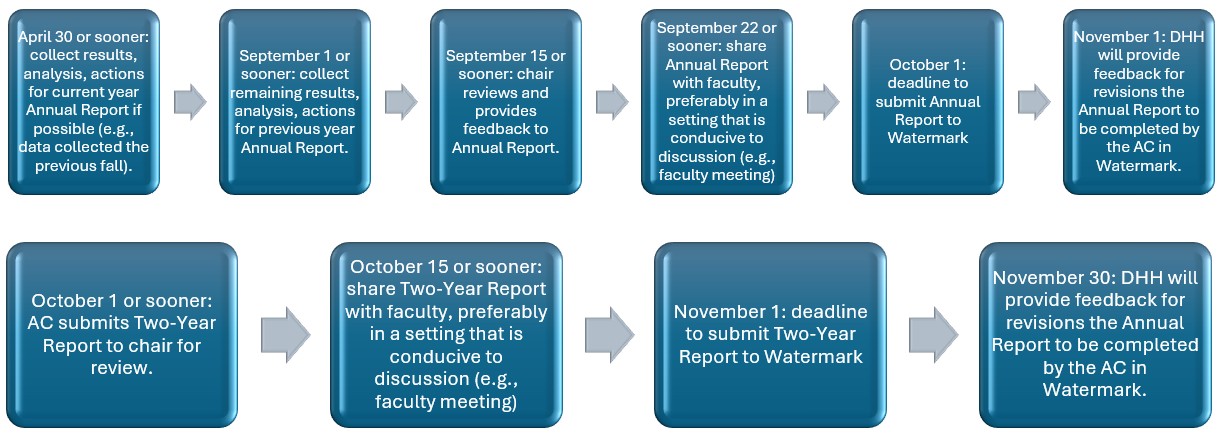
The UTRGV ARTS office provides comprehensive social media, advertisements, newsprint opportunities and email blasts to its constituencies for all UTRGV-related departments, schools, programs and partnership within the College of Fine Arts. In order to receive timely and robust communications products and tools, the cooperation of administrators, faculty and staff are essential.
In order to produce appropriate materials for your events and presentation, please be mindful:
- When requesting time on the UTRGV ARTS calendar, requestors should include some basic details, such as the day/date/time, nature of the program, who is presenting, ticketed or free, and title of the event. Email for information or questions to munoz@utrgv.edu.
- If applicable to your event, all marketing materials, photos, biographies, descriptive written content, event title/location/program/presenters, video content should be made available to Jillian Torres (torres@utrgv.edu) no later than 6 weeks prior to the scheduled event(s).
- Any changes in the event, event parameters, timing, presenters, etc. may be difficult to change in public venues with short notice. Your cooperation is appreciated in keeping UTRGV ARTS informed as soon as possible.
- All media provided to UTRGV ARTS must meet the professional standards of the College of Fine Arts. You have questions about meeting expectations, please contact UTRGV ARTS.
- Any marketing materials containing the primary academic or spirit logos must comply with UTRGV Brand Guidelines (https://www.utrgv.edu/umc/creative-services/graphic-identity-guidelines/). To ensure compliance, please send a draft of these marketing materials to umcreview@utrgv.edufor feedback/direction.
UTRGV ARTS need to receive information for programs two weeks in advance of the event. Depending on the nature of the event, UTRGV ARTS will create digital and/or printed programs.
For marketing needs outside of UTRGV ARTS (such as department rack cards, audition posters, program brochures, etc.,), CFA faculty and staff may complete a “CFA Graphic Design Request” by completing a brief form to describe the request (https://utrgv.sharepoint.com/sites/UTRGV_CollegeofFineArtsGraphicDesignRequests/SitePages/GraphicDesignForm.aspx?env=Embedded).
XIV.a. Event Scheduling Process
This process applies to venues directly scheduled by UTRGV ARTS staff, namely:
- Performing Arts Complex (PAC) in Edinburg
- Auditorium
- Lobby
- Rehearsal Halls
- Multipurpose Room in BLMSC in Brownsville
- Off-campus venues, including, but not limited to:
- Harlingen Municipal Auditorium
- TSC Performing Arts Center in Brownsville
Timeline. While some flexibility is necessary to meet needs throughout the college, deadlines should be adhered to as much as possible.
| 1st day of Spring class: |
UTRGV ARTS staff creates a “calendar template" for the entire subsequent fiscal year (September-August) that contains “typical” events that occur on an annual basis, including events that are outside of the College of Fine Arts. |
| March 1 or sooner: | If possible, considering guest artist availability, UTRGV ARTS staff will block out/schedule Distinguished Artist Series events dates for the series, prioritizing days designated for the series from the calendar template. |
| March 8 or sooner: | UTRGV ARTS staff will send academic units an updated calendar template with confirmed dates and recommendations based on “typical events.” |
| March 8-31: | School director/department chairs will work with faculty to create an events schedule request for all events in the year based on criteria specific to the needs of the unit, using the revised calendar template as a guide. |
| April 1: | Deadline to send a school/department initial schedule request for the entire subsequent fiscal year to UTRGV ARTS staff. This request will be given first priority. |
| April 15: | UTRGV ARTS staff will notify school directors/department chairs of any date conflicts and suggest solutions. Additionally, UTRGV ARTS staff will coordinate with the Theatre box office to avoid conflicts with productions occurring in Theatre venues whenever possible. |
| April 30: | Once conflicts have been resolved between the applicable school directors/department chairs, they will notify UTRGV ARTS staff who will publish the calendar on the website. |
| May 1 and later: | Faculty who wish to add events to the calendar should look at the published calendar on the website and contact UTRGV ARTS staff to request (see below) those remaining dates on a first come, first-served basis. Faculty should always keep their school director/department chair informed of any request. |
Requests. Faculty who are requesting space after May can click on the applicable links:
2026-2027 Edinburg Rehearsal Hall Reservation Form – Fill out form – Fill out form
2026-2027 UTRGV PAC Performance Hall Reservation Request Form – Fill out form
Season Calendar 2026-2027.xlsx
Rehearsal Hall Schedule Fall 2026.xlsm
These reservations are for official UTRGV events, not for outside organizations. There is a different process for rental of these spaces by outside organizations. To reserve a date on behalf of another organization, visit UTRGV Facility Rentals. Outside vendors are not allowed on campus by UT Systems without an approved contract.
In accordance with HOP ADM 10-301 Facility Use, all Jointly Sponsored activities must be approved by the President's office. The use of University buildings or facilities by individuals who are not students, faculty, or staff; by groups that are not registered student, faculty, or staff organizations; or by associations or corporations for programs or activities must be jointly sponsored by UTRGV and shall be subject to approval, visit Joint Sponsored Events.
UTRGV ARTS staff will respond to requests submitted using the appropriate forms about two (2) to three (3) business days after you have submitted your request. Requests made over the phone, via email, text, in person, or by contacting staff directly will not be processed and confirmed until the requestor has submitted the appropriate request form.
When scheduling, please be aware that any cancellations involve a cost in time and money. Patrons who have redeemed tickets or the public who have purchased tickets need to be notified of cancellations, refunds must be made, ticketing costs will still be incurred, and cancellation of police/custodial services will need to be made. Unless there is an emergency, we ask that you provide at least three (3) weeks’ notice of your cancellation.
Due to the high demand for use of the performance spaces and the time and resources required to advertise public performances, cancellations less than three (3) business weeks at any of the performance spaces will result in:
- loss of the date(s) in the hall and
- no guarantee that the performance will be rescheduled.
XIV.b. Complimentary Tickets
Complimentary tickets (Faculty, Student Majors, Student Minors, Performers/Exhibitors) are determined by departments/schools for use in building community, supplementing attendance and recognizing participation is handled differently by each department and school. These complimentary tickets are removed from ticket sales inventories. UTRGV ARTS will issue a Complimentary Ticket based on eligibility. Any unused Complimentary Tickets at a prescribed date will be returned to the sales inventory pool for purchase.
As stated in the College of Fine Arts FY25-29 Strategic Plan, the college will “promote academic readiness for students in the Arts in partnership with K-12 schools, including the UTRGV Collegiate High Schools.” To that end, the college needs to create a “budget based on participation fees, coupled with grants and institutional support to fully fund workshops, festivals, and summer camps, including competitive faculty summer stipends or other incentives for organizing and leading workshops, festivals, and summer camps” (CFA Objective II.4).
Below are guidelines to incentivize faculty to create new outreach opportunities.
Definition. Any of the faculty- or staff-led summer activities below fall under this policy, provided that they collect funding. This policy does not address activities that are free to participants, which are managed individually by schools and departments within the College of Fine Arts.
- Camp, Day and Overnight with UTRGV students, faculty, and/or staff; community members outside of UTRGV, including minors.
- One-Day Workshop with UTRGV students, faculty, and/or staff; community members outside of UTRGV, including minors.
- Class/workshop/ensemble/production that meets multiple times during the summer, such as, ensembles, community theatre, or art classes.
Ticketed, public events, such as performances, gallery openings, and public readings are not covered by this policy.
Revenue Neutral. It is expected that all summer outreach events are revenue neutral, meaning that institutional funds are not used. Institutional funds can only be used as “start-up” funding to support marketing and communication needs or pay deposits at the discretion of the department chair/school director. It is expected that these funds will be “repaid” through revenues generated by the outreach event. Exceptions may be made to this rule, deposits at the discretion of the department chair/school director, particularly if there is a grant that requires some level of matching funding, or the outreach event is in a high-need recruitment area.
Communication and Marketing. University Marketing and Communications can assist in the creation of marketing materials and assets for outreach events, including creating an event website. CFA faculty and staff may complete a “CFA Graphic Design Request” by completing a brief form to describe the request (https://utrgv.sharepoint.com/sites/UTRGV_CollegeofFineArtsGraphicDesignRequests/SitePages/GraphicDesignForm.aspx?env=Embedded).
Any marketing materials containing the primary academic or spirit logos must comply with UTRGV Brand Guidelines (https://www.utrgv.edu/umc/creative-services/graphic-identity-guidelines/). To ensure compliance, please send a draft of these marketing materials to umcreview@utrgv.edu for feedback/direction.
Youth Programs Training. Any program that will involve the participation of minors needs to register with the Youth Programs office (https://www.utrgv.edu/youthprograms/) at least 30 days before the start of the event. If you have any questions regarding Youth Program Protection, you can contact the Youth Programs Support Manager at youthprogramprotection@utrgv.edu or (956) 665-2522.
If the youth program is considered Custodial care, meaning the students are NOT accompanied by their parent/chaperone, Consent Forms are submitted through our Ideal-Logic Registration portal. If the students are accompanied by their parents/chaperone, then the consent forms are not necessary. In these cases, parents/school officials must be informed that an adult must remain present for the entirety of the program.
Summer Stipends. Nine-month employees are eligible to receive a summer stipend for work completed between mid to late May and mid to late August. Any compensation that a nine-month employee receives cannot exceed the equivalent of 1/3 of their base salary, including a stipend for summer outreach events, teaching, faculty awards, grants, or service/administrative duties. Twelve-month employees cannot receive a summer stipend unless the duties are outside of the duties of their university position. Faculty who serve as program/camp director, teachers, and artistic directors may receive a summer stipend.
Students may be employed as hourly employees. Duties and hours must be specified. All stipends and student hires must be approved by the department, college, and human resources department.
Food and Housing. Employees need to contact Dining Services and the Department of Student Housing to receive estimates of costs, as well as to make reservations.
Proposal Guidelines. Proposals should be submitted to the department chair or school director in enough time to allow for a successful marketing campaign. Marketing for the program should not begin until it has been approved by the department chair or school director.
Below are recommendations for what should be included in an outreach program proposal.
Description. Give a brief description of the program, including:
- Focus (i.e., Band, Youth Theatre, Art)
- Target population (6-12 grade students, adults)
- Purpose and/or expected outcomes (recruitment, community outreach, continuing education for credit or no credit)
Personnel Needs. List the various and number of personnel: program director, instructors, artistic directors, counselors, etc., If possible, the proposal should name who would fill these positions, particularly if they are UTRGV employees or students.
Marketing Plan. Give a brief description of marketing, including inclusion on the UTRGV website. This plan may include:
- University Marketing and Communications to create material assets and a website (digital and printed assets).
- UTRGV ARTS staff in creating social media posts (where applicable).
- Advertising in the region and/or with professional organizations.
Budget. The budget should include all expected expenses, including personnel compensation, insurance, materials/supplies, marketing, and scholarships; and income, including tuition, grants, sponsorships, and institutional support. See Section XI.a. for a budget template.
XV.a. SUMMER OUTREACH BUDGET TEMPLATE
|
|
Expected Number |
|
|
Day Participants |
|
|
|
Overnight Participants |
|
|
|
Employees |
|
|
|
|
|
|
|
Expenses |
|
|
|
Category |
Description |
Amount |
|
Contingency (10% of toal budget) |
|
0 |
|
Carry over for start-up for next fiscal year |
|
|
|
Personnel (specify job type and stipend insert rows asnecessary) |
|
|
|
|
|
|
|
|
|
|
|
|
|
|
|
Student Insurance (Day Camp) |
|
0 |
|
Student Insurance (Overnight Camp) |
|
0 |
|
Employee Insurance |
|
0 |
|
Materials/Supplies |
|
|
|
|
|
|
|
Meals |
|
|
|
Accommodations (overnight program only) |
|
|
|
Marketing |
|
|
|
Scholarships |
|
|
|
3% Transaction Fee for Registration |
|
0 |
|
Other (insert rows as necessary) |
|
|
|
Total |
|
0 |
|
|
|
|
|
Income |
|
|
|
Category |
Description |
Amount |
|
Tuition |
|
|
|
Grants |
|
|
|
Sponsorships |
|
|
|
Institutional Support |
|
|
|
|
|
|
|
Total |
|
0 |
The College of Fine Arts Governance Committee provided guidelines that all departmental and college committees should follow when conducting official business. If you have any questions about Robert’s Rules of Order, please contact the chair of the Governance Committee.
Guiding Principles:
- Everyone has the right to participate in discussion if they wish, before anyone may speak a second time.
- Everyone has the right to know what is going on at all times. Only urgent matters may interrupt a speaker.
- Only one thing (motion) can be discussed at a time.
A motion is the topic under discussion (e.g., “I move that we add a coffee break to this meeting”). After being recognized by the president of the board, any member can introduce a motion when no other motion is on the table. A motion requires a second to be considered. If there is no second, the matter is not considered. Each motion must be disposed of (passed, defeated, tabled, referred to committee, or postponed indefinitely).
How to do things:
You want to bring up a new idea before the group.
After recognition by the president of the board, present your motion. A second is required for the motion to go to the floor for discussion, or consideration.
You want to change some of the wording in a motion under discussion.
After recognition by the president of the board, move to amend by:
- adding words,
- striking words or
- striking and inserting words.
You like the idea of a motion being discussed, but you need to reword it beyond simple word changes.
Move to substitute your motion for the original motion. If it is seconded, discussion will continue on both motions and eventually the body will vote on which motion they prefer.
You want more study and/or investigation given to the idea being discussed.
Move to refer to a committee. Try to be specific as to the charge to the committee.
You want more time personally to study the proposal being discussed.
Move to postpone to a definite time or date.
You are tired of the current discussion.
Move to limit debate to a set period of time or to a set number of speakers. Requires a 2/3rds vote.
You have heard enough discussion.
Move to close the debate. Also referred to as calling the question. This cuts off discussion and brings the assembly to a vote on the pending question only. Requires a 2/3rds vote.
You want to postpone a motion until some later time.
Move to table the motion. The motion may be taken from the table after 1 item of business has been conducted. If the motion is not taken from the table by the end of the next meeting, it is dead. To kill a motion at the time it is tabled requires a 2/3rds vote. A majority is required to table a motion without killing it.
You believe the discussion has drifted away from the agenda and want to bring it back.
“Call for orders of the day.”
You want to take a short break.
Move to recess for a set period of time.
You want to end the meeting.
Move to adjourn.
You are unsure the president of the board announced the results of a vote correctly.
Without being recognized, call for a “division of the house." A roll call vote will then be taken.
You are confused about a procedure being used and want clarification.
Without recognition, call for "Point of Information" or "Point of Parliamentary Inquiry." The president of the board will ask you to state your question and will attempt to clarify the situation.
You have changed your mind about something that was voted on earlier in the meeting for which you were on the winning side.
Move to reconsider. If the majority agrees, the motion comes back on the floor as though thevote had not occurred.
You want to change an action voted on at an earlier meeting.
Move to rescind. If previous written notice is given, a simple majority is required. If no notice is given, a 2/3rds vote is required.
Unanimous Consent:
If a matter is considered relatively minor or opposition is not expected, a call for unanimous consent may be requested. If the request is made by others, the president of the board will repeat the request and then pause for objections. If none are heard, the motion passes.
You may INTERRUPT a speaker for these reasons only:
- to get information about business –point of information to get information about rules– parliamentary inquiry
- if you can't hear, safety reasons, comfort, etc. –question of privilege
- if you see a breach of the rules –point of order
- if you disagree with the president of the board’s ruling –appeal
- if you disagree with a call for Unanimous Consent –object
|
|
|
Quick |
Reference |
|
|
|
|
Must Be Seconded |
Open for Discussion |
Can be Amended |
Vote Count Required to Pass |
May Be Reconsidered or Rescinded |
|
Main Motion |
√ |
√ |
√ |
Majority |
√ |
|
Amend Motion |
√ |
√ |
|
Majority |
√ |
|
Kill a Motion |
√ |
|
|
Majority |
√ |
|
Limit Debate |
√ |
|
√ |
2/3rds |
√ |
|
Close Discussion |
√ |
|
|
2/3rds |
√ |
|
Recess |
√ |
|
√ |
Majority |
|
|
Adjourn (End meeting) |
√ |
|
|
Majority |
|
|
Refer to Committee |
√ |
√ |
√ |
Majority |
√ |
|
Postpone to a later time |
√ |
√ |
√ |
Majority |
√ |
|
Table |
√ |
|
|
Majority |
|
|
Postpone Indefinitely |
√ |
√ |
√ |
Majority |
√ |