
  • Home
  • Research Faculty
    • Cayuse
    • Faculty Opportunities for Research Growth and Excellence (FORGE)
    • Forms, Policies, Guidelines & Procedures
    • Funding Opportunities
    • Institutional Animal Care and Use Committee (IACUC)
    • Institutional Biosafety Committee (IBC)
    • Institutional Review Board (IRB)
    • Intent To Submit a Proposal
    • Laboratory Animal Resources (LAR)
    • Limited Submissions
    • Research Insights
    • Technology Commercialization
    • Time and Effort (T&E)
    • Travel Resources and Investments Program (T.R.I.P.)
  • Students
  • Departments
    • Research Analytics
    • Research Administration
    • Research Integrity
    • Research Enhancement
    • Clinical Research
    • Research Operations
  • Analytics
    • ARGO
    • Control Tower
    • Datapulse
    • Discovery Site
    • Faculty Insight
    • Academic Analytics
    • Reports and Dashboards
  • News
    • Announcements
    • Accomplishments
    • Research Newsroom
    • Annual Reports
  • About
    • Leadership
    • Research Pathways
    • Centers and Institutes
    • Meet the Senior Vice President for Research
    • Associate Deans for Research
    • Committees
    • Personnel
    • Office Locations
  • About
  • DIRECTORY
  • MAPS
  • MYUTRGV
  • NEWS
  • GIVE
UTRGV home
The University of Texas
Rio Grande Valley
  • DIRECTORY
  • MAPS
  • MYUTRGV
  • News
  • GIVE
Open Search Menu
Menu
UTRGV Trademark Logo
Division of Research
  • Home
  • Research Faculty
    ▼
    Research Faculty Square placeholder image 300px

    Streamlining research processes at UTRGV. Access tools and guidance for compliance, proposal submissions, funding, and more

    • Research Faculty
      • Cayuse
      • Faculty Opportunities for Research Growth and Excellence (FORGE)
      • Forms, Policies, Guidelines & Procedures
      • Funding Opportunities
      • Institutional Animal Care and Use Committee (IACUC)
      • Institutional Biosafety Committee (IBC)
      • Institutional Review Board (IRB)
      • Intent To Submit a Proposal
      • Laboratory Animal Resources (LAR)
      • Limited Submissions
      • Research Insights
      • Technology Commercialization
      • Time and Effort (T&E)
      • Travel Resources and Investments Program (T.R.I.P.)
  • Students
  • Departments
    ▼
    Departments Square placeholder image 300px

    The Division of Research at UTRGV is dedicated to advancing and supporting the university's research activities, benefiting students, faculty, and staff.

    • Departments
      • Research Analytics
      • Research Administration
      • Research Integrity
      • Research Enhancement
      • Clinical Research
      • Research Operations
  • Analytics
    ▼
    Analytics Square placeholder image 300px

    The Analytics Hub provides centralized access to key tools like ARGO, Control Tower, Data Pulse, DPM, and Academic Analytics, empowering data-driven decisions across research, academics, and operations at UTRGV.

    • Analytics
      • ARGO
      • Control Tower
      • Datapulse
      • UTRGV Discovery Site
      • UTRGV Faculty Insight
      • Academic Analytics
      • Reports and Dashboards
  • News
    ▼
    News Square placeholder image 300px

    Research Communications enhances the visibility and impact of research activities across UTRGV. Our mission is to ensure that UTRGV’s research reaches both internal and external audiences, enhancing the university’s research reputation.

    • News
      • Announcements
      • Accomplishments
      • Research Newsroom
      • Annual Reports
  • About
    ▼
    About Square placeholder image 300px

    Discover UTRGV’s Division of Research, supporting high-impact research and scholarship across all disciplines.

    • About
      • Leadership
      • Research Pathways
      • Centers and Institutes
      • Meet the Senior Vice President for Research
      • Associate Deans for Research
      • Committees
      • Personnel
      • Office Locations

Institutional Animal Care and Use Committee (IACUC)

  1. Home
  2. Departments
  3. Research Integrity
  4. Research Compliance
  5. Institutional Animal Care and Use Committee (IACUC)
Institutional Animal Care and Use Committee (IACUC) Menu
Menu

Institutional Animal Care and Use Committee (IACUC) Menu

  • Meeting Schedules & Deadlines
  • Prompt Report Form

Contact Us

Amy Mutore

IACUC/IBC Coordinator
iacuc@utrgv.edu
(956)-665-2889

Monica Barrera

IACUC/IBC Specialist
iacuc@utrgv.edu
956-665-7873

Quick Links

  • Laboratory Animal Resources (LAR)
  • Institutional Biosafety Committee (IBC)
  • Staff Directory

Institutional Animal Care and Use Committee (IACUC)

 PHS Assurance D16-00919 (A4730-01) | USDA Certificate #74-R-0216

The UTRGV's Institutional Animal Care and Use Committee (IACUC) is specifically charged with the responsibility to assure the humane care and treatment of animals used or intended for use in all research, research training, experimentation, teaching, biological testing, or for related purposes involving live vertebrate animals. An animal use protocol (AUP) must be approved by the IACUC prior to any live vertebrate animal work can commence.

In contrast, if planning to do work with invertebrates the UTRGV's IACUC request that a 'notification of work' be submitted.

When a protocol is submitted to the Institutional Animal Care and Use Committee (IACUC), it undergoes several stages of review. The process begins with an administrative review to ensure the submission is complete and sufficiently detailed, and to determine whether the protocol requires Full Committee Review (FCR) or Designated Member Review (DMR). These review processes are outlined in the charts below. In addition, for approved protocols, certain actions may be processed through administrative review in accordance with Office of Laboratory Animal Welfare (OLAW) guidance.

  1. Submission for IACUC administrative review.
  2. The submission proceeds to IACUC administrative review and assessment.
  3. If revisions are needed, the Principal Investigator (PI) and/or IACUC administrators make revisions.
  4. The review and assessment step is repeated until revisions are complete.
  5. Once complete, the protocol receives IACUC administrative approval and updates are entered into the electronic system.
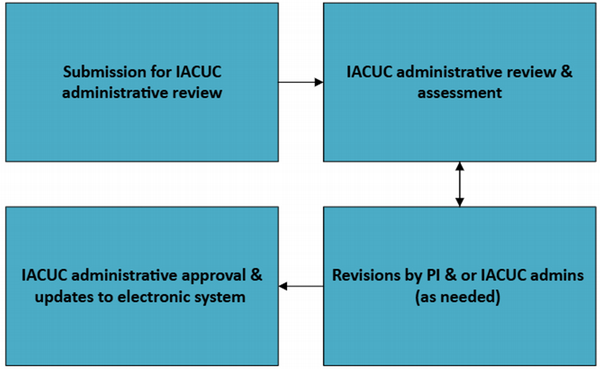
Flowchart showing the IACUC administrative review process.

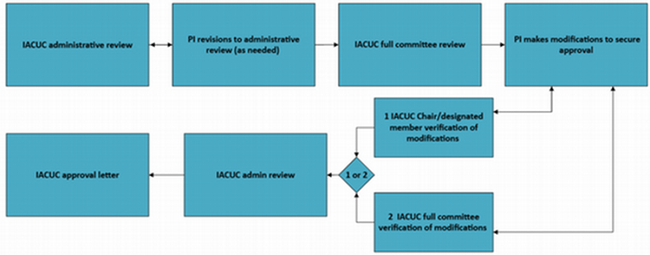
  1. The process begins with IACUC administrative review.
  2. If administrative revisions are required, the Principal Investigator (PI) revises the submission. The protocol may move back and forth between administrative review and PI revisions until the administrative review is complete.
  3. The protocol proceeds to IACUC full committee review.
  4. The PI makes modifications to secure approval.
  5. Verification of modifications is completed by either:
    • One IACUC Chair or designated member, or
    • The full IACUC committee.
  6. A decision determines which verification path is used.
  7. Following verification, the protocol proceeds to IACUC administrative review.
  8. An IACUC approval letter is issued.

Flowchart illustrating the IACUC Full Committee Review process. A detailed workflow description follows.

  1. The process begins with IACUC administrative review.
  2. If administrative revisions are required, the protocol is returned to the Principal Investigator (PI) for revisions to the administrative review. The protocol may move back and forth between administrative review and PI revisions until the administrative review is complete.
  3. Once the administrative review is complete, the protocol proceeds to eReview, where designated reviewers have 7 days to complete their review.
  4. After the eReview period, a designated member is assigned to review the protocol.
  5. If modifications are required, the protocol is returned to the PI, who makes the necessary modifications to secure approval. The protocol may move back and forth between the designated member's review and the PI's modifications until the designated member is satisfied that all required changes have been addressed.
  6. After the designated member completes the final review, the protocol proceeds to IACUC administrative review.
  7. Once the administrative review is complete, an IACUC approval letter is issued, completing the review process.
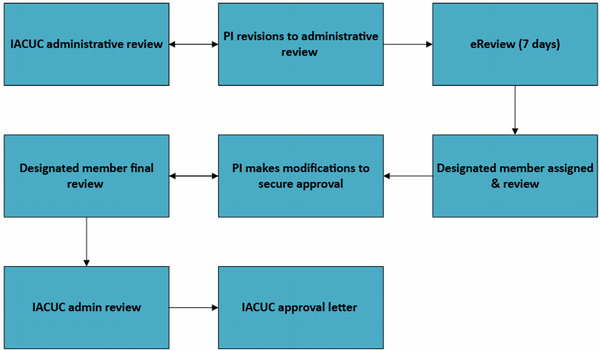
Flowchart illustrating the IACUC Designated Member Review process, including administrative review, designated member review, protocol modifications, final administrative review, and issuance of the IACUC approval letter. A detailed workflow description follows.

IACUC Noncompliance Review Process
  • The process begins when the IACUC receives a notification of an issue.
  • The information related to the issue is verified.
  • The verified information proceeds to IACUC notification and review. Additional information may be requested during the review, and the process may return to the verification step before continuing.
  • Following the review, the issue is classified as either Serious or Nonserious.
Serious Noncompliance Path
  • If the issue is determined to be Serious, including a preliminary assessment and consideration of preliminary reporting requirements, the process continues with an investigation.
  • After the investigation, the IACUC performs an assessment.
  • Based on the assessment, corrective actions are specified.
  • Once corrective actions have been determined, the IACUC issues a notification of findings.
  • The process concludes with external and internal reporting, as required.
Nonserious Noncompliance Path
  • If the issue is determined to be Nonserious, following a preliminary assessment, the process continues with an investigation.
  • After the investigation, the IACUC performs an assessment.
  • Based on the assessment, corrective actions are specified.
  • Once corrective actions have been determined, the IACUC issues a notification of findings.
  • The process concludes with internal reporting only.
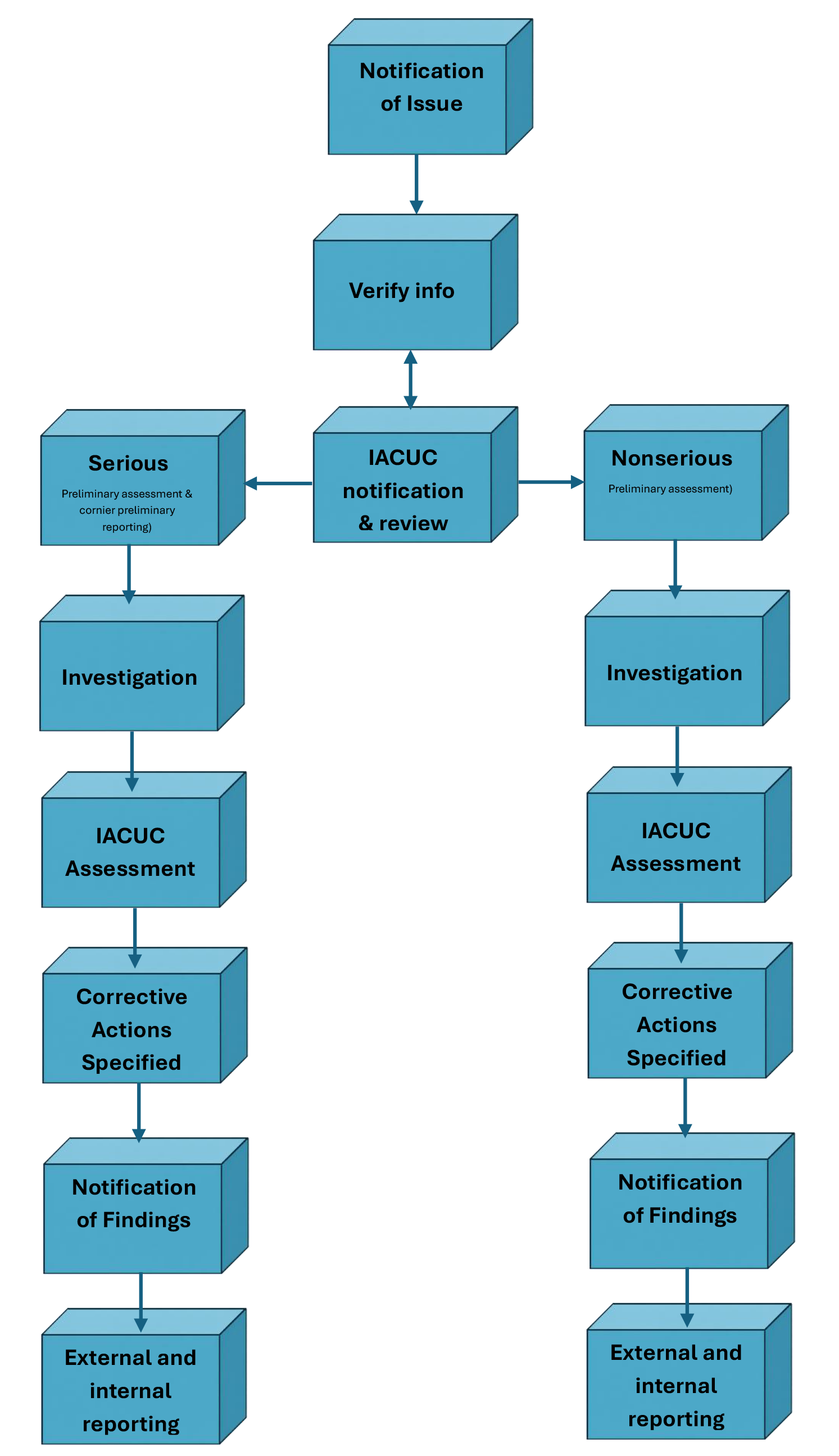
Flowchart illustrating the IACUC noncompliance review process, including initial review, classification as serious or nonserious, investigation, assessment, corrective actions, findings, and reporting requirements. A detailed workflow description follows.

tick@lab

All IACUC applications and forms must be submitted to IACUC electronic system, tick@lab. If unable to login, please submit an access request form through IT. Include all supporting documentation for your animal use protocol or notification of work.

How to Request Access
Enter tick@lab

Announcements

Next IACUC meeting: Wednesday, March 25, 2026 11:00am - 1:00pm

Resources

  • How to Submit Animal Use Protocols
  • How to Submit Continuing Reviews and Amendments
  • Common Protocol Errors Checklist
  • CITI Program Training
  • Guidance for Navigating Occupational Health
  • NIH Office of Laboratory Animal Welfare (OLAW)
  • Guide for the Care and Use of Laboratory Animals


For Emergencies contact Campus Police at (956) 882-4911.

To Report any Suspected Violations of law, policy or regulations please contact the Compliance Hotline at: (877) 882-3999

Division of Research


Brownsville

research@utrgv.edu
BBRHB 2.210

(956)-296-1549

Edinburg

research@utrgv.edu
ESSBL 5.110

(956)-665-3883

Hours

Monday - Friday
8:00 AM - 5:00 PM CST

Find us on Social Media


LIKE. FOLLOW. SUBSCRIBE. ADD.


UTRGV Trademark logo
  • CARES, CRRSAA and ARP Reporting
  • Site Policies
  • Required Links
  • Accreditation Statement
  • Fraud Reporting
  • Senate Bill 18
  • Clery Act Reports
  • Web Accessibility
  • Mental Health Resources
  • Sexual Misconduct Policy
  • Reporting Sexual Misconduct
  • Contact UTRGV
  • 1-844-ATUTRGV
  • Facebook
  • X Twitter
  • Instagram
  • LinkedIn
  • Academics
  • Admissions
  • Cost and Financial Aid
  • Student Life
  • Search Programs
  • First-Year Students
  • Transfer
  • International Students
  • Graduate Students
  • Current Students
  • Faculty Resources
  • Staff Resources
  • UTRGV Careers
  • Visit Campus
  • Directory
The University of Texas Rio Grande Valley