

 rotate(10)'/%3E%3Cpath d='M.038.113v.15l.15.088.15-.088v-.15L.188.025l-.15.088Z' stroke='%23c44900' stroke-width='.0375' transform='rotate(10)'/%3E%3C/svg%3E)
Simulation Experiences
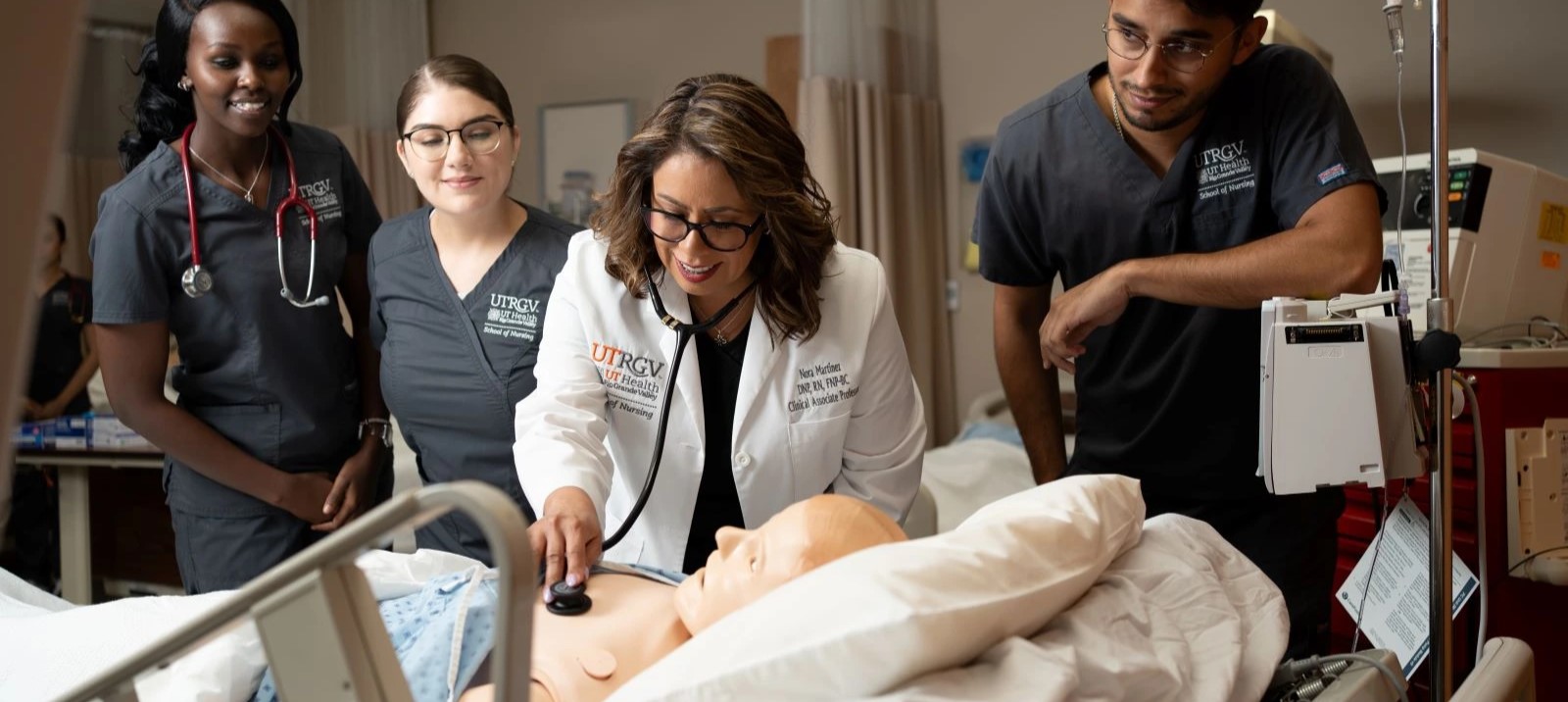
UTRGV’s School of Nursing offers high-fidelity simulation in some courses in Edinburg and Brownsville to complete required clinical hours. The National Council of State Boards of Nursing (NCSBN) approves the substitution of high-quality simulation experiences for up to 50% of traditional clinical hours across the prelicensure nursing curriculum. Delivering continuous and consistent quality patient care requires proper training, accurate assessments, interventions, and clinical decision-making skills to ensure the best patient outcomes. To achieve these goals, the School of Nursing incorporates consistent simulation scenarios in the nursing curriculum, which assist nursing students in their clinical training. An advantage of patient simulations is that students can correct their clinical errors without adverse consequences.
SimMan 3G
One of our high-fidelity manikins is the SimMan 3G. It is an advanced patient simulator that can display neurological and physiological symptoms. One of the key benefits of SimMan 3G is its ability to provide realistic feedback to students. The simulator can generate real-time data on students’ performance, including areas of strength and weakness. This feedback can then be used to guide further practice and learning. With this high-tech, multi-function adult manikin, students can become adept at running basic cases and highly complex scenarios. Features include:
- Spontaneous breathing (bilateral and unilateral chest rise)
- Normal/abnormal breath sounds
- Difficult airway scenarios
- Palpable pulses synchronized with EKG and QCPR
- Recognition of depth, release, and frequency of compressions with real-time feedback
- Comprehensive monitoring of respiratory, cardiac, hemodynamic, and neurologic parameters
Nurse Anne
The Nurse Anne manikin is a high-fidelity patient simulator that can mimic a real patient and provide students with hands-on experience while displaying a range of vital signs, including heart rate, respiratory rate, blood pressure, and oxygen saturation levels, among others. Utilizing Nurse Anne in simulations allows nursing students to practice various clinical scenarios, such as responding to a patient in distress, managing post-operative care, and administering medication. These simulations help students learn how to communicate effectively with patients, work collaboratively with other healthcare professionals, and make sound clinical judgments. Nurse Anne simulations also enable students to practice critical thinking and decision-making skills, which are essential for providing safe and effective patient care.
National League for Nursing (NLN) Scenarios
The School of Nursing uses National League for Nursing (NLN) scenarios that are aligned with our CoursePoint resources. NLN scenarios are a valuable tool for nursing education and can be used in a variety of simulation settings to enhance students’ knowledge, skills, abilities, and clinical judgment. The NLN has developed several scenarios that can be used in simulation to enhance nursing education. These scenarios provide a realistic, safe, and controlled environment for nursing students to practice their skills and improve their clinical reasoning and decision-making abilities. Some ways in which these NLN scenarios are utilized in simulation include:
- Assessment: To assess students’ knowledge and skills in a particular area, such as pediatric nursing or critical care, students are given scenarios to work through, and their performance is evaluated by instructors or through self-assessment.
- Skill Development: To develop specific skills, such as communication, critical thinking, and clinical reasoning, students work through realistic scenarios and practice and refine these skills in a safe and controlled environment.
- Teamwork: To work as part of a team of students, which can help develop teamwork and collaboration skills, students work together to solve complex problems and learn to communicate effectively and make better decisions as a team.
- Patient Safety: To promote patient safety by highlighting common errors and mistakes that can occur in clinical practice, students work through scenarios that involve medication errors, falls, or other adverse events and learn to recognize and prevent these types of errors in real-world clinical settings.
Unfolding Case Studies
The School of Nursing incorporates unfolding case studies in simulations. These valuable and versatile healthcare education training activities can be tailored to meet the specific needs of students in a variety of healthcare settings, including hospitals, clinics, and the community. This flexibility allows students to practice their skills in a range of environments and prepare for the diverse challenges in the healthcare field.