
 rotate(10)'/%3E%3Cpath d='M.038.113v.15l.15.088.15-.088v-.15L.188.025l-.15.088Z' stroke='%23c44900' stroke-width='.0375' transform='rotate(10)'/%3E%3C/svg%3E)
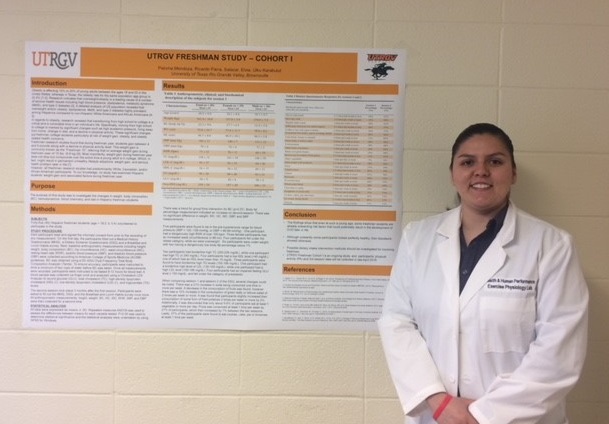
Paloma Mendoza, a graduate student from the Exercise Science Master’s Program, received 2nd place at the Graduate Research Symposium in February 2018 with her “UTRGV Freshman Study – Cohort I” presentation.
Paloma’s study is the first Hispanic Freshman Study to investigate changes in weight, body composition (BC), hemodynamics, blood chemistry, and diet in Hispanic freshman students.
Previous freshman research studies found that during the first year, students gain between 4 and 9 pounds along with a decline in physical activity levels. This weight gain is commonly referred to as the “Freshman 15,” describing an average weight gain of 15 pounds (6.8 kg) during the freshman year.
Paloma’s mentor, Dr. Ulku Karabulut, is from the Health and Human Performance Department.
Dr. Murat Karabulut revised the format of one of the classes (KINE 3160 Exercise Testing and Prescription) to link scholarship with learning. This provides opportunities for students to test their knowledge, discover relationships between health-related independent and dependent variables, and gain more hands-on experience.
In his class, he guides students in exploring the literature and identifying a unique health issue or problem to investigate. Students also complete online training on research ethics, the Belmont Report, and federal regulations necessary to conduct research studies.
Students perform real IRB-approved research studies and present their findings at local, regional, and national conferences and symposiums.
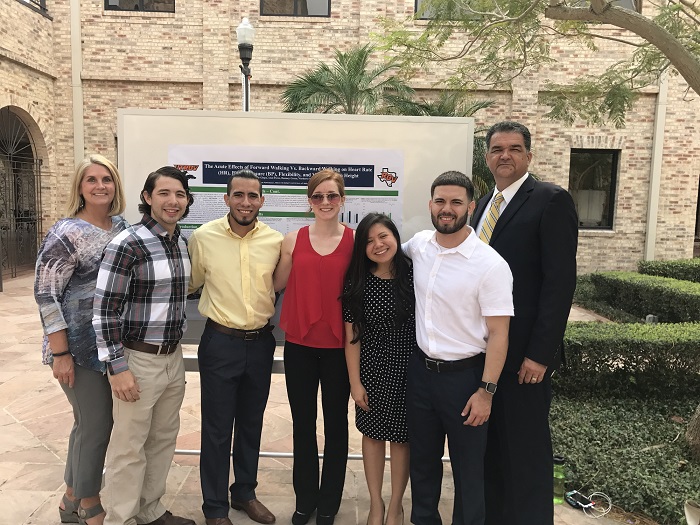
Title: The Acute Effects of Forward Walking Vs. Backward Walking on Heart Rate (HR), Blood Pressure (BP), Flexibility, and Vertical Jump Height
Josh Rangel, Amber Glapa, Anai Perez, Ramsey Garza, Norberto Marquez
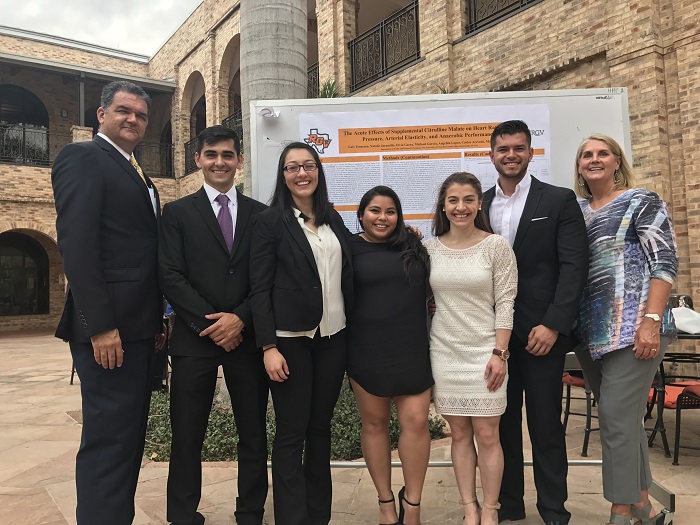
Title: The Acute Effects of Supplemental Citrulline Malate on Heart Rate, Blood Pressure, Arterial Elasticity, and Anaerobic Performance
Luis Troncoso, Natalie Jaramillo, Elvia Garza, Michael Garcia, Angelita Lopez, Carlos Acevedo
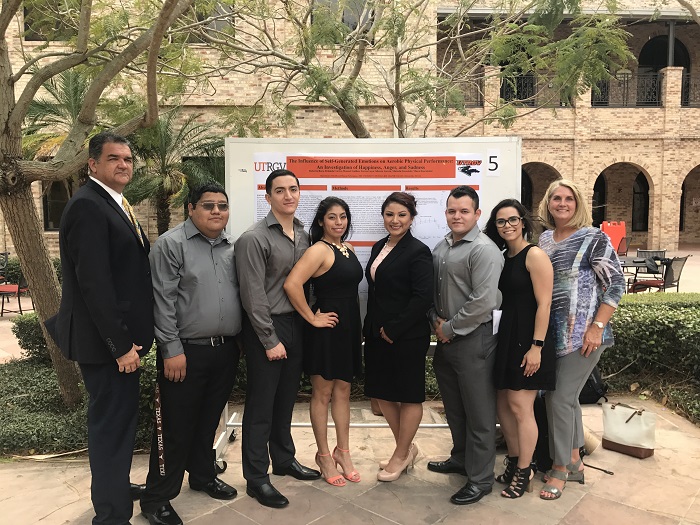
Title: The Influence of Self-Generated Emotions on Aerobic Physical Performance: An Investigation of Happiness, Anger, and Sadness
Roberto Baca, Brianda Cortez, Manuel Guillen, Teresa Loya, Alberto Garcia, Michelle Kowalski
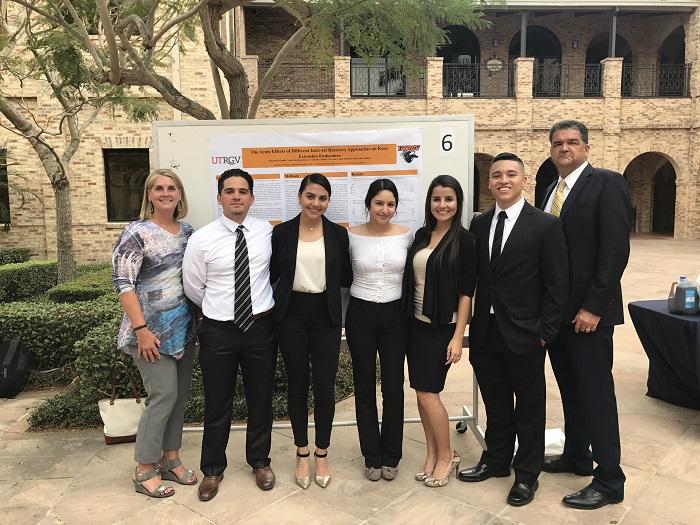
Title: Acute Effects of Different Inter-set Recovery Approaches on Knee Extension Endurance
Elizabeth Castillo, Victor Borrego, Karen Carmona, Amber Cavazos, Carlos Portales
The Office of Engaged Scholarship & Learning supports two awards: Engaged Scholar Award for Undergraduate Research and Engaged Scholar Award for Creative Works . These awards provide the opportunity to fund original academic research or creative works. Receiving an ESA will help you:
- Gain real-world experience. Develop a new project by submitting a formal project proposal.
- Experience one-on-one mentoring. Work directly with a faculty mentor to map out your project step-by-step.
- Apply your skills. Achieve project goals through rigor beyond what you may encounter in a classroom setting alone.
- Build your CV, résumé, or portfolio. Present your project to a public audience to gain experience, exposure, and credibility in your field of study.
Did you know that applications for the Engaged Scholar Award open periodically? Be sure to check the Engaged Scholar Award webpage for the latest updates and deadlines.