
 rotate(10)'/%3E%3Cpath d='M.038.113v.15l.15.088.15-.088v-.15L.188.025l-.15.088Z' stroke='%23c44900' stroke-width='.0375' transform='rotate(10)'/%3E%3C/svg%3E)
Testing Technologically Aided Transcription- Training & Methods
During July, the PI and co-PIs on the project, funded by the National Endowment for the Humanities, met often to determine the design and organization of the trials for the transcription methods.
The PI and co-PIs worked with six (6) research assistants (RAs). The three (3) students from the University of Arizona (UA) were all PhD students, while the three (3) students from the University of Texas Rio Grande Valley (UTRGV) included: two students who completed their bachelor's degrees and were starting their MA in the Fall as well as one student who had just finished their MA at UTRGV.
The team decided to test the transcription methods with four (4) two-minute audio files - two (2) from the Corpus Bilingüe del Valle (CoBiVa, UTRGV corpus) and two (2) from the Corpus del Español en Arizona (CESA, UA corpus). These audio files were selected to demonstrate a variety of different features within the corpora, including background noise, higher speed, and slower more enunciated speech. (An additional file was used for the short 30 second test.)
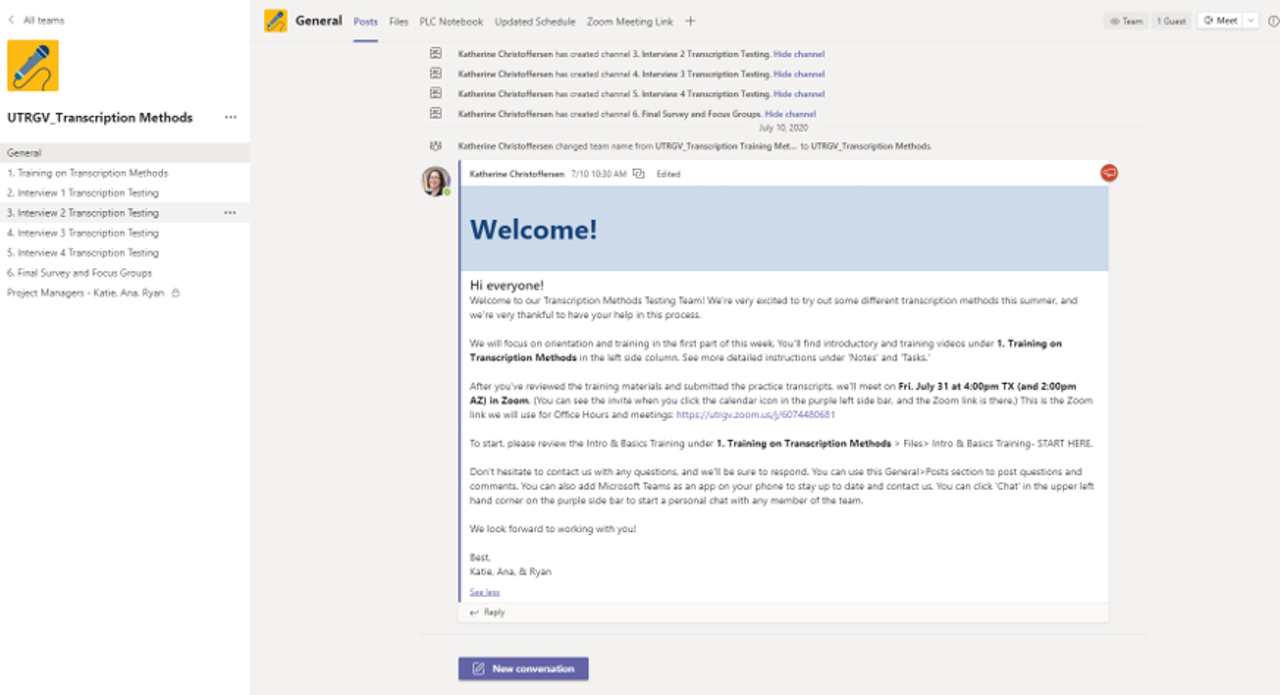
The research team organized the transcription testing trials in Teams. The trials were organized into six (6) modules, one for training and focus groups, one for each of the four audio files, and one for the final survey and focus groups. (See below.)
The trials were organized into three (3) weeks with three synchronous meetings via Zoom. One after the training module, another after the Interview 1 module, and a final one at the end of the project. The research team members met with RAs as needed to review/problem solve issues that arose and provide additional instruction.
For the first training module, the research team created a series of instructional videos including:
- 3 overall instructional videos on the project and the transcription protocol
- 1 instructional video on ExpressScribe
- 2 instructional videos on SpeechNotes
- 4 instructional videos for Stream
As a part of the training module, the RAs completed a short 30 second audio file transcription using the three methods. The research team provided feedback for each RA, and then the team met to discuss.
During each of the four interview transcription modules, the RAs completed the transcription using each of the three methods. They carefully recorded the time required for each of the methods, and after each method, they filled out a survey on ease of use, speed, and general experience/process. The order of the methods was different for each module/interview audio. (See details below.)
Schedule for Testing of Transcription Methods
Revised on August 5, 2020
Office hours and individual meetings are available by appointment.
https://utrgv.zoom.us/j/6074480681
| Week | Tasks | Due Date |
|---|---|---|
| Week 1 | Optional Office Hours | Wednesday, July 29 – Thursday, July 30 4:00–5:00 p.m. Texas time 2:00–3:00 p.m. Arizona time |
| Week 1 | Module 1 – Tasks Due
|
Thursday, July 30, by 11:59 p.m. |
| Week 1 | Intro Meeting | Friday, July 31 4:00–4:30 p.m. Texas time 2:00–2:30 p.m. Arizona time |
| Week 2 | Module 2 – Tasks Due
|
Tuesday, August 4, by 11:59 p.m. |
| Week 2 | Week 2 Meeting | Wednesday, August 5 4:00–4:30 p.m. Texas time 2:00–2:30 p.m. Arizona time |
| Week 2 | Module 3 – Tasks Due
|
Friday, August 7, by 11:59 p.m. |
| Week 3 | Module 4 – Tasks Due
|
Monday, August 10, by 11:59 p.m. |
| Week 3 | Module 5 – Tasks Due
|
Thursday, August 13, by 11:59 p.m. |
| Week 3 | Final Meeting | Friday, August 14 4:00–5:00 p.m. Texas time 2:00–3:00 p.m. Arizona time |
The last module (Module 6 Final Survey and Focus Groups) provided an opportunity for students to complete a final survey comparing and explaining their experiences with the three transcription methods in more detail. The focus group allowed students to discuss their experiences with one another, and it also allowed the researchers to ask follow up questions based on the RAs' surveys and their observations throughout the process.
Check out upcoming blog posts for our preliminary analysis of the transcription method trials.