
 rotate(10)'/%3E%3Cpath d='M.038.113v.15l.15.088.15-.088v-.15L.188.025l-.15.088Z' stroke='%23c44900' stroke-width='.0375' transform='rotate(10)'/%3E%3C/svg%3E)
Bilingual Technologically Aided Transcription Methods, Spanish and English
As a first step in our research project on technologically aided transcription methods, the research team reviewed 27 different technologically aided transcription methods.
Due to our purposes and those of the National Endowment for the Humanities (NEH) grant, we needed to fulfill two major criteria:
- It needed to work with both Spanish and English
- It needed be sustainable, meaning it was open-source or free to us at our institutions.
| Transcription Method. | Spanish & English | Sustainable | Type | WebVtt Format, DataConcerns |
|---|---|---|---|---|
| Stream | Yes | Yes | Auto | |
| Youtube | Yes | Yes | Auto | Data Converns |
| Otranscribe | Yes | Yes | Revocing | |
| Speech Notes | Yes | Yes | Revocing | |
| Express Scribe | Yes | Yes | Manual | |
| FTW Transcriber | Yes | Yes | Manual | |
| Speech Notes | Yes | No | Auto | |
| Amazon Transcribe | Yes | No | Auto | Data Concerns |
| Dragon | Yes | No | Revocing | |
| Live Transcribe(Google) | Yes | No | Revocing | |
| InqScribe | Yes | No | Manual | |
| F4 / F5 | Yes | No | Manual | |
| Voci | Yes | No | Service | |
| Automatic Sync | Yes | No | Service | Yes |
| TranscribeWreally | Yes | No | Service | |
| Ligre | Yes | No | Service | |
| Trint | Yes | No | Service | |
| Happy Scribe | Yes | No | Service | |
| sonix.ai | Yes | No | Service | |
| Simon Says | Yes | No | Service | |
| Watson (speech recognition) | Yes | No | Service | |
| Panopto | English Only | Yes | Auto | |
| Temi | English Only | No | Service | |
| Rev | English Only | No | Service | |
| Otter.ai | English Only | No | Service | Yes |
| Descript | English Only | No | Service | |
| scribblr.ai | English Only | No | Service |
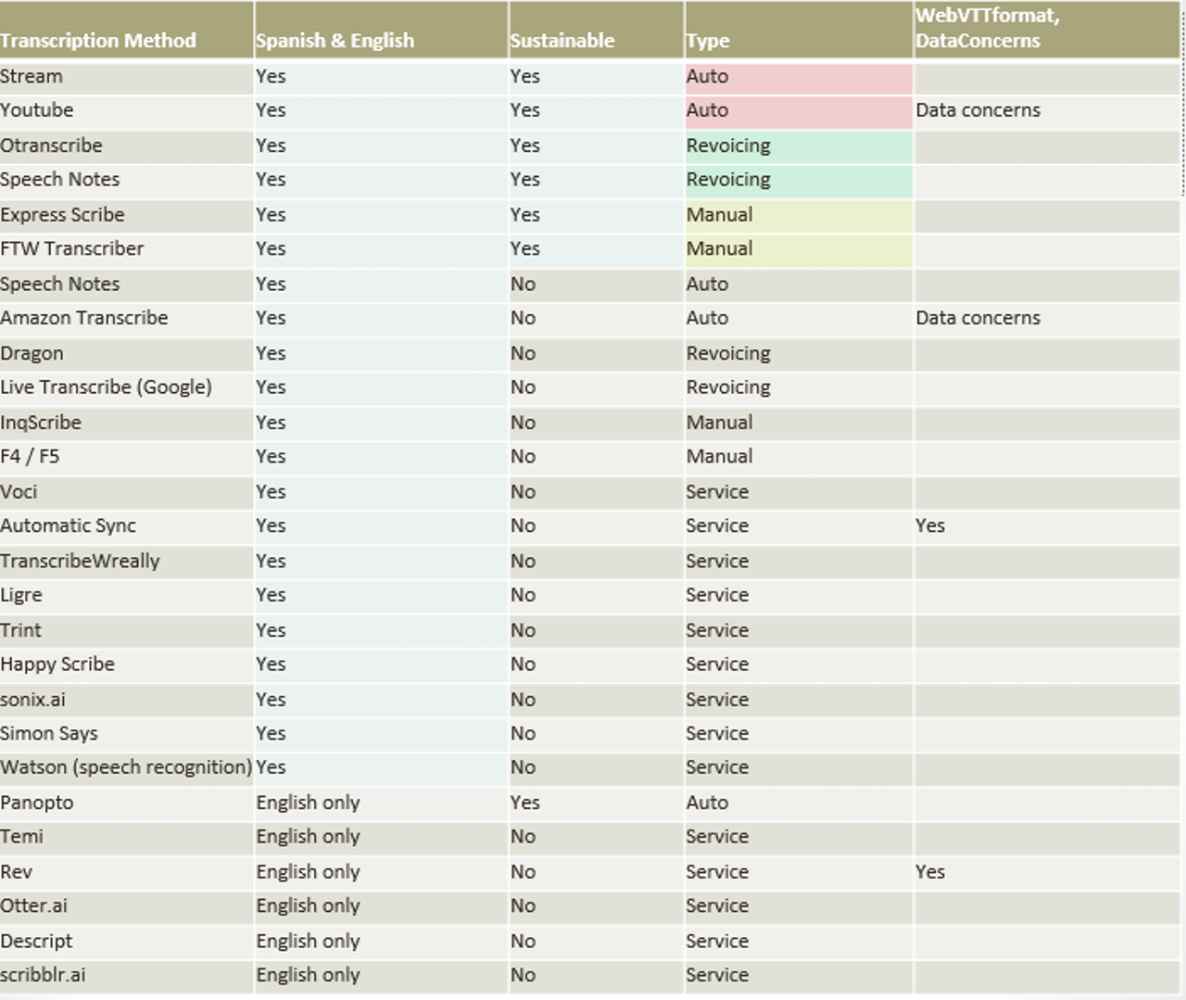
Of the 27 transcription methods reviewed, 21 had the ability to work with both Spanish and English (light blue, second column). However, only six (6) of these were sustainable (light blue, third column).
Of these six (6) options, two (2) automatically generated a transcription draft after users uploaded an audio or video file (pink, auto, fourth column). Two (2) others required users to play the audio through speakers or repeat the speech into a microphone (green, re-voicing, fourth column). Many of us are familiar with speech-to-text features on mobile phones, as well as similar features in platforms such as Zoom and Microsoft Teams. The remaining two (2) were manual, technologically aided transcription methods that have been used for quite some time in transcription research. These methods support the transcription process through features such as slowed audio playback, foot pedals, and the ability to replay segments as needed.
We chose to test one of each of these three types of technologically aided transcription methods: auto-generated, re-voicing, and manual. We chose Microsoft Stream instead of Youtube due to concerns about data. For the other categories, we chose SpeechNotes and ExpressScribe due to some additional features and user-friendliness.
In future posts, we will outline the process for testing these methods, as well as our findings.