150+
Cup inventory

The University of Transportation Center for Railway Safety at the University of Texas Rio Grande Valley supports railway partners with advanced testing infrastructure, instrumented experimentation, public data systems, and applied engineering development.
UTCRS has contributed technical insight to major incident review, maintains a large public bearing database, develops predictive failure methods, and extends testing into rail anchor mechanics and materials analysis.
Serialized Testing Inventory
150+
Cup inventory
100+
Cone assemblies
35
Defective cups
19
Defective cones
25
Defective rollers
5
Dynamic testers
Core Capabilities
UTCRS supports collaborative research and applied testing programs spanning freight bearing performance, rail anchor mechanics, instrumentation, data systems, automation, and materials analysis.
UTCRS operates a comprehensive freight bearing testing program supported by a serialized inventory of healthy and defective components, specialized test axles, calibrated instrumentation, and high-capacity loading systems.
The SBT is designed to replicate freight bearing operating conditions with tightly controlled loading and sensing for focused experimental work.
UTCRS operates four Four-Bearing Testers that accelerate data collection by testing four bearings on a shared axle under service-representative conditions.
UTCRS extends its mechanical testing capabilities beyond dynamic bearing systems into static calibration, cyclic loading, and track structure evaluation.
UTCRS combines mechanical testing, electronics design, software development, and data systems to create deployable research tools and industry-facing technologies.
UTCRS supports lubrication and material characterization through thermal analysis and standards-based laboratory methods useful for railway and adjacent industries.
Why Partners Work With UTCRS
UTCRS offers a rare combination of physical testing infrastructure, instrumented experimentation, public data stewardship, and in-house engineering development. For industry, agency, and research collaborators, that means one group can support the full path from hypothesis and hardware setup to data collection, analysis, and software delivery.
Engagement Areas
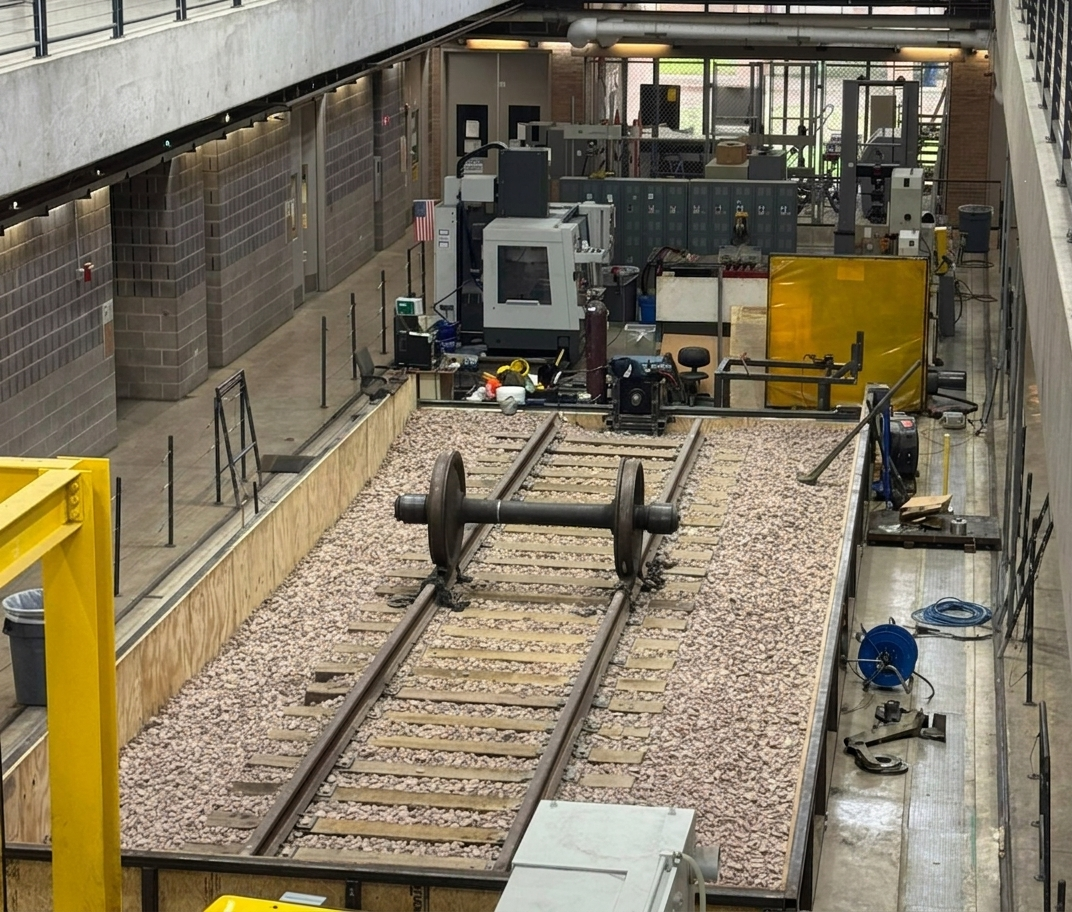
The University Transportation Center for Railway Safety (UTCRS) at The University of Texas Rio Grande Valley operates one of the most comprehensive freight bearing test facilities in the United States. With more than 20 years of operational history, UTCRS provides dynamic and static bearing evaluation, rail anchor testing, materials characterization, and applied technology development to public agencies and private industry partners.
Notable contributions include providing data and technical analysis to support congressional review and the National Transportation Safety Board (NTSB) investigation of the 2023 East Palestine, Ohio incident; maintaining the only publicly accessible freight bearing vibration and temperature database of its scale; developing world-first vibration-based formulas for predictive freight bearing failure detection; and establishing a research program to quantify rail anchor failure force thresholds through standardized testing.
The UTCRS operates a comprehensive freight bearing testing program supported by a serialized inventory of bearing components, purpose-built test axles, calibrated instrumentation, and high-capacity loading systems. All testing is conducted to AAR recommended guidelines and can be tailored to customer specifications for cooperative research programs.
The UTCRS component library includes upwards of 150 cups and 100 cone assemblies, available with both steel and polymer roller cages. The defective inventory provides approximately 35 cups with documented spall sizes ranging from 0.06 in² to 10 in², 19 defective cones with spall sizes from 0.5 in² to 5.6 in², and 25 defective rollers with surface damage ranging from minor pitting to spalls covering up to 50% of the roller surface area.
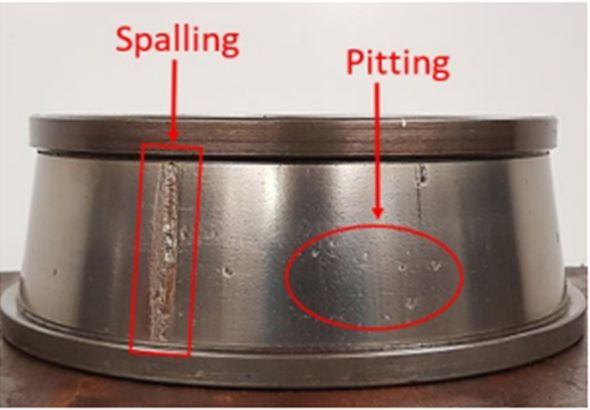
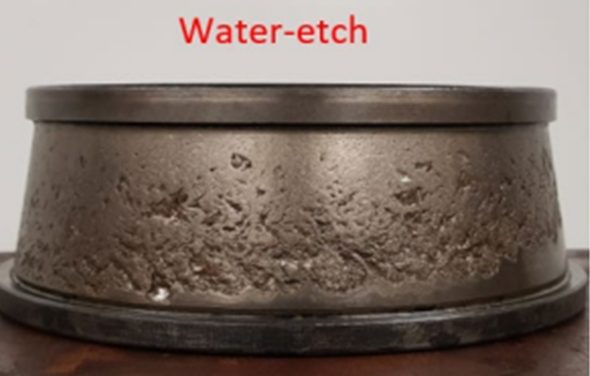
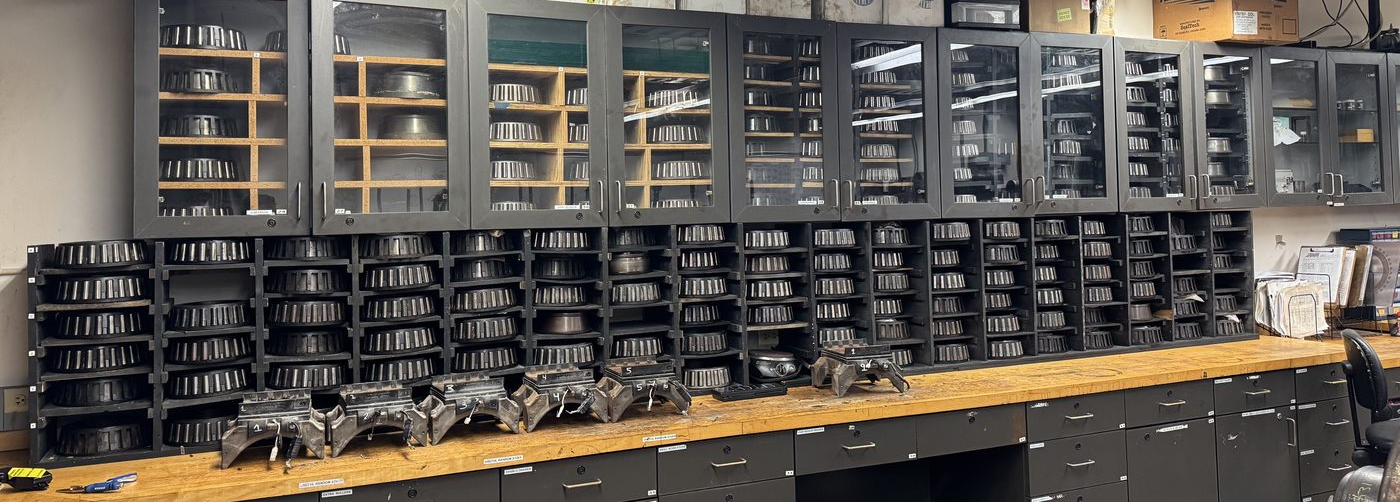
All components are tracked through a serialized slot-based storage system. Records for each slot document cone assembly type, defect characteristics, prior experiment participation, and accumulated mileage. In addition to bearing components, the inventory system encompasses load sensors, accelerometers, thermocouples, load cells, and structural frame hardware.
Bearings are assembled from the serialized inventory to AAR recommendations. To press bearings onto specialized test axles, UTCRS operates the only 300-ton hydraulic press south of San Antonio. Loading measurements are recorded for each assembly to verify that test axles meet AAR recommendations for service-equivalent use.
All UTCRS instrumentation and measurement tools are calibrated annually. Certificates of calibration are maintained on-site and are available upon request.
The SBT is a dynamic bearing test rig designed to accurately replicate the operating conditions a freight bearing experiences during revenue service. The system applies vertical, lateral, and impact forces representative of real-world loading.
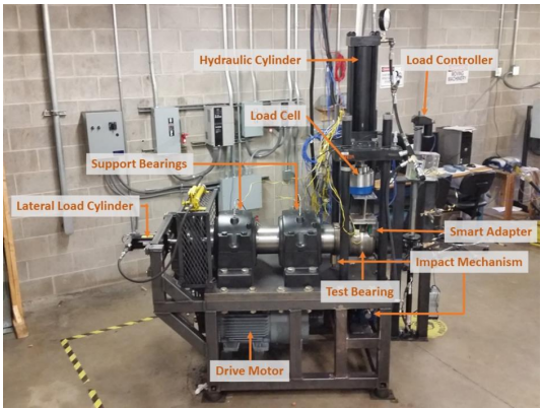
Recorded parameters include bearing vibration, temperature, applied forces, motor speeds, and motor power.
UTCRS operates four Four-Bearing Testers (4BT), each accommodating four bearings on a shared axle for simultaneous testing and accelerated data collection under service-representative conditions. Recorded parameters include bearing vibration, temperature, vertical load, motor speed, and motor power.
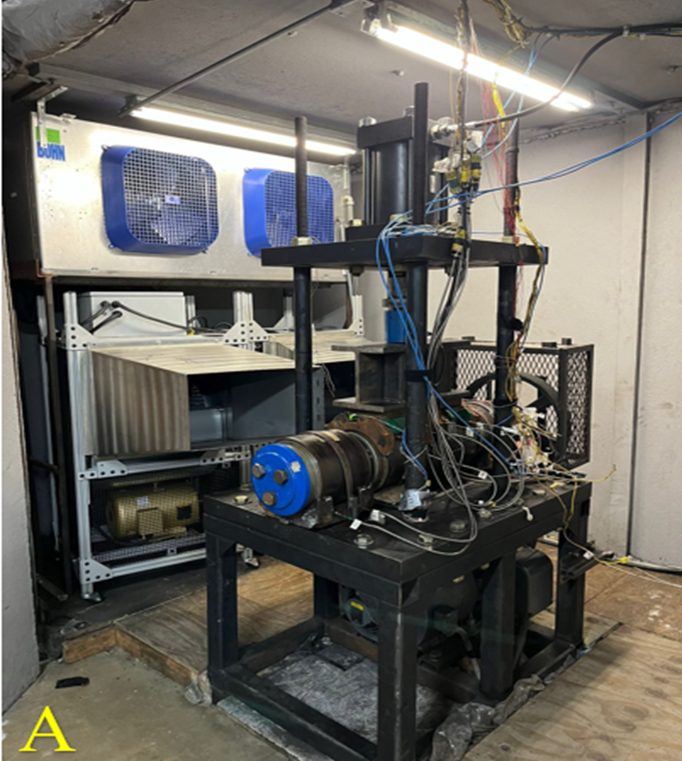
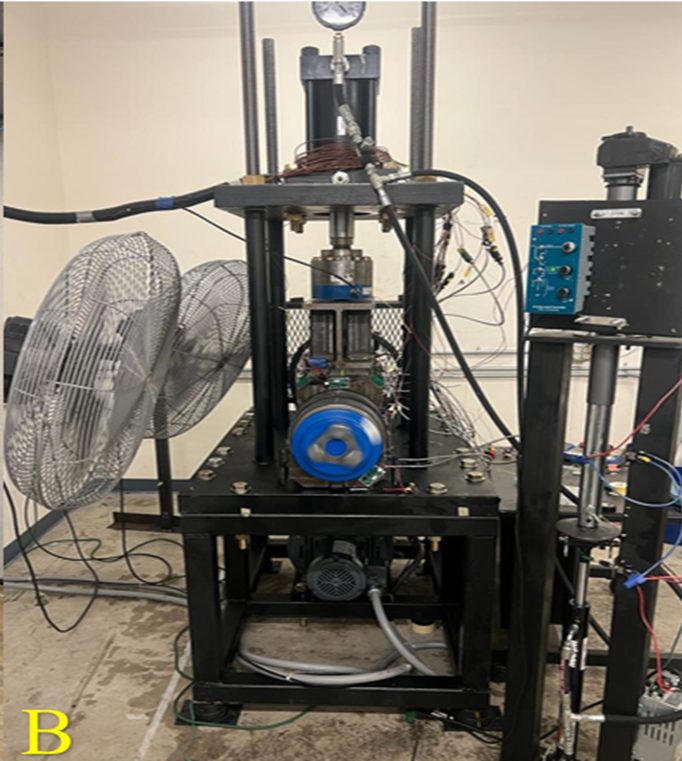
In addition to the dynamic testers, UTCRS operates two static bearing adapter testers intended for load sensor validation, calibration, and cyclic loading evaluation. Both systems match the 125% AAR-recommended loading capability of the dynamic testers and support ramping and cyclic load profiles under varying bearing adapter temperatures.
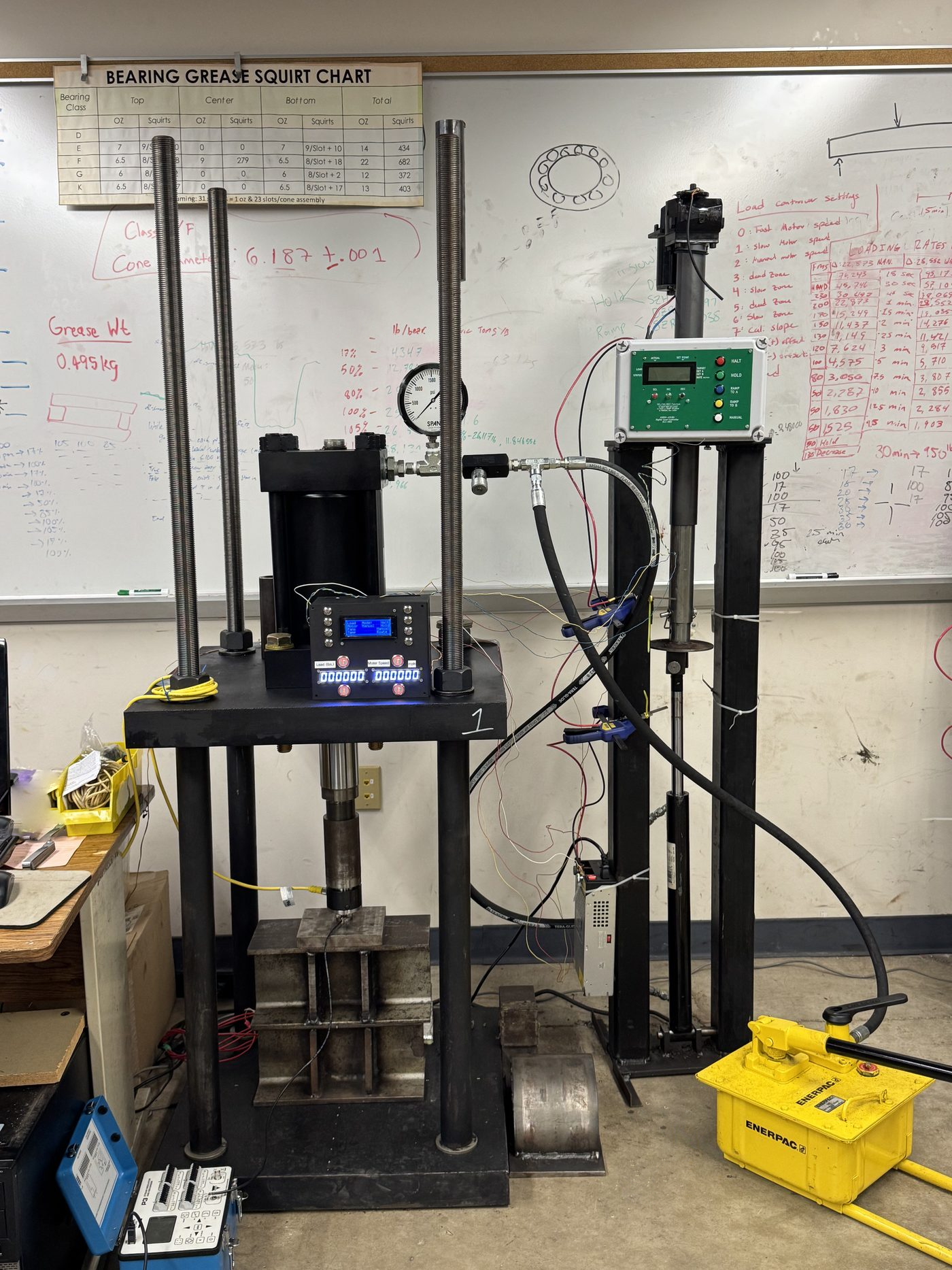
The Material Test System (MTS) is used for longevity testing of load sensor designs. Because current designs incorporate screws and welds, it is critical to evaluate how long these components can withstand service conditions. The MTS applies cyclic loading between loaded and unloaded states over many cycles, allowing researchers to examine the damage sustained and make design changes if necessary.
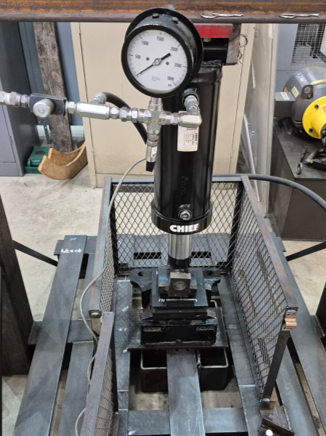
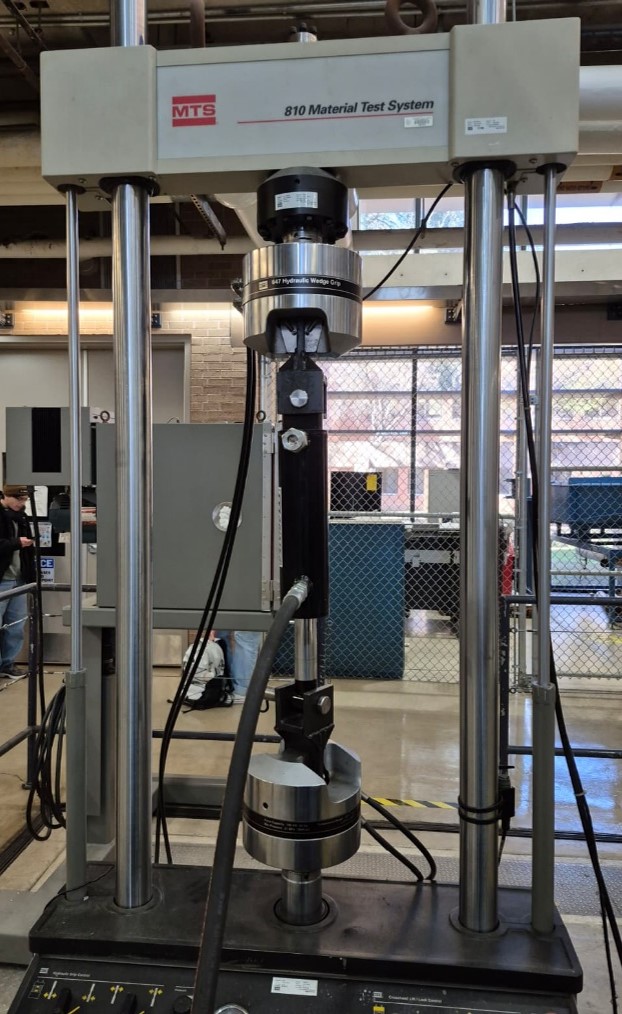
Two hydraulic cylinders are used to apply cyclic loading to the adapter: a large cylinder with a 6-inch bore applies the load, and a smaller cylinder with a 1.5-inch bore interfaces with the machine to provide the cyclic action.
UTCRS has developed a modified Track Panel Pull Test (TPPT) to evaluate rail anchor performance under conditions representative of continuous welded rail (CWR) service. The apparatus applies controlled tensile forces simulating those experienced in field installations and measures the response using a high-precision load cell in conjunction with a linear variable displacement transducer (LVDT).
The TPPT produces force-displacement data that establishes a reproducible, quantitative basis for evaluating rail anchor performance and identifying force thresholds associated with anchor failure. This capability supports research into track structure integrity and provides a standardized method for comparing anchor designs and installation practices.
The UTCRS maintains an in-house engineering program combining hardware development, electronics design, and software engineering to advance instrumentation, automation, and data accessibility for railway safety applications.
Electrical engineering researchers design and fabricate custom electronic solutions for test and sensing applications, including automated load controllers, wireless sensing devices, and sensor interface circuits. Key systems developed and deployed at UTCRS include:
Computer science researchers develop the public-facing data systems and analytical tools that extend UTCRS research to external partners. Current resources include:
Future development plans include incorporating real-time test data ingestion and automated plotting capabilities into the public database, enabling industry and research partners to access experimental results rapidly without waiting for post-test processing.
All software tools and resources are available through the UTCRS official website under Technology Transfer → Products.
UTCRS provides material characterization services with a focus on lubricating greases and a broad range of solid materials. The following instruments support condition assessment, quality evaluation, and failure analysis.
The Koehler Dropping Point Tester measures the dropping point of lubricating grease in accordance with ASTM standards. The instrument heats grease specimens in a calibrated oil bath using precision test cups to determine the temperature at which the first drop of material falls, providing a quantitative measure of thermal stability and upper service temperature limit. Applications at UTCRS include evaluating fresh-versus-field grease samples to assess degradation, supporting performance and quality assessments, and informing failure analysis of bearing lubricants.
Thermogravimetric Analysis measures changes in a material's mass as a function of temperature or time under controlled thermal conditions. In lubricating grease analysis, sequential weight-loss events identify the decomposition of lighter lubricant fractions followed by the breakdown of heavier components and additives.
The TGA is applicable across a broad range of material classes:
Differential Scanning Calorimetry measures the heat flow into or out of a sample relative to a reference as both are subjected to a controlled temperature program. At UTCRS, the DSC is used to determine the Oxidation Induction Time (OIT) of lubricating greases, a quantitative measure of oxidative stability, and to estimate thermal decomposition energy as an indicator of residual lubricant content.
In addition to OIT and decomposition work, the DSC characterizes melting points, crystallization kinetics, and glass transition temperatures, supporting performance and stability evaluation across a wide variety of engineering and research materials.