

 rotate(10)'/%3E%3Cpath d='M.038.113v.15l.15.088.15-.088v-.15L.188.025l-.15.088Z' stroke='%23c44900' stroke-width='.0375' transform='rotate(10)'/%3E%3C/svg%3E)
About Us
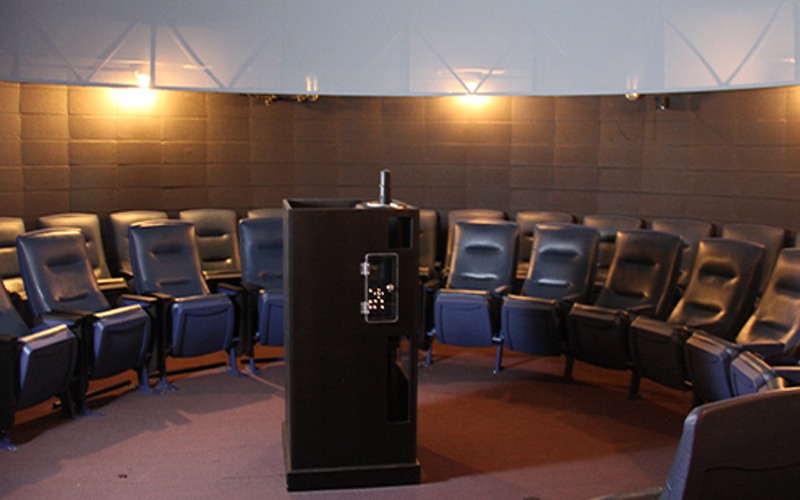
Here at the H-E-B Planetarium we have a plethora of movies ranging from the history of space to how black holes are formed. With a seating capacity of 40 students, the Planetarium is a wonderful addition to a school field trip. Make sure to check out the Film Showings for more information on our selection of films.
If you are unable to visit the Planetarium we can take your students to the moons of Jupiter or explore the night sky and its constellations right on your campus with The University of Texas Rio Grande Valley STAR Voyager Planetarium. The UTRGV Planetarium is proud to offer a stellar journey through the universe from the comfort and security of your own school for students at all grade levels with the STAR Voyager Dome. Moreover, if you are looking for a simple journey through the stars, the H-E-B Planetarium hosts Wednesday evening Telescope Viewings where everyone is welcome to come and take a peek into the vastness of space!
Mission for the H-E-B Planetarium
The University of Texas Rio Grande Valley (UTRGV) Planetarium, including the UTRGV STAR Voyager Planetarium, serves the rapidly growing, international, multicultural Rio Grande Valley community. The Planetarium creates, promotes, and disseminates learning and educational experiences through utilizing digitally enhanced visualization technology, surround sound and other innovative specialized equipment.
The Planetarium interactively motivates and attracts youth, as well as the entire family and our community, toward education by capturing their imagination while educationally exploring our universe through a wide range of disciplines—including but not limited to science, technology, engineering and mathematics. Additionally, the visualization laboratory provided by the Planetarium enhances university student learning outcomes through various educational areas and disciplines, preparing them for lifelong learning and leadership roles in the state, nation and global community.
Vision for the H-E-B Planetarium
The University of Texas Rio Grande Valley (UTRGV) H-E-B Planetarium inspires the local community; university faculty, staff and students; and future generations to spark an interest and appreciation for Astronomy.
The History of the Planetarium
In 1956, as the Space Race with the Soviet Union was heating up, Pan American College completed the first building on its new West Campus, an observatory. It housed a relatively small 17 inch reflecting telescope belonging to a professor. A few years later, in 1963, the planetarium was built for the expanding Astro-Science program.
This little building housed an old Spitz dodecahedron-style projector system and stretched-cloth inner dome, all donated by the closing Harlingen Air Force Base with assistance from the Moonwatch Division of the Smithsonian Astro-physical Observatory. It had been among the first generations of Spitz projectors, used to teach how to navigate by the stars. However, someone in the Air Force decided to paint it blue, wiping out a great many of the tiny pinhole stars.
Despite this, the planetarium was a popular attraction throughout the 1960s. Schools would send bus after bus filled with their students to learn about the sky. Students of the college would be required to visit the dome for astronomy courses. Presenting at the planetarium was even a degree requirement for some.
Then, in 1973, the Astro-Science program was discontinued for lack of enrollment. The attendance of the planetarium waned dramatically over the next two decades, but it remained open and used by astronomy classes. In 1995, the observatory, the oldest building on UTPA’s campus, was torn down to make room for the new science complex. The planetarium remained. It received a face lift to match the theme of the new science complex but the inner workings remained in tact. However, it fell into disuse, little more than a glorified storage closet.
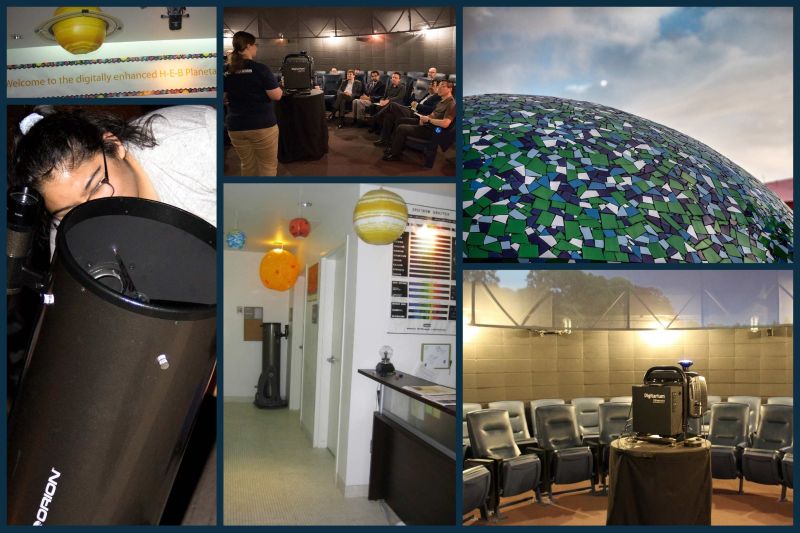
In the spring of 2008, the planetarium went through another major renovation. This time, the inner workings were finally updated. The old mechanical projector was replaced by a new Digitalis digital projector system, controlled by a handheld remote as opposed to the old desk-sized console. This new system could be easily packed into a single padded box and, combined with a brand new STAR Voyager dome, could be taken to the local schools that often couldn’t afford to come to the university.
In 2012, there was another round of renovations. The original projection system was replaced by a new Spitz NanoSeam dome.
Today, the UTRGV Planetarium boasts two projector systems, one dedicated to portable use and a top-of-the-line Digitalis projector system in the dome theater itself. Both able to back up the other in case of technical issues. Recently, the planetarium implemented a Bose sound system and new control methods, an ipad and xbox controller, to work with the latest planetarium software to take viewers beyond the boundaries of our galaxy. When it reopened in 2008, it had just three videos. It now has a catalog of around 25 videos, including a few made in-house. At request, attendees can learn about black holes, water in the solar system, the Hubble Space Telescope, even about dinosaurs or the human body. Or, should they want a more interactive experience, a staff member can take them on a tour of whatever astronomy topic they’re curious about… as long as it’s in the visible spectrum.