By News and Media Relations
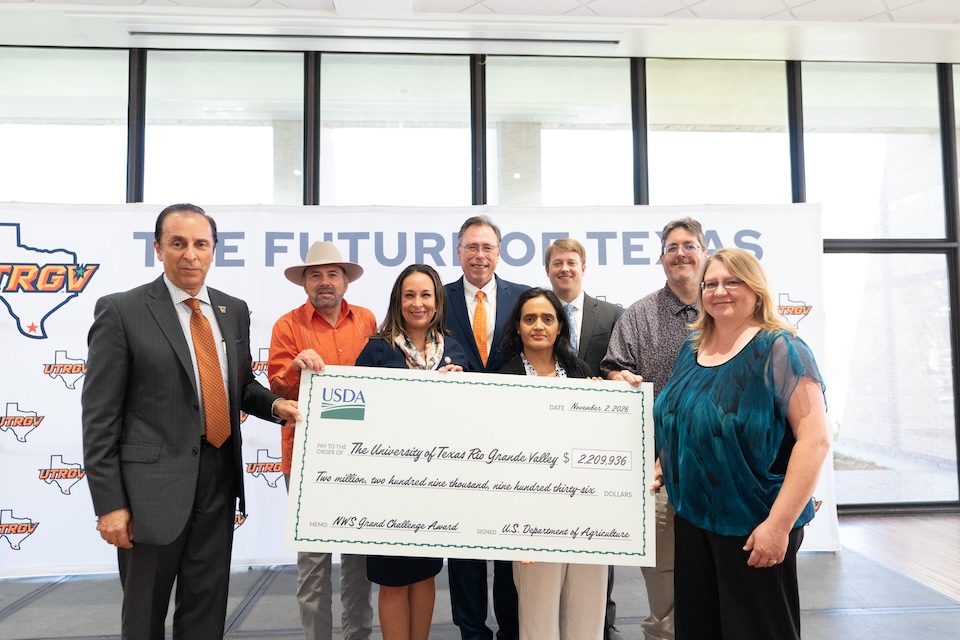
RIO GRANDE VALLEY, TEXAS – NOV. 2, 2026 – The University of Texas Rio Grande Valley celebrated a $2.2 million award from the U.S. Department of Agriculture on Monday to develop drone-based technologies that could help detect New World screwworm infestations and protect livestock and wildlife across South Texas.
U.S. Rep. Monica De La Cruz joined Dan Hunter, Texas state executive director for USDA’s Farm Service Agency, and university leaders at UTRGV’s Edinburg Campus for a check presentation celebrating the award through USDA’s New World Screwworm Grand Challenge.
UTRGV’s project is among 40 selected nationwide to receive a combined total of about $105 million to advance screwworm detection, control and response capabilities. Launched in January 2026 by USDA’s Animal and Plant Health Inspection Service (APHIS), the challenge invited proposals from universities, businesses, government agencies and nonprofit organizations to help prevent the pest’s northward spread. The initiative supports USDA’s five-pronged strategy to protect producers and the nation’s food supply.
“As The Valley's University, we have a responsibility to address the challenges that directly affect our region,” UTRGV President Guy Bailey said. “This investment reflects the expertise of our faculty and the important role UTRGV plays in developing innovative solutions to protect South Texas agriculture, livestock and wildlife. Through research like this, we are not only serving the needs of our communities but also contributing to a national effort to safeguard our agricultural resources.”
The university will draw on its research expertise and relationships with regional producers to develop practical tools that address South Texas needs and strengthen national screwworm preparedness.
De La Cruz said the funding will provide meaningful support to the community while strengthening local agricultural initiatives.
“It brings me such joy to match the talent that we have at UTRGV with federal dollars to make a true difference in our community. That’s why I proudly stand here to announce $2.2 million dollars from the USDA New World Screwworm Grant Challenge,” De La Cruz said. “I’m proud to work with the university and be able to bring this funding back home to make a real difference.”
Hunter emphasized that the research underway at NWS is intended to help address the growing number of newly reported cases.
“There were 226 applicants for the grant challenge competition and there were only 40 rewarded,” he said. “The work that’s going to be done here is not just about the innovation, it’s the technology you’re going to use. This is about creating better tools for the future.”
The two-year project is led by principal investigator Dr. Sarah Mays Maestas, an assistant professor in UTRGV’s School of Integrative Biological and Chemical Sciences. The grant was submitted and awarded through the university’s Center for Vector-Borne, Zoonotic and Emerging Diseases.
Co-principal investigators include Dr. Andrea Contina, assistant professor, and Dr. Pushpa Soti, associate professor, both in the same school, and Dr. Christopher Vitek, associate professor and director of the center. The team will develop detection methods and habitat models to support APHIS surveillance, prevention and response efforts.
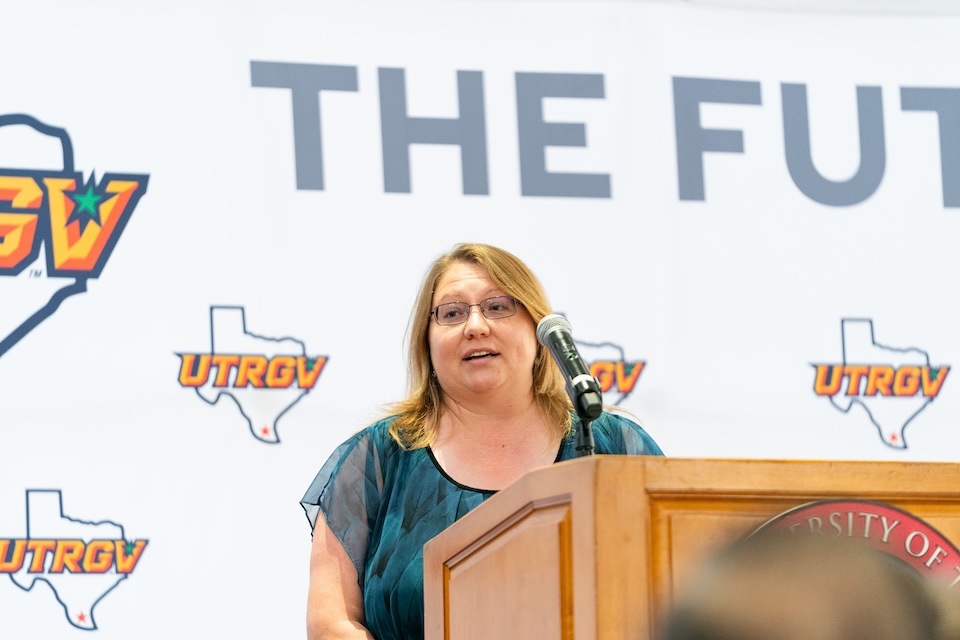
“This award provides significant support for us to address a threat to animal health and livestock producers at both the regional and national level,” Maestas said. “We hope to be able to supply new tools to aid in the fight against New World screwworm.”
DEVELOPING TOOLS FOR EARLY DETECTION
Traditional screwworm surveillance relies on examining animal wounds for larvae and using traps to detect adult flies. Those methods can be especially challenging when monitoring wildlife, Maestas said.
The project will explore ways to monitor livestock and wildlife across larger areas. Researchers will test thermal imaging and machine learning to identify potential infestations, as well as animals with wounds that may require preventive treatment. The team also will evaluate drones for releasing sterile flies and delivering animal treatments.
Another focus is understanding how common South Texas vegetation shapes screwworm habitat, including whether compounds released by certain plants attract the flies.
Using high-resolution drone imagery and other environmental data, researchers will develop habitat models to identify areas likely to support adult screwworm flies. The findings could help agencies target trapping, monitoring and sterile fly releases more effectively.
PROTECTING SOUTH TEXAS
The Lower Rio Grande Valley is a critical region for screwworm preparedness because cross-border livestock movement, wildlife migration and favorable environmental conditions create opportunities for reintroduction.
“South Texas has the potential to be significantly impacted by the re-incursion of New World screwworm, as livestock production is a source of income for many individuals,” Maestas said. “Wildlife can also be heavily affected. The goals of this research are to safeguard animal health by providing tools to support and improve screwworm monitoring and control efforts.”
The project aims to support livestock producers, wildlife managers and animal health agencies, including USDA-APHIS and the Texas Animal Health Commission.
For more information about New World screwworm and USDA’s prevention and preparedness efforts, visit screwworm.gov.
UTRGV — The Valley’s University
The University of Texas Rio Grande Valley is The Valley’s University, deeply rooted in the communities it serves and committed to improving lives and expanding opportunities across the region. From keeping a high-quality education affordable and expanding healthcare services to preparing the workforce, advancing research, and supporting economic growth, UTRGV is putting its people, expertise and resources to work for the Rio Grande Valley. The Valley and UTRGV rise together, building a healthier, stronger and more prosperous region.