By Heriberto Perez–Zuñiga
RIO GRANDE VALLEY, TEXAS – OCT. 27, 2026 – Waiting for pain to go away on its own may seem reasonable. For some people, however, that delay can mean giving up activities, changing how they move or letting a manageable problem become a greater limitation.
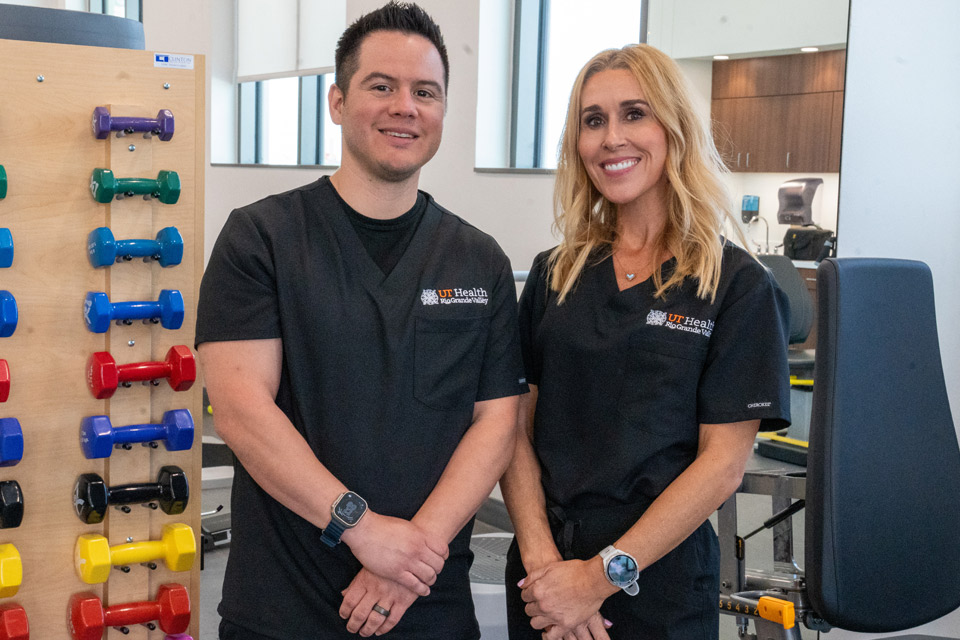
UT Health RGV physical therapists Alex Alejandro and Desiree French want people to know they do not have to wait until pain sidelines them to seek help.
During National Physical Therapy Month in October, Alejandro and French are encouraging Rio Grande Valley residents to see physical therapy as a resource for more than recovery. It can also help them address problems early, stay active and continue doing the things that matter to them.
MORE THAN EXERCISES
Physical therapy is sometimes viewed as simply a series of exercises prescribed after an injury or surgery. Alejandro said much more happens during a therapy session.
"There is a lot of clinical reasoning behind what we do," Alejandro said. "We’re constantly assessing how someone moves, how their strength and mobility are progressing, how they respond to different activities and what may still be limiting them."
For him, one of the most rewarding parts of the job is understanding what each patient wants to return to.
"One of the things I enjoy most about my job is that no two days are exactly the same," Alejandro said. "I really enjoy figuring out what matters to each patient and building their rehabilitation around getting them back to it."
French said physical therapy also helps people address problems before they become more limiting.
"We can help people recover from injuries, but we can also help identify movement problems, address weakness, improve strength and mobility, prevent future injuries and help people stay active throughout their lives," French said.
Patients do not need to wait for a major injury or surgery to seek care. French works with people experiencing chronic back or knee pain, athletes recovering from injuries and runners with recurring problems. As a Certified Running Rehabilitation Specialist, she helps runners safely return to training.
"Anyone who wants to move better can potentially benefit from physical therapy," French said.
BUILDING CONFIDENCE
Pain can lead people to avoid activities they enjoy. Physical therapists help patients gradually rebuild strength, mobility and confidence while learning what their bodies can handle.
Alejandro said pain does not always mean someone needs to stop moving.
"Part of our job is determining what movements and activities are appropriate and finding ways to gradually build their tolerance and confidence again," he said.
Treatment may include strength and mobility exercises, movement retraining, education and other techniques tailored to each patient’s needs.
For French, education is an important part of that process.
"The goal isn’t necessarily to make sure you never feel pain," French said. "Our goal is to help you understand it, manage it and get back to living your life."
Care begins with an evaluation that looks beyond the location of the pain. Therapists ask what brought patients in, which activities have become difficult and what they want to return to. They may also assess strength, mobility, balance, coordination, movement and functional performance.
Alejandro recommends an evaluation when a problem interferes with exercise, work, sleep, sports or everyday tasks. He also encourages people to seek care for recurring problems, increasing weakness, loss of mobility or the repeated need to modify their activities because of the same issue.
"Sometimes getting evaluated earlier allows us to identify what is going on and address it before it becomes a bigger limitation," Alejandro said.
As physical therapy evolves, therapists are increasingly using objective measurements and technology to track progress.
At UT Health RGV, Alejandro uses force plates and digital strength testing to measure progress and identify differences between limbs. These tools can help determine whether a patient is ready to return to everyday activities, running or competitive sports.
"I try to go beyond simply asking whether pain has improved or whether enough time has passed," Alejandro said. "I use objective strength and performance testing, movement assessment, current research and clinical judgment to identify deficits that may not always be obvious during a traditional examination."
French said those assessments are part of a broader approach to care.
"We’re increasingly looking at the whole person, their goals, lifestyle, activity level and long-term health, not simply the body part that hurts," French said.
For both therapists, the aim is to help patients feel capable of moving again and give them tools to stay active after therapy ends.
"We’re not just helping someone recover from an injury," French said. "We’re helping them build the strength, confidence and knowledge to keep moving for the rest of their lives."
To learn more about rehabilitation services at UT Health RGV, visit UTHealthRGV.org.
UTRGV — The Valley’s University
The University of Texas Rio Grande Valley is The Valley’s University, deeply rooted in the communities it serves and committed to improving lives and expanding opportunities across the region. From keeping a high-quality education affordable and expanding healthcare services to preparing the workforce, advancing research, and supporting economic growth, UTRGV is putting its people, expertise and resources to work for the Rio Grande Valley. The Valley and UTRGV rise together, building a healthier, stronger and more prosperous region.