By Heriberto Perez–Zuñiga
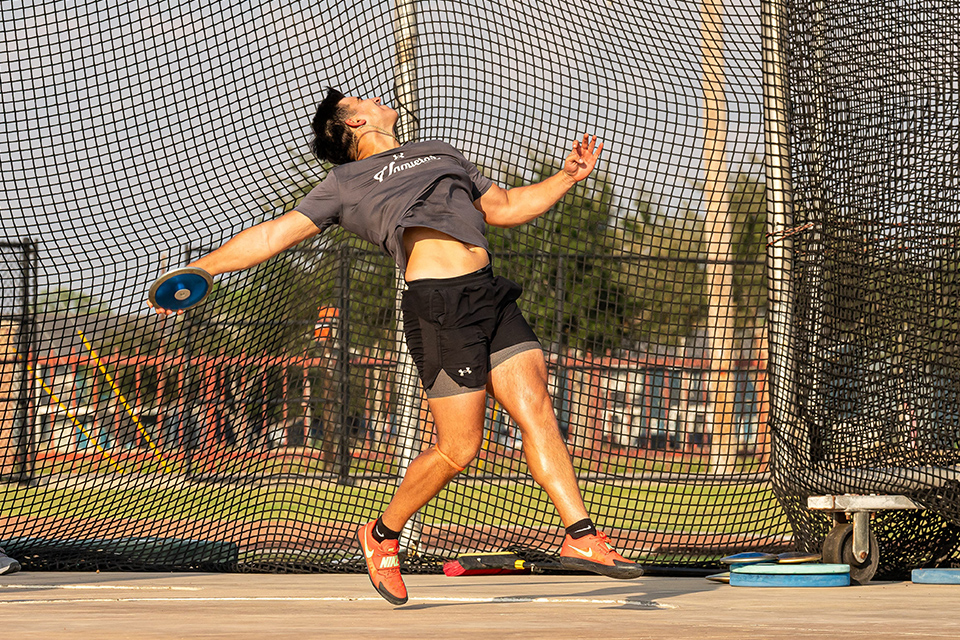
RIO GRANDE VALLEY, TEXAS – JULY 22, 2026 – Success is built through discipline, repetition and countless hours of preparation. For a discus thrower, the winning throw is decided long before stepping into the circle, shaped by early mornings in the weight room, thousands of practice throws and the resilience to improve after every missed mark.
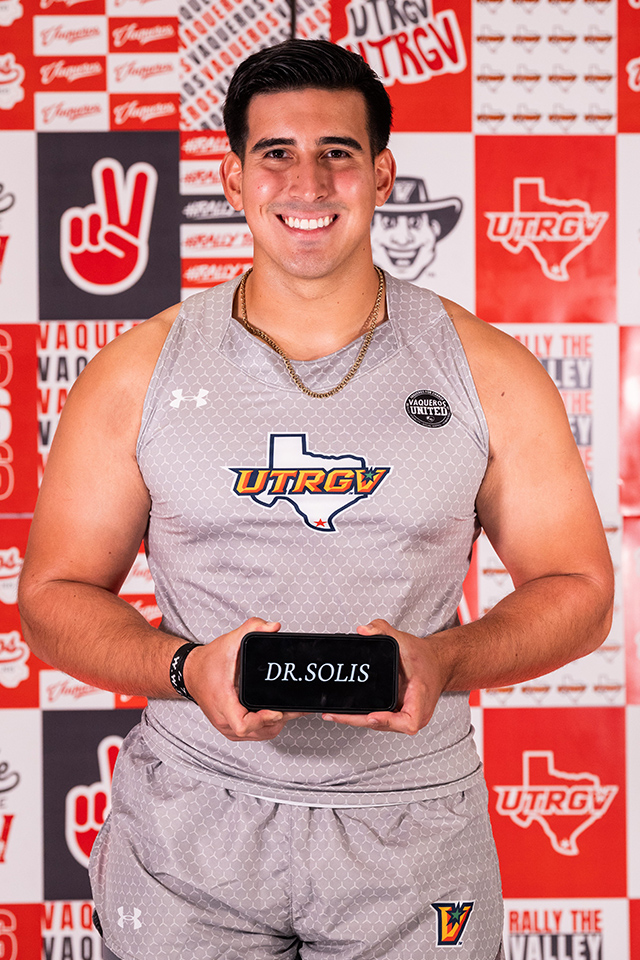
Tristan Solis learned those lessons in the field.
Now, the former UTRGV Track and Field student-athlete, Luminary Scholar and incoming member of the UTRGV School of Medicine Class of 2030 sees that becoming a physician has required much the same commitment.
Long before the scholarships, athletic honors and medical school acceptance letter, there was an 8-year-old boy from Rio Grande City sitting in an emergency room after a severe allergic reaction, frightened by what was happening around him.
Then a physician walked into the room.
"The comfort from the physician made me feel so much better about myself," Solis said.
That experience stayed with him. So did the countless hospital visits that followed as he accompanied his grandfather through cancer treatments, watching physicians care for someone he loved.
"That gave me more exposure and reinforced why I wanted to pursue medicine," he said.
FIRST GENERATION
For Solis, medicine had always been the destination. Figuring out how to get there was the challenge.
As the first person in his family to attend college, he entered the journey without a roadmap.
Programs like the Joint Admission Medical Program (JAMP) helped him navigate the medical school application process while preparing him for one of his biggest hurdles: the Medical College Admission Test (MCAT).
"JAMP helped me understand the intricacies of applying to medical school," Solis said. "Preparing for the MCAT taught me how to study, prepare and overcome challenges."
Whether traveling to competitions or spending hours in the throwing circle, Solis learned to maximize every minute of the day. His years as a biology major and Division I track and field student-athlete prepared him in ways few classrooms could.
Balancing practices, workouts, competitions and rigorous science courses demanded discipline every day – qualities he now carries into medical school. As a student-athlete, Solis earned the Lou Hassel Award for having the highest GPA during the academic year.
"Being a student and an athlete is very time-consuming," he said. "Medical school is going to be hard and rigorous, but I feel like those experiences prepared me for demanding situations."
Despite never having the opportunity to finish high school themselves, Solis said his parents worked hard to provide him with the resources he needed to reach his goals.
"I'm the first person to go to college," Solis said.
Soon, he will also become the first physician in his family.
"It's a step in the right direction, changing the trajectory of my family," he said. "My parents didn't even finish high school. With their support, it just means a lot."
VALLEY ROOTS
As a UTRGV Luminary Scholar, Solis earned one of the university's highest scholarship distinctions. The program covers education-related expenses through medical school in exchange for a commitment to practice in the Rio Grande Valley after graduation, enabling him to pursue his dream while giving back to the community that shaped him.
Solis plans to specialize in orthopedic surgery, with the goal of one day opening his own clinic in the Rio Grande Valley and returning to UTRGV Athletics as part of the Vaqueros sports medicine team.
This fall, Solis will join 55 classmates as members of the UTRGV School of Medicine Class of 2030. Selected from more than 5,000 applicants, the 56-member class is the largest in school history to come from the Rio Grande Valley, with 63% of students calling the region home.
Dr. Everardo Cobos, dean of the UTRGV School of Medicine, said the Class of 2030 continues the school's mission of preparing physicians who understand the unique healthcare needs of the communities they serve.
"Every new class represents another step toward improving the health of the Rio Grande Valley," Cobos said. “We are proud to welcome the Class of 2030 as they begin a journey that will transform not only their own lives, but the lives of the patients and communities they will one day serve."
For Solis, that journey begins this Saturday as he prepares to don his white coat for the first time at the UTRGV School of Medicine White Coat Ceremony, which symbolizes students’ formal entry into the medical profession and their commitment to compassionate, ethical patient care.
"It feels very surreal," Solis said. "Getting to this point has been so rewarding because it's a hard path. I think putting on a white coat is going to make everything feel real."
Like every successful throw, the moment has been years in the making.
Soon, Solis will step into a different arena – not as a student-athlete chasing a personal best, but as a future physician preparing to care for the community that first inspired his dream.
ABOUT UTRGV
Celebrating its 10th anniversary during the 2025-26 academic year, The University of Texas Rio Grande Valley is on a mission to serve the Rio Grande Valley and beyond via an innovative and unique education dedicated to student access and success. As one of the country’s largest Hispanic-Serving Institutions and Seal of Excelencia-certified university, UTRGV has earned national recognition for its academic excellence, social mobility, and student success since opening in fall 2015. Ranked among the Best Colleges for Your Tuition (and Tax) Dollars in 2025 by Washington Monthly (No. 7 nationally; No. 1 in Texas), UTRGV continues to break enrollment records, launch new academic and athletics programs, and progress toward achieving R1 research status. Additionally, UTRGV holds the Carnegie Community Engagement Classification, awarded in 2020 and 2025, reflecting its commitment to strengthening community ties and addressing local challenges.
The only university in Texas with schools of Medicine and Podiatric Medicine, UTRGV’s regional footprint spans South Texas — with locations, teaching sites, and centers established in Edinburg, Brownsville, Rio Grande City, McAllen, Weslaco, Harlingen, Laredo, Port Isabel and South Padre Island.