By Heriberto Perez–Zuñiga
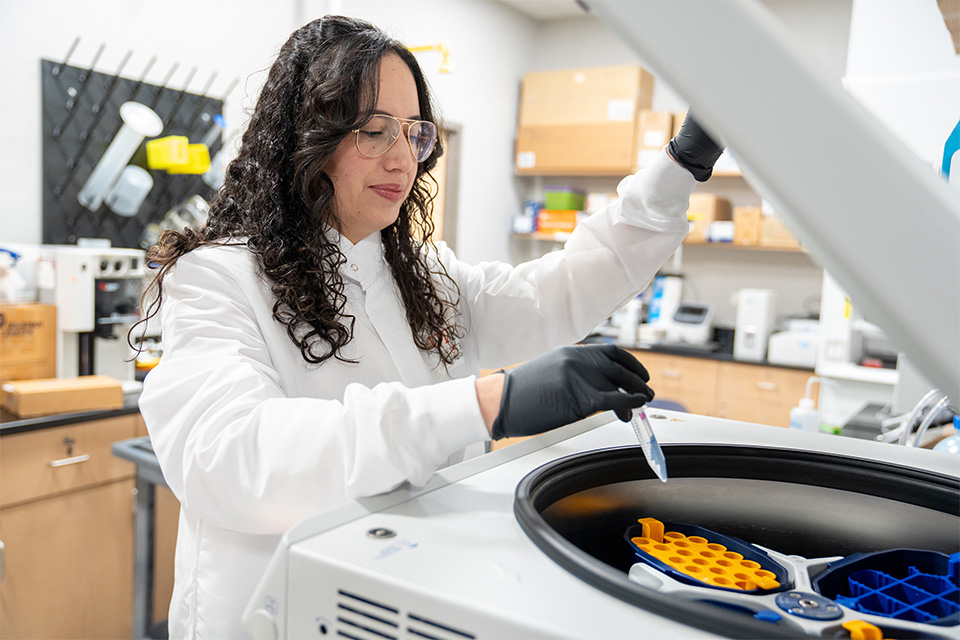
RIO GRANDE VALLEY, TEXAS – JULY 1, 2026 – In a laboratory at the UTRGV School of Medicine, Dr. Karla Perez looks at cellular data with the precision of a rocket scientist, which, until recently, is exactly what she was.
Originally from El Paso, she began her career as a research engineer in aerospace before pivoting to biomedical science, earning her Ph.D. in bioengineering and later completing postdoctoral training in tumor biology.
“What inspires me about cancer research specifically is the combination of intellectual depth and urgency," said Perez, a postdoctoral fellow. “These are hard problems, and they matter in the most concrete way possible."
That urgency was recently recognized on a national stage by one of the nation’s most respected scientific organizations. Perez’s work on the molecular drivers of liver cancer progression earned her the prestigious AACR (American Association for Cancer Research) Early-Career Scholar Award at the 2026 Annual Meeting in San Diego.
The award recognizes promising early-career scientists and supports the next generation of cancer researchers working to advance scientific discovery and improve patient outcomes.
Perez said the honor carries particular significance as her work is driven by a deep sense of obligation to underserved South Texas communities.
“Honestly, what it means most is that the questions we’ve chosen to pursue are recognized as important,” Perez said. “Early-career research can feel uncertain, so recognition from an organization as respected as the AACR is genuinely motivating. Professionally, it opens doors – it creates visibility for my research program, strengthens my ability to pursue funding and collaborations and signals to potential partners and institutions that this work is worth investing in.”
THE RGV IMPACT
According to the American Cancer Society, liver cancer rates have more than tripled since 1980. The primary risk factors – diabetes, obesity and chronic stress –are conditions that disproportionately affect residents of the Rio Grande Valley.
"My research focuses on a class of molecules called long non-coding RNAs (lncRNAs) and the role they play in driving the progression from fatty liver disease to liver cancer, a transition that is increasingly common as rates of obesity and diabetes rise," Perez said. "These molecules act as powerful regulators of gene expression, essentially controlling whether cancer-promoting programs get switched on or off."
Perez’s research aims to identify which lncRNAs contribute to disease progression so they can be targeted through future therapies.
"The broader hope is that this research contributes to earlier detection strategies and to a new class of RNA-based treatments that are more precise than conventional approaches, ultimately improving outcomes for patients who today have very few options," she said.
MENTORSHIP AND GROWING ROOTS IN THE VALLEY
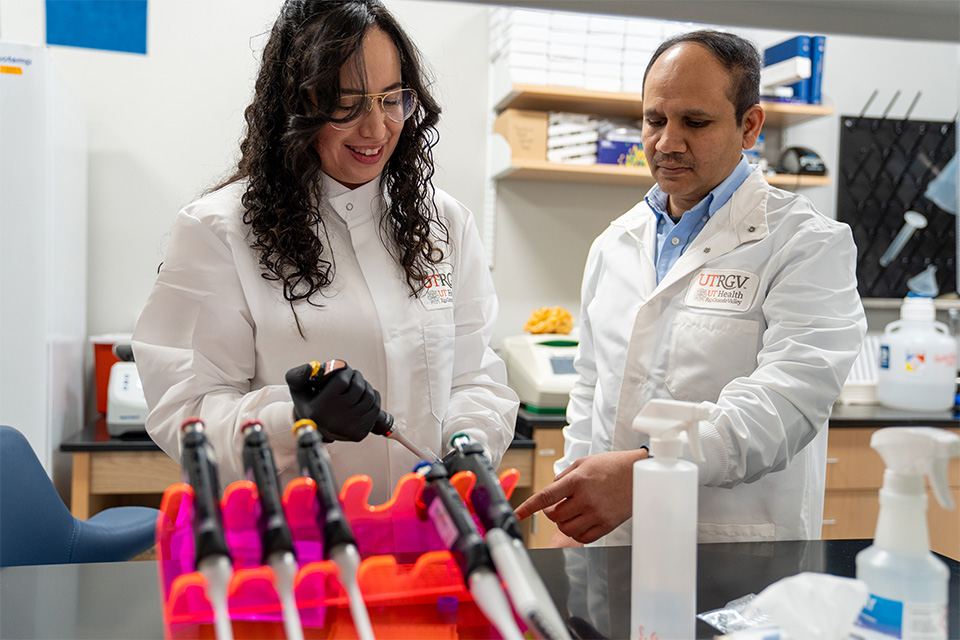
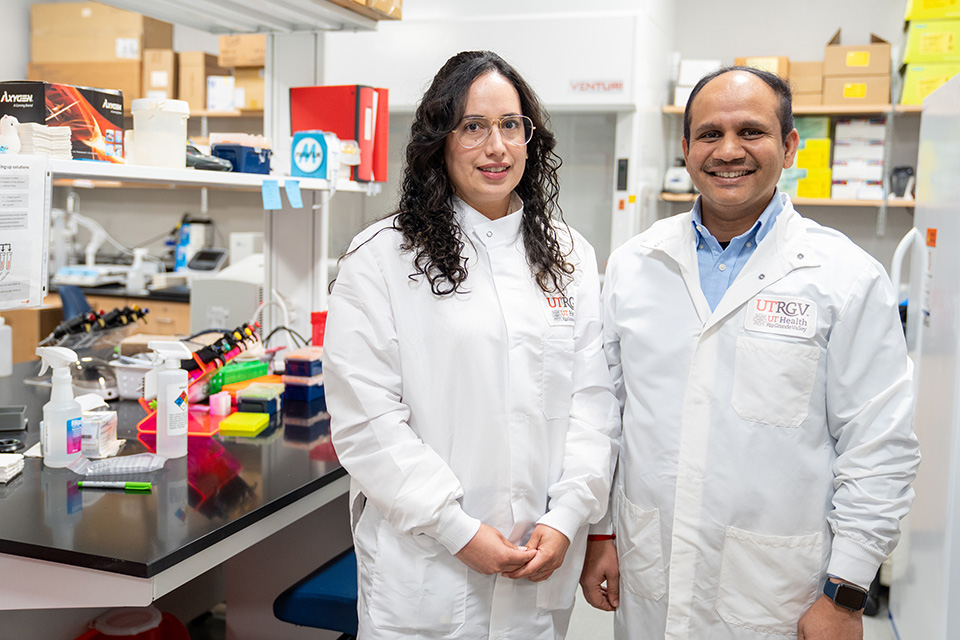
Perez’s breakthroughs contribute to a rapidly growing body of oncology research at UTRGV under the mentorship of Dr. Shrikanth Gadad, associate professor of medicine and oncology, and Dr. Subhash Chauhan, director of the South Texas Center of Excellence in Cancer Research.
Gadad’s lab studies how changes in gene activity influence the development and progression of diseases like cancer, helping researchers better understand how tumors grow and spread.
"We’re interested in how gene expression is regulated in ways that drive disease, and what we can learn from those patterns to better understand, detect and ultimately treat them," Gadad said.
Conducting this high-level research in the Valley has been especially rewarding for Perez, who credits the university’s supportive environment.
"UTRGV has provided an environment where I've been able to build a research program with real independence and real resources," Perez said. "I'm deeply grateful for the support I've received at every level of this institution. Dr. Chauhan has consistently looked for ways to provide resources and remove barriers, and Dr. Everardo Cobos [dean of the UTRGV School of Medicine] has been a champion for growing research capacity here in meaningful ways. And my mentor, Dr. Gadad, has been an unwavering source of guidance and encouragement throughout this process."
Gadad said mentorship is one of the most important responsibilities of scientific leadership.
"Mentorship is irreplaceable," Gadad said. "You can teach techniques and you can assign papers, but developing a scientist's instincts, their ability to ask the right question, to troubleshoot creatively and to persist through setbacks, that happens through relationship and proximity."
He added that Perez’s national recognition shines a spotlight on both her individual potential and the thriving research environment at the university.
"It's genuinely gratifying," Gadad said. "As a mentor, one of your primary goals is to help the people in your lab develop into independent scientists who can make their own mark on the field and recognition like this from the AACR is a strong signal that that's happening."
INSPIRING THE NEXT GENERATION
The expansion of advanced research training at UTRGV is creating entirely new pathways for local students and young scientists who may have once believed a career in research required leaving the region.
"UTRGV's growth as a research institution means that students and trainees who grew up here no longer have to leave to pursue serious scientific careers," Gadad said. "That matters enormously, both for the individuals and for the long-term research capacity of the region."
Perez hopes the national spotlight inspires future researchers from South Texas and other border communities to see a clear place for themselves in biomedical science.
“When a researcher based at UTRGV receives national recognition, it signals to students, trainees, and early-career scientists in this region that world-class science can be done here, and that research careers are within reach for them,” Perez said.
For Gadad, that shift in perspective is the ultimate goal of expanding the university's cancer research footprint.
“If you're from this region, from the Valley, know that the work being done here is real, it is nationally recognized and there is a place for you in it,” he said.
ABOUT UTRGV
Celebrating its 10th anniversary during the 2025-26 academic year, The University of Texas Rio Grande Valley is on a mission to serve the Rio Grande Valley and beyond via an innovative and unique education dedicated to student access and success. As one of the country’s largest Hispanic-Serving Institutions and Seal of Excelencia-certified university, UTRGV has earned national recognition for its academic excellence, social mobility, and student success since opening in fall 2015. Ranked among the Best Colleges for Your Tuition (and Tax) Dollars in 2025 by Washington Monthly (No. 7 nationally; No. 1 in Texas), UTRGV continues to break enrollment records, launch new academic and athletics programs, and progress toward achieving R1 research status. Additionally, UTRGV holds the Carnegie Community Engagement Classification, awarded in 2020 and 2025, reflecting its commitment to strengthening community ties and addressing local challenges.
The only university in Texas with schools of Medicine and Podiatric Medicine, UTRGV’s regional footprint spans South Texas — with locations, teaching sites, and centers established in Edinburg, Brownsville, Rio Grande City, McAllen, Weslaco, Harlingen, Laredo, Port Isabel and South Padre Island.