By Heriberto Perez–Zuñiga
RIO GRANDE VALLEY, TEXAS – JUNE 22, 2026 – Serious health conditions often develop quietly, long before patients realize something is wrong. Hypertension, or high blood pressure, is often called a “silent killer,” because it can go undetected for years until serious complications appear, such as stroke, heart disease and kidney damage.
While physicians have long used the eye to detect signs of disease, new imaging technologies are helping researchers identify those changes earlier than ever before, even during routine eye exams.
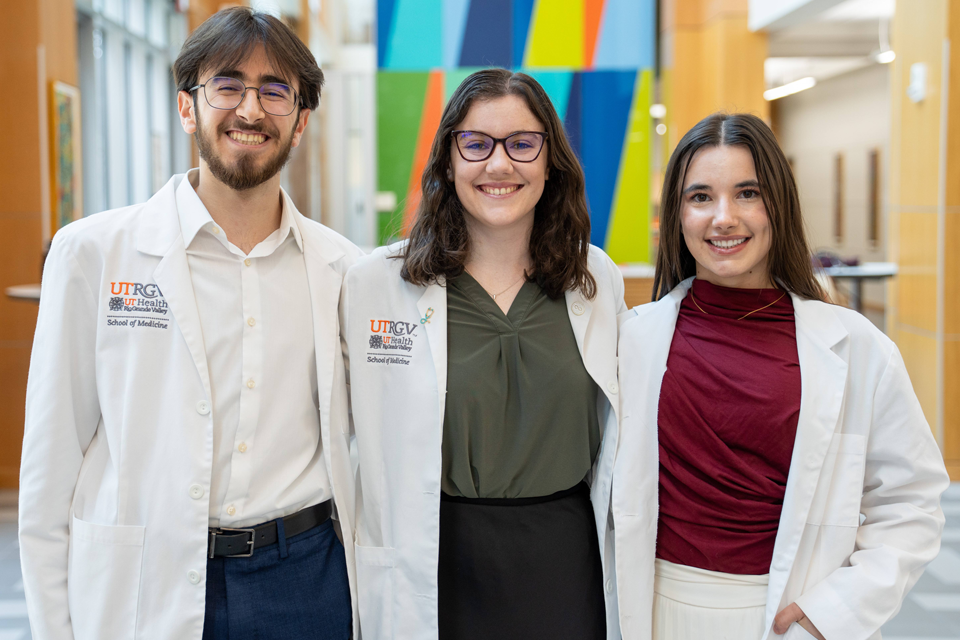
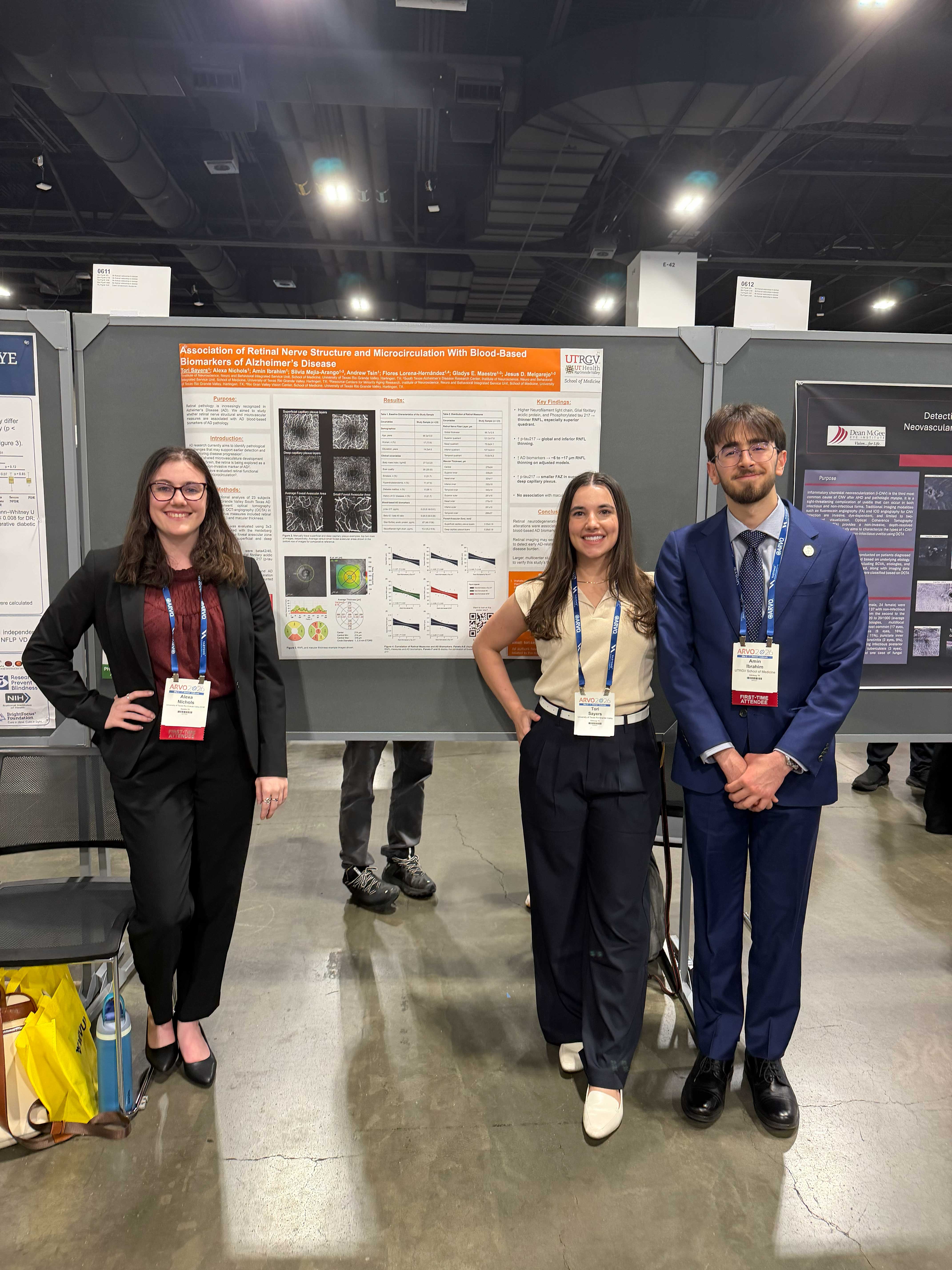
Alexa Nichols, Tori Sayers and Amin Ibrahim, second-year students at the UTRGV School of Medicine, are studying how subtle changes in the eye may reveal clues about neurological and vascular conditions throughout the body. Working under the mentorship of Dr. Jesus Melgarejo, assistant professor of Neuroscience at the UTRGV School of Medicine, the students are contributing to research that could one day help physicians detect hypertension and neurodegenerative diseases in their earliest stages.
According to the Centers for Disease Control and Prevention (CDC), heart disease and stroke are among the leading causes of death in the United States. This research is especially vital in the Rio Grande Valley, where rates of diabetes, hypertension and cardiovascular disease remain a significant public health concern.
"Many neurological and vascular diseases begin years before symptoms appear," Melgarejo said. "Our goal is to identify those changes earlier using tools that are accessible, affordable and noninvasive. If we can detect signs of disease before significant damage occurs, we have a greater opportunity to intervene and improve patient outcomes."
WINDOW TO THE BRAIN
Inside the eye, the retina contains a dense network of tiny blood vessels that mirror the body's circulatory system. Because these vessels can be viewed noninvasively through advanced imaging technologies such as optical coherence tomography (OCT) and OCT-angiography (OCT-A), researchers are increasingly focused on how retinal changes may reflect conditions affecting the brain and cardiovascular system.
The students conduct their research using the Heidelberg HEYEX 2 Spectralis, an advanced imaging system capable of capturing detailed images of the retina and its blood vessels. While standard OCT has long been used in eye care, OCT-angiography is an emerging technology that allows researchers to examine retinal blood flow without invasive procedures.
This biological link between ocular health and neurological disease became the primary focus for Nichols.
"The retina and parts of the brain share the same embryological origin, which is why the eye is sometimes referred to as a 'window to the brain' for certain neurological conditions," Nichols said. "In this study, we looked at participants from the RGV Alzheimer's Disease Center for Minority Aging Research and compared their retinal scans with findings from brain MRIs. We found that thinning in certain areas of the retina was associated with markers of cerebral small vessel disease."
Those findings suggest retinal imaging could one day provide a simpler way to identify neurological changes linked to conditions such as Alzheimer's disease. Building on that idea, Sayers is exploring a related question: whether retinal imaging can identify early biological markers of Alzheimer's disease before physical symptoms even appear.
"My project focuses on using images of the eye to see whether there's a correlation with Alzheimer's disease as a way to screen for it noninvasively," Sayers said. "We look at blood biomarkers associated with Alzheimer's and compare them with the thickness of certain areas in the back of the eye."
In communities like the Rio Grande Valley, where rates of chronic disease such as Alzheimer’s remain some of the highest in the nation, research like this could eventually help physicians detect problems sooner and connect patients with care earlier.
READING THE RETINA
Beyond neurological changes, the students are also examining how the eye reflects the health of the body's vascular system, particularly through blood pressure.
According to the CDC, nearly half of adults in the United States have high blood pressure, and do not realize it. Ibrahim's research explores this issue by evaluating how changes in the body’s blood vessels relate to those in the retina, and whether blood pressure in the arm versus the aorta shows a stronger connection to eye health. Crucially, his project investigates whether tracking blood pressure continuously over 24 hours offers a more accurate picture of cardiovascular health then a single clinic reading.
"The goal is to see if 24-hour blood pressure monitoring gives us a better understanding than just the readings taken in a doctor's office," Ibrahim said.
Focusing on a population of older Hispanic patients in the Rio Grande Valley, the study uses this 24-hour data to capture day and night fluctuations. This continuous tracking is proving vital to identifying cognitive risks, aligning with previous findings from Melgarejo.
"What we have been able to show is that the group of individuals who are more likely to have cognitive impairment or dementia have blood pressure that changes more over 24 hours compared to those who are cognitively healthy," Melgarejo said.
Melgarejo believes this constant pressure shifts may contribute to damage in the brain and blood vessels over time, even when patients show no obvious symptoms. Beyond improving early detection, the research could also make screening more accessible for patients in medically underserved regions like the Valley.
In the future, Nichols said, a routine eye exam could provide valuable insight into a patient's overall health.
"With brain MRIs, as you can imagine, they're really expensive," Nichols said. "This type of imaging is more affordable and a lot less invasive, so it provides an opportunity to increase access to health care, specifically neurological care."
MEETING REGIONAL NEEDS
The students credit opportunities like this research project to the strong mentorship and support they have found at the UTRGV School of Medicine.
"They provided me with amazing peers that I honestly look up to," Ibrahim said, "I'm inspired by them every day, with mentors that keep on pushing me to go forward and excel, the resources to grow and thrive."
Nichols added that the school encourages students to connect their research with the needs of the region.
"It teaches us a lot about the local community itself, " Nichols said. "It encourages us to get involved early on and incorporate what we discover into our research to help the local community."
For these students, the experience is helping shape the kind of physicians they hope to become, doctors who stay connected to their communities and look for new ways to improve patient care. Sometimes, as their project demonstrates, the earliest clues to understanding disease may appear in a place most people rarely think to look, like the back of an eye.
The students recently presented their findings at the Association for Research in Vision and Ophthalmology (ARVO), one of the world's leading conferences for vision research.
As their work continues, it represents a larger, ongoing mission of the UTRGV School of Medicine: training future physicians who not only advance research but ultimately improve access to care and strengthen the health of the communities they serve.
ABOUT UTRGV
Celebrating its 10th anniversary during the 2025-26 academic year, The University of Texas Rio Grande Valley is on a mission to serve the Rio Grande Valley and beyond via an innovative and unique education dedicated to student access and success. As one of the country’s largest Hispanic-Serving Institutions and Seal of Excelencia-certified university, UTRGV has earned national recognition for its academic excellence, social mobility, and student success since opening in fall 2015. Ranked among the Best Colleges for Your Tuition (and Tax) Dollars in 2025 by Washington Monthly (No. 7 nationally; No. 1 in Texas), UTRGV continues to break enrollment records, launch new academic and athletics programs, and progress toward achieving R1 research status. Additionally, UTRGV holds the Carnegie Community Engagement Classification, awarded in 2020 and 2025, reflecting its commitment to strengthening community ties and addressing local challenges.
The only university in Texas with schools of Medicine and Podiatric Medicine, UTRGV’s regional footprint spans South Texas — with locations, teaching sites, and centers established in Edinburg, Brownsville, Rio Grande City, McAllen, Weslaco, Harlingen, Laredo, Port Isabel and South Padre Island.