By Heriberto Perez–Zuñiga
RIO GRANDE VALLEY, TEXAS – MAY 7, 2026 – There is a moment, in the early hours of a hospital shift, when the weight of what medicine truly means settles in.
It arrives quietly, in the grip of a patient's hand, in the hush before a diagnosis is spoken aloud, in the choice a young physician makes to stay when staying is hard.
That moment is the reason the UTRGV School of Medicine exists.
Ten years ago, a new building rose in Edinburg.
Classrooms filled with students who had grown up in the colonias, the border towns, the small cities strung along the Rio Grande. Students who knew what it meant to live in a community where a specialist was hours away and a diabetes diagnosis might all too often arrive too late.
From the beginning, the UTRGV School of Medicine was built on a premise as audacious as it was urgent: that a region long underserved deserved a medical school of its own.
One connected with its culture, committed to its people, and bold enough to send its graduates to the highest levels of the profession while calling them back home.
The inaugural class arrived with that charge. They were, in the words of one of their own, building a school "from the ground up" with no blueprint.
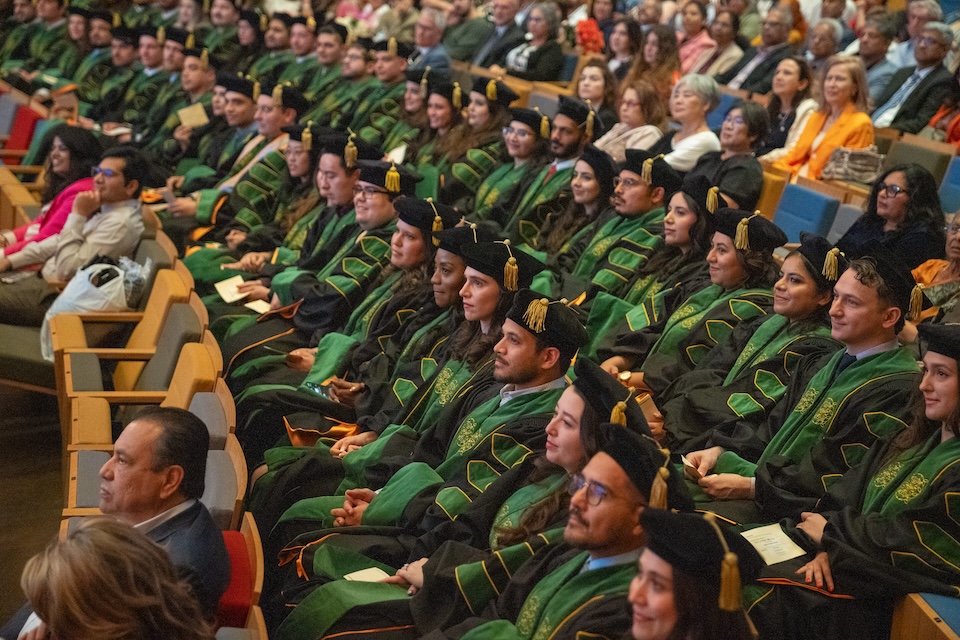
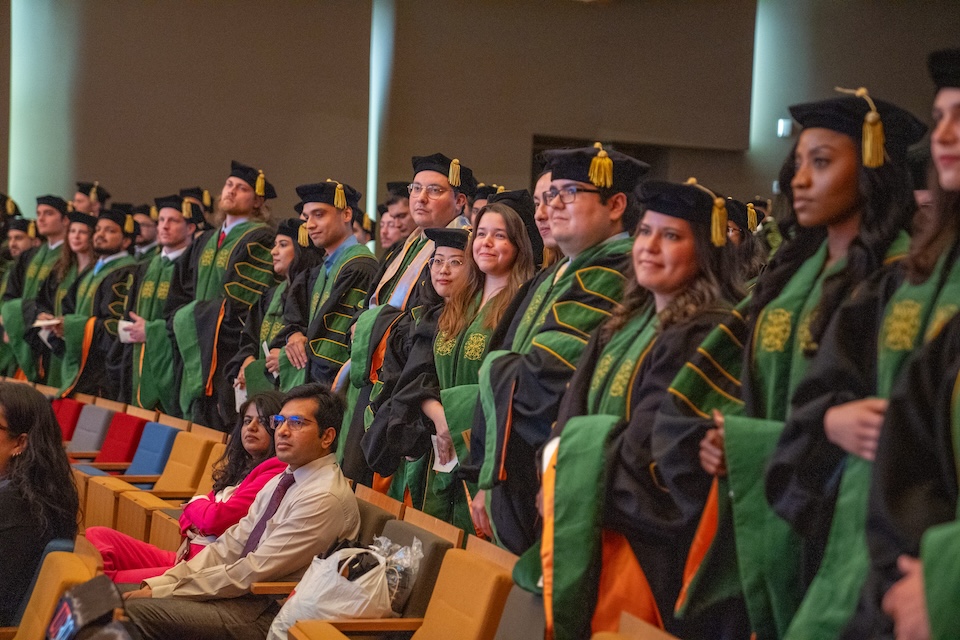
Since then, six classes have graduated, and with the upcoming seventh class, the program will reach more than 300 physicians. Today, they practice in clinics and trauma bays, in fellowship programs and cancer centers, in the Valley they grew up in, and in institutions that carry some of the most storied names in academic medicine.
"Ten years ago, we made a promise to this region," said Dr. Everardo Cobos, dean of the UTRGV School of Medicine. "Looking at where our graduates are today. At Johns Hopkins, at MD Anderson, at Harvard, and right here in the Valley. I can say with conviction, we have kept it, and we are just getting started."
THE TRAILBLAZER
When Dr. Michael LaPelusa arrived as part of the Class of 2020, the first class ever to graduate from the UTRGV School of Medicine, there was no alumni network to call, no class ahead of them to show the way.
There was only possibility, and the particular courage it takes to step into the unknown.
He matched into internal medicine at Vanderbilt University. He went on to complete a hematology and oncology fellowship at MD Anderson Cancer Center, one of the world's foremost cancer institutions, where he served as chief fellow.
But long before those milestones, a moment during his clinical rotations in the Rio Grande Valley shaped everything that followed.
In the internal medicine halls at Valley Baptist Medical Center, he watched patients arrive in crisis with pain from cancers already spread too far, from diagnoses that should have been caught years earlier. Patients who had never been screened. Patients who had slipped through every gap in a system that had long overlooked this corner of Texas.
"That experience," LaPelusa said, "is what ultimately led me to oncology."
The Valley showed him the need. His training equipped him to answer it.
He often thinks about what those years at the UTRGV School of Medicine gave him beyond medicine—the mentors who invested in his growth not as a student but as a future colleague.
As a member of the inaugural class, LaPelusa carries something the classes that followed do not.
The memory of building something from nothing, and the knowledge that the foundation holds.
"My classmates and I were in the trenches together in a way that forged some of the deepest relationships of my life," he said. "Knowing that UTRGV graduates are now practicing and training at the highest levels across the country fills me with immense pride."
THE HOMECOMING
Dr. Adriana Saavedra-Simmons grew up in the Rio Grande Valley as the daughter of Mexican immigrants, the first in her family to go to college. She left for Providence, R.I., to attend Brown University. She came back to Edinburg to become a doctor.
"For me, it was a no-brainer," she said.
The Class of 2022 graduate matched into the internal medicine residency program at Massachusetts General Hospital, Harvard Medical School, one of the most competitive programs in the country. She has since completed that residency and is now training as an endocrinology fellow at UT Southwestern in Dallas.
Her motto, the one she has carried since medical school: Our limitations do not define our aspirations.
She lived that motto long before she coined it.
She was "on the fence" about medicine, she once admitted. The first in her family to pursue higher education, uncertain whether someone like her belonged in a world that had not always made space for someone like her.
But as she learned about the physician shortage, and especially the acute need for Hispanic doctors, the uncertainty resolved into something clear.
"As a daughter of Mexican immigrants, I know that my listening ear, my experiences with poverty, and my grit will make me a better physician," she said. "I will be able to better relate to my patients and have the privilege of earning their trust."
At the UTRGV School of Medicine, she found a community that reflected her own and faculty who trained her to think critically, challenge assumptions, and approach medicine as both a science and an act of service.
She remembers the anatomy lessons of Dr. Padmanabhan Rengasamy, professor of medical education at the UTRGV School of Medicine and Dr. Xiaoqian Fang, associate professor of neuroscience at the UTRGV School of Medicine, with a smile, noting that even now, mid-fellowship, parsing the surgical anatomy for endocrine procedures, those lessons return to her.
When her fellowship ends next summer, Saavedra-Simmons plans to return to the Rio Grande Valley as an endocrinologist.
Fewer families, she believes, should have to travel for hours to receive the specialized care she can provide. She wants to connect with community organizations, increase access to screening, and mentor the next generation of students.
Students who might see themselves in her story and wonder, as she once did, whether they belong.
They do.
THE HISTORY-MAKER
Dr. Valentine Alia grew up in Houston in a single-parent household, the child of a mother who worked full-time as a teacher, raised four children, and still found time to pursue her own education.
That image of a woman who refused to use hardship as an excuse became the mental foundation for everything that followed.
Before medical school, he spent four years as an emergency department nurse at Lyndon B. Johnson County Hospital in Houston. He saw trauma. He saw the particular weight borne by under-resourced communities. He saw who was not being served and decided he wanted to be someone who could help change that.
He deliberately chose the UTRGV School of Medicine. The patient population in the Rio Grande Valley, he said, is unlike anywhere else in the country, and understanding the social determinants of health that shape lives here became the bedrock of his academic identity.
The Class of 2024 graduate matched into general surgery at his first choice: Johns Hopkins Hospital in Baltimore, Md. Johns Hopkins is the first surgery training program in the country, a cornerstone of academic medicine, and a place as committed to public health as it is to clinical excellence.
Then, in his second year of residency, something extraordinary happened.
For the first time in the hospital's history, the trauma and acute care surgery service was led entirely by Black residents and fellows, five surgeons, one of them was Alia.
The story made national headlines, reported by ABC News as a historic milestone in a specialty where Black surgeons represent just 5.6 percent of those in training, compared to 13.4 percent of the U.S. population.
"I am grateful to have had the opportunity to pursue a career in medicine," he said. "I know it is a privilege, not only to reach this milestone, but to have been selected to receive my training at one of the most prestigious residency programs in the country.
His advice to students coming behind him is direct: have a plan, start early, ask for help without shame, and give thanks, genuinely, to those who helped you get there.
And then turn around.
"Do not forget to lift those who are coming after you," he said.
A DECADE OF IMPACT
Three physicians. Three different graduating classes. Three paths that began in the same building in Edinburg and have since reached Vanderbilt, Harvard, MD Anderson, UT Southwestern, and Johns Hopkins.
They represent the promise the UTRGV School of Medicine made to this region a decade ago.
That talent was already here, that it only needed to be cultivated, and that the graduates it sent into the world would carry the Valley with them wherever they went.
Some will come back, like Saavedra-Simmons, who will return as the specialist her community has long needed.
Others, like LaPelusa, will practice elsewhere but will remain forever shaped by how they helped Valley patients.
And others, like Alia, will stand in the rooms where history is made and know that the road to that room passed through the Rio Grande Valley.
"Every one of these physicians carries this community with them," said Cobos. "When they succeed, in a fellowship, in a residency, in a history-making moment at a place like Hopkins, the Valley succeeds with them. That is what we set out to build."
ABOUT UTRGV
Celebrating its 10th anniversary during the 2025-26 academic year, The University of Texas Rio Grande Valley is on a mission to serve the Rio Grande Valley and beyond via an innovative and unique education dedicated to student access and success. As one of the country’s largest Hispanic-Serving Institutions and Seal of Excelencia-certified university, UTRGV has earned national recognition for its academic excellence, social mobility, and student success since opening in fall 2015. Ranked among the Best Colleges for Your Tuition (and Tax) Dollars in 2025 by Washington Monthly (No. 7 nationally; No. 1 in Texas), UTRGV continues to break enrollment records, launch new academic and athletics programs, and progress toward achieving R1 research status. Additionally, UTRGV holds the Carnegie Community Engagement Classification, awarded in 2020 and 2025, reflecting its commitment to strengthening community ties and addressing local challenges.
The only university in Texas with schools of Medicine and Podiatric Medicine, UTRGV’s regional footprint spans South Texas — with locations, teaching sites, and centers established in Edinburg, Brownsville, Rio Grande City, McAllen, Weslaco, Harlingen, Laredo, Port Isabel and South Padre Island.