By Saira Cabrera
RIO GRANDE VALLEY, TEXAS – MAY 5, 2026 – At NASA's Johnson Space Center, where astronauts train for missions hundreds of miles beyond Earth, medicine looks a little different. There are no emergency rooms, no hospital beds, and no gravity.
Instead, there are simulations, spacecraft systems and one critical question: How do you keep a human alive where help is millions of miles away?
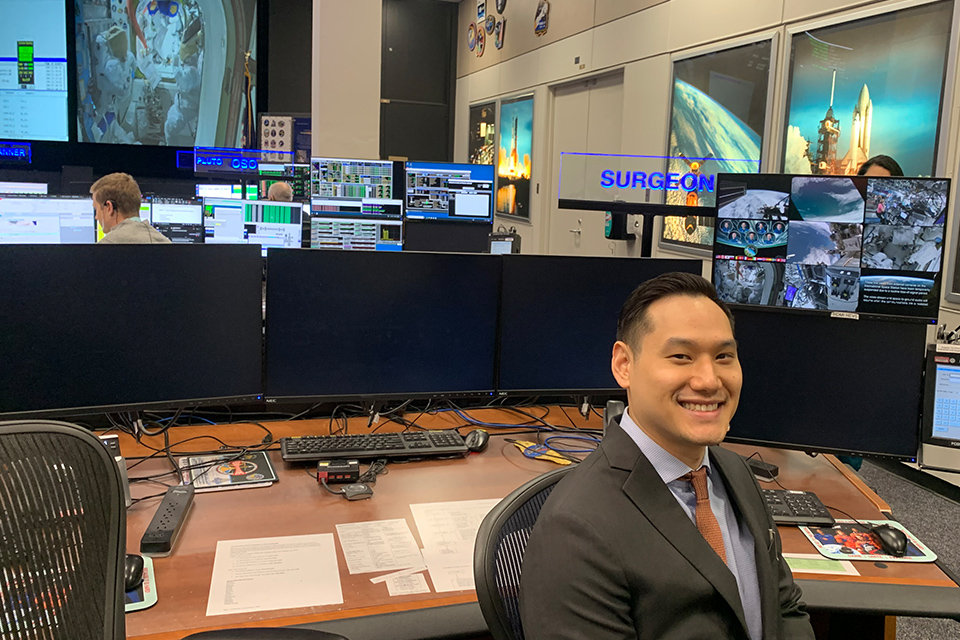
For Michael Tran, a fourth-year student at the UTRGV School of Medicine, that question became real during his recent completion of the NASA Aerospace Medicine Clerkship, a highly competitive program that introduces future physicians to the field of space medicine.
Over four weeks, Tran immersed himself in the science of human survival beyond Earth — studying space physiology, radiation exposure and the medical systems designed for astronauts aboard the International Space Station and future deep-space missions. His days were filled with lectures, research and behind-the-scenes access to NASA's training facilities, culminating in a research project presented to the space medicine community.
It was medicine at its most extreme. But for Tran, the responsibility felt familiar.
WHEN THE CALL COMES
Months earlier, that same responsibility found him in a very different place, a commercial flight from Maui to Los Angeles.
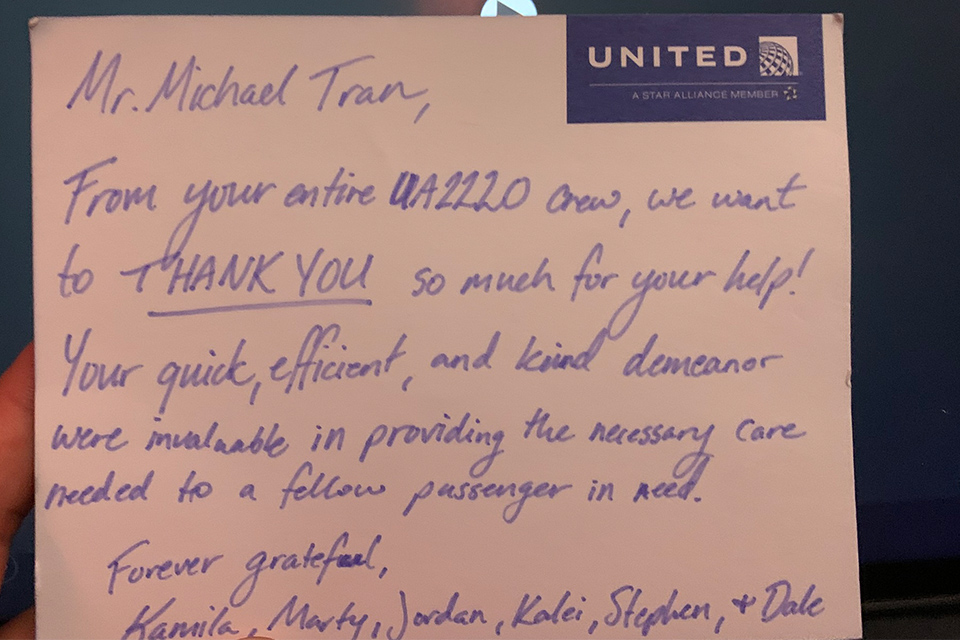
"Is there a doctor on board?" The question cut through the cabin, and for a moment, Tran hesitated.
"I didn't feel qualified," he said. "I was hoping someone else would respond."
No one did. So, he stood up.
Alongside his wife and fellow UTRGV medical student, MariCarmen Marroquin, Tran assessed a passenger who was drifting in and out of consciousness. With limited supplies and no standard equipment, the two worked quickly – building a diagnosis, monitoring vital signs and determining the need for intravenous fluids.
Without an IV pole, Tran improvised by using a carabiner clipped to an overhead compartment to suspend the fluid bag, letting gravity do what medicine required.
"I introduced myself, and my training kicked in," he said.
For six hours, he remained by the patient's side, reassessing her condition until emergency medical services took over after landing. It was a moment that affirmed something deeper than skill – it was readiness.
BUILT FOR ANY ENVIRONMENT
Before medical school, Tran spent eight years as a registered nurse in intensive care units and emergency departments, where high-stakes decisions were part of everyday life.
At UTRGV, that foundation was expanded. Through clinical skills training, community-based care and programs like the student-run clinic and Area Health Education Centers (AHEC), a UTRGV program that offers scholars real-world experience providing health care services to patients in South Texas, Tran developed the confidence to meet patients wherever they are. Whether in a clinic, a hospital or 30,000 feet in the air.
"I'm grateful for the opportunities I've had to learn and serve," he said. "Those experiences prepared me to step in when it mattered most."
BEYOND EARTH — AND BACK HOME
Now, as he prepares to graduate, Tran's journey reflects the reach of academic medicine — from the Rio Grande Valley to the frontiers of space.
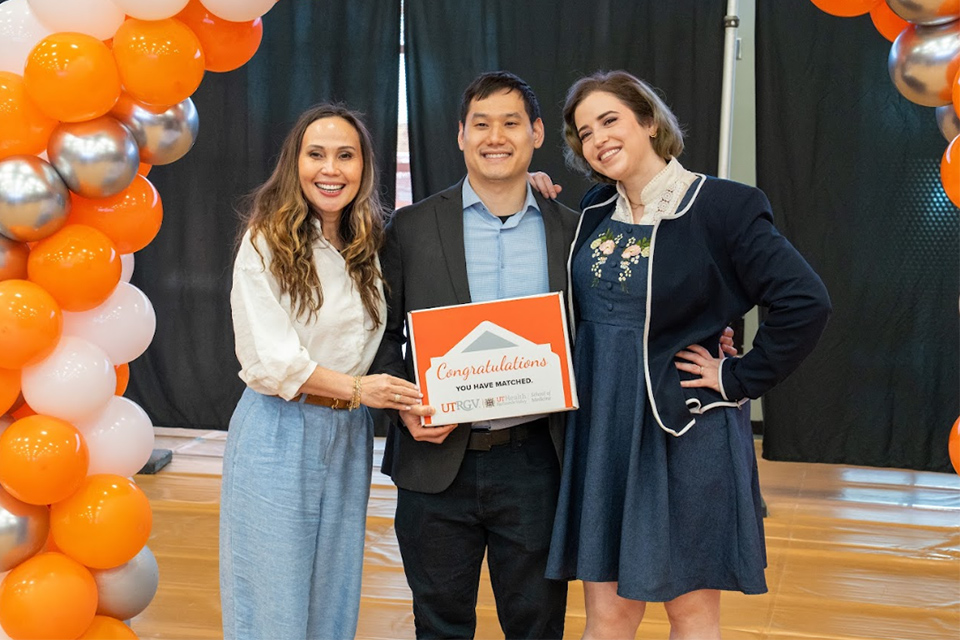
He recently matched into an internal medicine residency at Houston Methodist and will walk the stage during commencement on May 9 at the UTRGV Performing Arts Center, as the School of Medicine celebrates its 10th anniversary.
Dr. Everardo Cobos, dean of the UTRGV School of Medicine, said Tran's path represents what the institution strives to achieve.
"Our students are prepared to lead in any environment," Cobos said. "Whether responding to an emergency mid-flight or contributing to research at NASA, they carry with them the knowledge, skill and purpose to serve."
For Tran, the lesson remains simple: whether the setting is a hospital room, an airplane cabin or a spacecraft, the responsibility does not change.
To show up. To act. And to care — wherever that moment happens.
ABOUT UTRGV
Celebrating its 10th anniversary during the 2025-26 academic year, The University of Texas Rio Grande Valley is on a mission to serve the Rio Grande Valley and beyond via an innovative and unique education dedicated to student access and success. As one of the country’s largest Hispanic-Serving Institutions and Seal of Excelencia-certified university, UTRGV has earned national recognition for its academic excellence, social mobility, and student success since opening in fall 2015. Ranked among the Best Colleges for Your Tuition (and Tax) Dollars in 2025 by Washington Monthly (No. 7 nationally; No. 1 in Texas), UTRGV continues to break enrollment records, launch new academic and athletics programs, and progress toward achieving R1 research status. Additionally, UTRGV holds the Carnegie Community Engagement Classification, awarded in 2020 and 2025, reflecting its commitment to strengthening community ties and addressing local challenges.
The only university in Texas with schools of Medicine and Podiatric Medicine, UTRGV’s regional footprint spans South Texas — with locations, teaching sites, and centers established in Edinburg, Brownsville, Rio Grande City, McAllen, Weslaco, Harlingen, Laredo, Port Isabel and South Padre Island.