
Dr. Tian Y. Dong, assistant professor in the UTRGV School of Earth, Environmental and Marine Sciences, led the study “Apparent Hack’s Law in River Deltas.” (Photo by Jesús Alférez)

News Release | Research
Dr. Tian Y. Dong, assistant professor in the UTRGV School of Earth, Environmental and Marine Sciences, led the study “Apparent Hack’s Law in River Deltas.” (Photo by Jesús Alférez)
Thursday, May 28, 2026
Research
By Maria Gonzalez
RIO GRANDE VALLEY, TEXAS – MAY 28, 2026 – A study led by a researcher at The University of Texas Rio Grande Valley has been published in Science – and featured on the journal’s cover – marking the first time the university has been listed as the first and corresponding institution for a research article in the publication.
The paper, “Apparent Hack’s Law in River Deltas,” is led by Dr. Tian Y. Dong, an assistant professor in the UTRGV School of Earth, Environmental, and Marine Sciences and professional outreach lead for the South Texas Space Science Institute.
Dong said the study, featured in the April issue, identifies a simple geometric pattern in how river deltas form and grow, despite their complexity.
“In simple terms, we found that as the land-building area, known as ‘nourishment area,’ of a delta network increases, the length of its distributary channels increases predictably,” Dong said. “That is surprising because deltas are much more complex than river basins and are shaped by many competing processes, such as waves and tides.”
The research draws from a global dataset of distributary channel networks derived from satellite imagery, allowing the team to examine patterns across many river deltas rather than relying on a single case. Dong said the findings suggest that deltas may follow a broader organizing principle like patterns already established in river basins.
“This is important because it suggests that although river deltas are landforms with intricate channel networks and are influenced by a wide range of processes, they may obey a general organizing rule, much like river basins,” he said.
He added that the work could help inform how scientists and policymakers approach environmental challenges.
“Because deltas are densely populated, ecologically vital and increasingly threatened by sea-level rise, having a simple predictive framework could also help guide restoration and coastal management,” Dong said.
The research, supported mainly by UTRGV and partially by the National Science Foundation, was motivated by a longstanding gap in understanding the relationship between river systems upstream and the deltas they form along coastlines.
“Deltas are the parts of river systems that build land along the coast, but their network organization remains poorly understood,” Dong said.
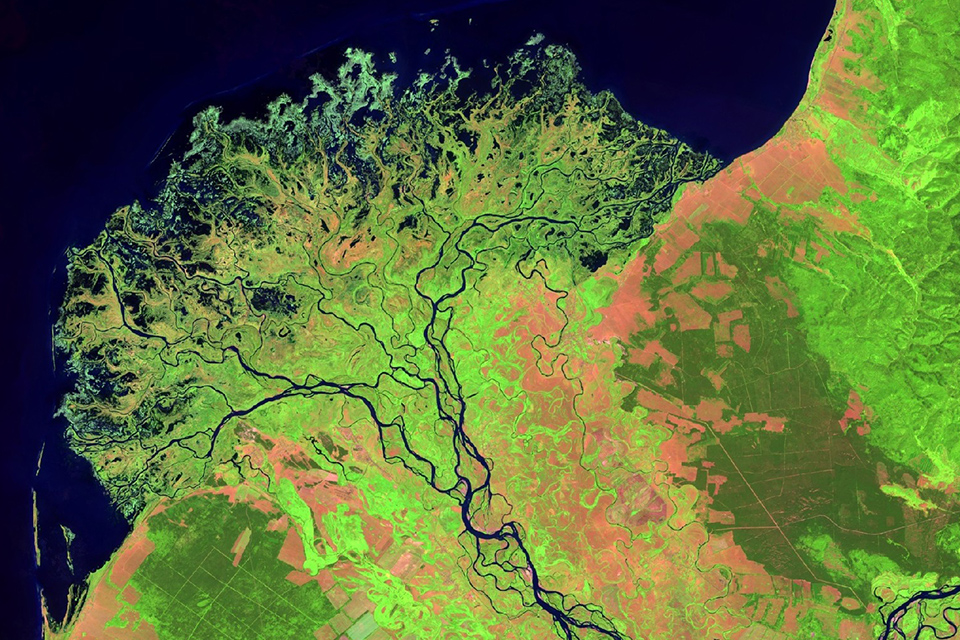 Sediment-laden water flows through the branching channels of the Selenga River Delta in Siberia before reaching Lake Baikal, illustrating the study’s finding that delta channel networks mirror Hack’s Law for upstream river networks. (Courtesy Photo)
MILESTONE HIGHLIGHTS UTRGV’S RESEARCH GROWTH
Dong said the publication in Science reflects both the strength of the research and the contributions of the broader team.
“For our research group, publication in Science is both a major recognition and a strong validation of the kind of questions we are pursuing,” he said. “It shows that research led by our group can contribute at the highest international level.”
He said the milestone also highlights the role of UTRGV in advancing research from the Rio Grande Valley.
“It is also meaningful for our students and collaborators, because it demonstrates that impactful science about Earth's surface can be led by UTRGV and from South Texas,” Dong said.
Dr. Can (John) Saygin, senior vice president for research and dean of the Graduate College at UTRGV, said the publication reflects the university’s continued growth in research.
“This publication in Science reflects the strength of our faculty and the direction of research at UTRGV,” Saygin said. “It shows that the work being done here is contributing to important questions with real-world impact while expanding the university’s portfolio in leading scientific venues.”
Looking ahead, Dong said the team will continue exploring why different deltas behave differently under the same scaling pattern.
“One major next step is to understand why some deltas seem to follow this scaling relationship smoothly, while others show breaks or transitions in behavior,” he said. “In the longer term, we hope this work will motivate the geoscience community to study the underlying physics that explain the similarity between the channel networks of river basins and coastal deltas.”
ABOUT UTRGV
Celebrating its 10th anniversary during the 2025-26 academic year, The University of Texas Rio Grande Valley is on a mission to serve the Rio Grande Valley and beyond via an innovative and unique education dedicated to student access and success. As one of the country’s largest Hispanic-Serving Institutions and Seal of Excelencia-certified university, UTRGV has earned national recognition for its academic excellence, social mobility, and student success since opening in fall 2015. Ranked among the Best Colleges for Your Tuition (and Tax) Dollars in 2025 by Washington Monthly (No. 7 nationally; No. 1 in Texas), UTRGV continues to break enrollment records, launch new academic and athletics programs, and progress toward achieving R1 research status. Additionally, UTRGV holds the Carnegie Community Engagement Classification, awarded in 2020 and 2025, reflecting its commitment to strengthening community ties and addressing local challenges.
The only university in Texas with schools of Medicine and Podiatric Medicine, UTRGV’s regional footprint spans South Texas — with locations, teaching sites, and centers established in Edinburg, Brownsville, Rio Grande City, McAllen, Weslaco, Harlingen, Laredo, Port Isabel and South Padre Island.