By Heriberto Perez–Zuñiga
RIO GRANDE VALLEY, TEXAS – MAY. 21, 2026 – Researchers at the UTRGV School of Medicine have identified a promising new biomarker that could help change how amyotrophic lateral sclerosis (ALS) is detected and studied, marking another step forward for biomedical research in the Rio Grande Valley.
The discovery offers hope for earlier diagnosis and improved monitoring of a disease that remains one of the most difficult neurological conditions to understand and treat.
Dr. Subhash Chauhan, director of the South Texas Center of Excellence in Cancer Research at the UTRGV School of Medicine, said the work addresses a critical need in ALS care and research.
"Our focus is on finding answers sooner," Chauhan said. "Developing reliable, non-invasive biomarkers could help doctors diagnose ALS earlier, track disease progression more accurately and evaluate treatments more effectively."
UNDERSTANDING ALS
ALS is a fast-progressing neurodegenerative disease that affects the nerve cells responsible for muscle movement. Over time, patients lose the ability to move, speak and eventually breathe.
Despite decades of research, the disease has no cure and very limited treatment options.
One of the biggest challenges is diagnosis. There is no single test to confirm ALS, and physicians must often rely on a combination of exams, imaging and months of observation to rule out other conditions.
"ALS is particularly challenging because there is no single blood or urine test. Doctors usually diagnose it by ruling out other diseases," Chauhan said. "By the time many patients receive a diagnosis, the disease has already progressed significantly."
To help close this gap, Chauhan and his team identified a biomarker known as p75 extracellular domain (p75ecd), which signals damage to motor neurons. When these cells are injured, a fragment of the p75 protein is released and can be detected through a urine sample.
Because it can be measured non-invasively, the biomarker has the potential to simplify the diagnostic process and provide a more accessible means of tracking disease progression over time.
"Testing for p75ecd does not require painful or invasive procedures," Chauhan said. "It could help physicians detect the disease earlier and better understand how it is changing in each patient."
The findings were recently published in the peer-reviewed journal Current Neuropharmacology, which reflects the study's scientific impact.
RGV SCIENCE, RGV IMPACT
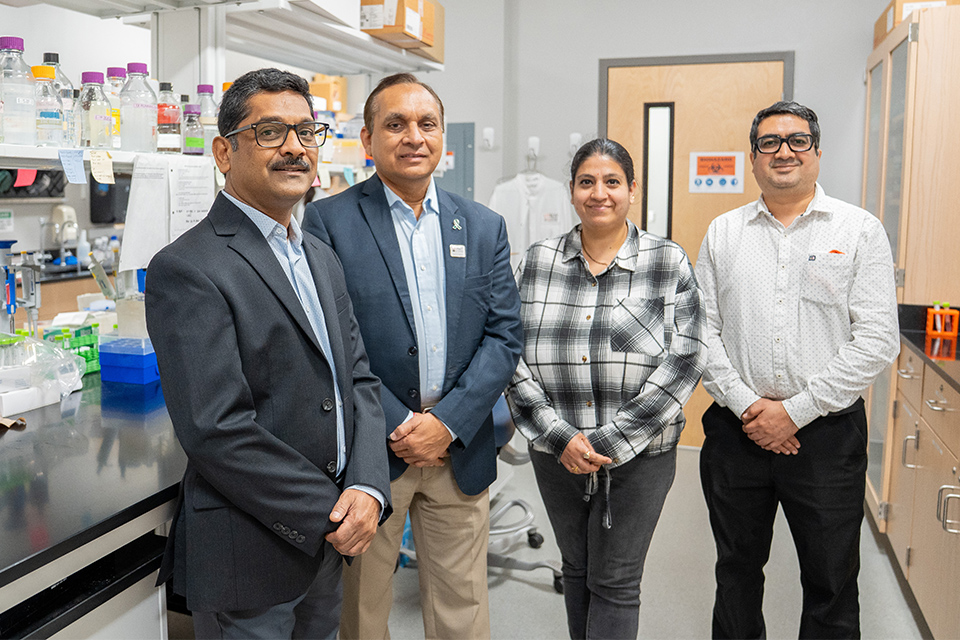
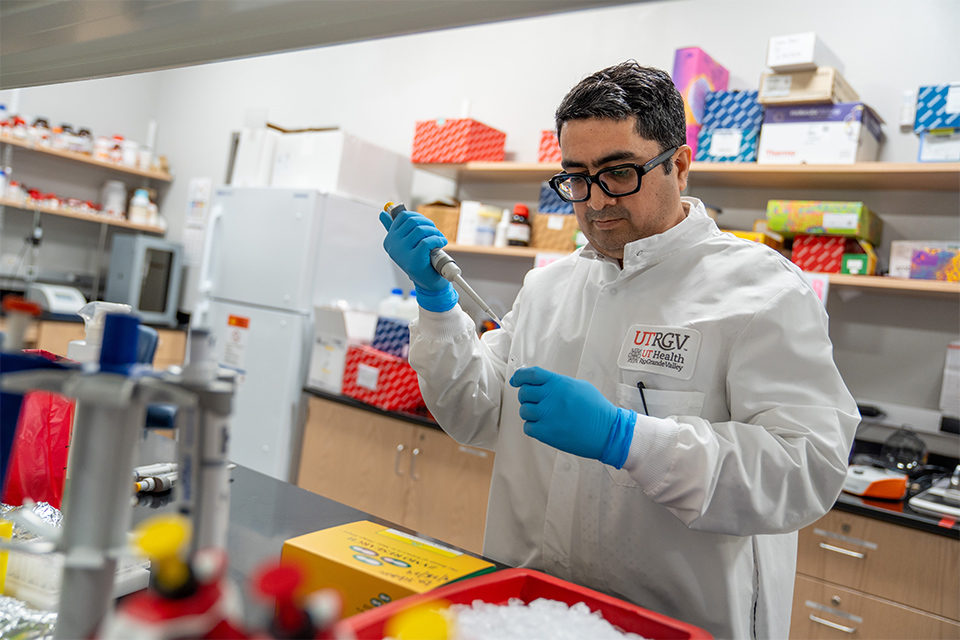
The research study brought together a multidisciplinary team at the UTRGV School of Medicine, conducted by postdoctoral fellow Dr. Swati Dhasmana. Team members included Dr. Anupam Dhasmana and Dr. Acharan Narula, along with Dr. Sheema Khan, assistant professor in the Division of Immunology and Microbiology. Oversight of the study design and manuscript development was provided by Dr. Murali Yallapu, associate professor in the Division of Immunology and Microbiology, while Dr. Subhash Chauhan guided the project as mentor and corresponding author.
The research was funded by the SSA Foundation, a charitable organization headquartered in the Rio Grande Valley, whose support helped move the project forward.
For Chauhan, the work is not only about advancing science, but also about expanding what is possible in the Rio Grande Valley.
"Bringing this type of research to our region is incredibly important," he said. "It allows us to build expertise in diseases like ALS and creates opportunities for our patients and families to benefit from new discoveries."
As research continues, the team hopes this biomarker will contribute to faster diagnoses, more effective clinical trials and, ultimately, better outcomes for those living with ALS.
"Our goal is to make a real impact on patients' lives," Chauhan said. "The work we are doing here shows that meaningful, high-level research is happening in the Valley, and it has the potential to reach far beyond our community."
ABOUT UTRGV
Celebrating its 10th anniversary during the 2025-26 academic year, The University of Texas Rio Grande Valley is on a mission to serve the Rio Grande Valley and beyond via an innovative and unique education dedicated to student access and success. As one of the country’s largest Hispanic-Serving Institutions and Seal of Excelencia-certified university, UTRGV has earned national recognition for its academic excellence, social mobility, and student success since opening in fall 2015. Ranked among the Best Colleges for Your Tuition (and Tax) Dollars in 2025 by Washington Monthly (No. 7 nationally; No. 1 in Texas), UTRGV continues to break enrollment records, launch new academic and athletics programs, and progress toward achieving R1 research status. Additionally, UTRGV holds the Carnegie Community Engagement Classification, awarded in 2020 and 2025, reflecting its commitment to strengthening community ties and addressing local challenges.
The only university in Texas with schools of Medicine and Podiatric Medicine, UTRGV’s regional footprint spans South Texas — with locations, teaching sites, and centers established in Edinburg, Brownsville, Rio Grande City, McAllen, Weslaco, Harlingen, Laredo, Port Isabel and South Padre Island.