By Victoria Brito Morales
RIO GRANDE VALLEY, TEXAS – FEB. 18, 2026 – UTRGV has received a $1.2 million federal grant from NASA to take the lead in a multi-institution collaboration that will study the Rio Grande Valley’s coastal and deltaic ecosystems to develop better climate predictions and warning tools.
To conduct the research, the project – called the Minority University Research and Education Project Earth Science Systems Research – will integrate sustainable sensor technology, NASA satellite data and AI-driven modeling to develop AI-enhanced biodegradable sensors. The goal is to be able to monitor environmental change, predict infectious disease risks and support space missions that study other planets.
The three-year award started in August 2025 and established the Virtual Institute for Temporal and Additive Learning (VITAL) project.
“Our goal is to build environmentally friendly sensing technologies that help us better understand how climate variability affects both ecosystems and public health in the Valley,” said Dr. Teresa “Paty” Feria, UTRGV professor in the School of Integrative Biological and Chemical Sciences (SIBCS) and principal investigator of VITAL. “By combining ground-based monitoring with NASA satellite data, we can develop predictive tools and early warning systems that directly benefit our communities.”
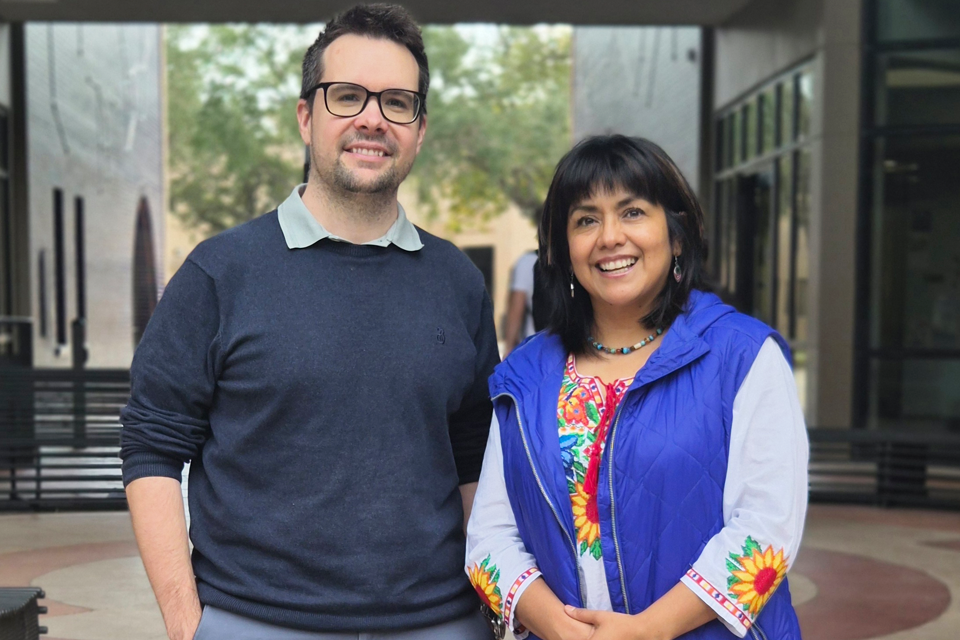
Feria and Dr. Eloi Camprubi, UTRGV assistant professor in astrobiology at UTRGV SIBCS and co-PI of VITAL, are partnering with three other higher education institutions, including UT Austin, Prairie View A&M University and Texas A&M University.
The team is designing the AI-driven biodegradable sensors to help to monitor climatic and water-related conditions in the Valley, enabling the use and enhancement of NASA databases. Currently, those databases sport mainly remote sensing data – with in situ data from the sensor network deployed across the lower Rio Grande Valley – in order to build models of potential outbreaks of infectious diseases transmitted by mosquitoes, and to compare how the Valley’s riverbeds dry out with how ancient wet areas on Mars used to dry out.
The team also will collaborate with the Museum of South Texas History in Edinburg to expand community outreach and public engagement by sharing findings, tools and educational programming to make scientific knowledge more accessible locally.
INNOVATIONS
Specifically, researchers will be creating small, eco-friendly sensors made from materials that naturally break down over time – like biopolymers and conductive glass. The sensors will be placed outdoors, alongside riverine environments, to measure data on temperature, moisture, water level and flow, and other environmental conditions.
Information collected will be combined with NASA’s satellite data, then analyzed using AI to help scientists understand how ecosystems are changing, how habitats are affected, and when conditions might increase the risk of mosquito-borne diseases.
By using the data collected, the team aims to:
- Identify conditions that could trigger outbreaks.
- Provide earlier alerts to help protect coastal communities.
- And provide a multi-parameter monitoring of the water conditions in the Lower Rio Grande Valley – a region highly sensitive to drought.
Camprubi, an expert in astrobiology and planetary sciences, will assist Feria with implementation and supervision of the project.
He also will lead the early Martian analog study using monitoring data and will mentor UTRGV students involved in the project.
“The Valley offers unique environments that mirror conditions we believe existed on early Mars,” Camprubi said. “Studying these systems here on Earth allows us to test hypotheses about planetary evolution, while advancing environmental monitoring at home.”
Undergraduate, master’s and doctoral students across participating institutions will participate in the study through research placements, mentorship and course-based undergraduate research experiences embedded in biology and astrobiology classes. They will gain hands-on experience in sensor design, fieldwork, data science and climate resilience research.
“Projects like VITAL connect cutting-edge science with the real challenges facing our region,” Feria said. “We’re excited to train the next generation of scientists while delivering tools that support sustainability, public health and resilience in South Texas.”
The project runs through August 2028.
ABOUT UTRGV
Celebrating its 10th anniversary during the 2025-26 academic year, The University of Texas Rio Grande Valley is on a mission to serve the Rio Grande Valley and beyond via an innovative and unique education dedicated to student access and success. As one of the country’s largest Hispanic-Serving Institutions and Seal of Excelencia-certified university, UTRGV has earned national recognition for its academic excellence, social mobility, and student success since opening in fall 2015. Ranked among the Best Colleges for Your Tuition (and Tax) Dollars in 2025 by Washington Monthly (No. 7 nationally; No. 1 in Texas), UTRGV continues to break enrollment records, launch new academic and athletics programs, and progress toward achieving R1 research status. Additionally, UTRGV holds the Carnegie Community Engagement Classification, awarded in 2020 and 2025, reflecting its commitment to strengthening community ties and addressing local challenges.
The only university in Texas with schools of Medicine and Podiatric Medicine, UTRGV’s regional footprint spans South Texas — with locations, teaching sites, and centers established in Edinburg, Brownsville, Rio Grande City, McAllen, Weslaco, Harlingen, Laredo, Port Isabel and South Padre Island.