By Saira Cabrera
RIO GRANDE VALLEY, TEXAS – FEB. 11, 2026 – Every time our heart beats, blood pressure travels through our arteries to ensure that organs receive blood and nutrients — a rhythm we rarely think about, but one that quietly shapes how we live, age, and remember.
This February, during American Heart Month, the UTRGV School of Medicine's pioneering research reveals that behaviors related to blood pressure may provide clues about the heart-brain's future.
IN CONSTANT CONVERSATION
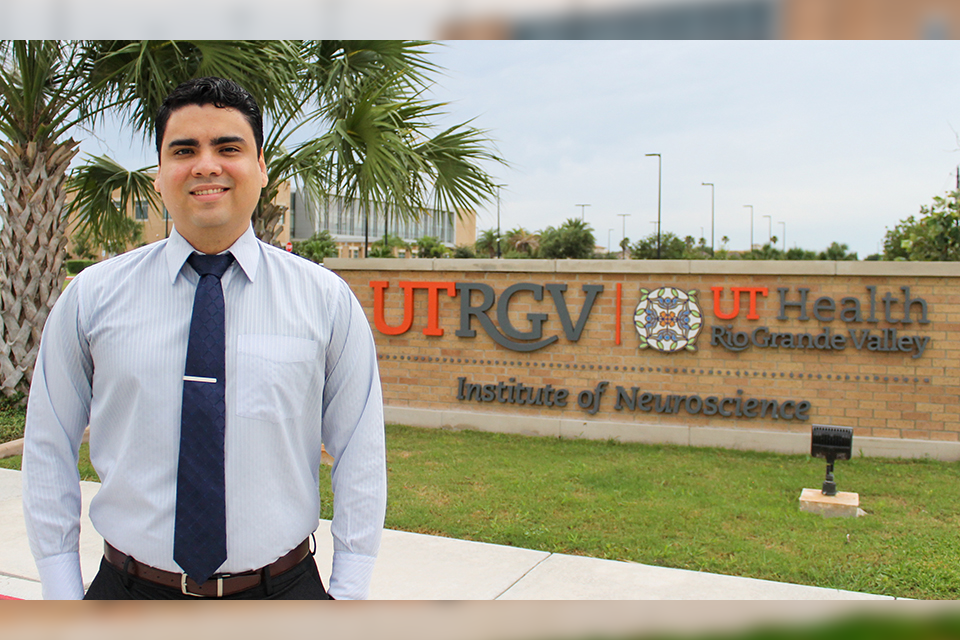
"The heart and brain are in constant conversation," Dr. Jesús Melgarejo, assistant professor of Neuroscience at the UTRGV School of Medicine, said. "When blood pressure patterns become too chaotic or too rigid, that conversation changes — and our cognitive health can change with it."
At a recent American Heart Association Hypertension Scientific Sessions, Melgarejo presented groundbreaking findings linking 24-hour blood pressure variability to cognitive decline.
His research suggests that it's not only how high blood pressure rises that matters — it's how much it fluctuates throughout the day and night.
For decades, studies have shown that consistently elevated blood pressure increases the risk of cognitive impairment and dementia. But Melgarejo's work pushes the field further by examining the complexity of blood pressure — the moment-to-moment shifts, rises, and dips that occur every few minutes.
"Using 24-hour ambulatory blood pressure monitoring, my team and I track these changes across both daytime and nighttime periods," he said. "Then, we apply advanced nonlinear measures — tools developed initially in physics — to analyze how 'organized' or 'chaotic' those fluctuations are.
One key metric is entropy, which quantifies unpredictability in a system.
"A healthy biological system has rhythm and flexibility," Melgarejo explained. "But too much chaotic variability — or too little — can signal that something is off. We're finding that these patterns in blood pressure may predict who is more likely to experience cognitive decline.”
He also believes that treating 24-hour blood pressure as a chaotic system will reveal new ways in which our biological system changes with aging and disease.
A NEW WINDOW INTO PREVENTION
His findings were replicated across two major datasets, including the SPRINT MIND study, strengthening the hypothesis that blood pressure complexity could serve as a novel risk factor for dementia.
Rather than focusing solely on the dangers of high blood pressure, Melgarejo hopes his work will inspire people to think more holistically about their heart health.
"This isn't about alarming patients," he said. "It's about understanding that the heart's rhythm is a powerful indicator — one we can measure, study, and ultimately use to protect brain health."
The implications for the Rio Grande Valley are especially significant. As rates of dementia and cardiovascular disease continue to rise nationally, research like Melgarejo's is helping identify earlier, more precise ways to detect cognitive risk — particularly in communities where health disparities and chronic disease burdens remain high.
HEART RESEARCH SHAPING BRAIN HEALTH
Since then, Melgarejo has also finalized the replication in two other datasets from the ENRICA study in Spain and the Ohasama Study in Japan. These have established an institutional collaboration between Teikyo University in Japan and UTRGV, as well as a research Memorandum of Understanding (MOU) with Universidad Autónoma de Madrid in Spain.
Dr. Everardo Cobos, interim dean of the UTRGV School of Medicine and chair of Medicine and Oncology, said Melgarejo's work reflects UTRGV's mission to advance impactful science for South Texas.
"Dr. Melgarejo is redefining how we understand the heart-brain connection," Cobos said. "His research has the potential to change how we screen for cognitive decline, intervene earlier, and ultimately improve quality of life for our patients and communities."
As American Heart Month encourages Texans to care for their cardiovascular health, Melgarejo hopes people will also think about the lifelong link between heart rhythms and brain resilience.
"The heart tells a story," he said. "And if we listen closely, we can learn how to protect both our memory and our future."
ABOUT UTRGV
Celebrating its 10th anniversary during the 2025-26 academic year, The University of Texas Rio Grande Valley is on a mission to serve the Rio Grande Valley and beyond via an innovative and unique education dedicated to student access and success. As one of the country’s largest Hispanic-Serving Institutions and Seal of Excelencia-certified university, UTRGV has earned national recognition for its academic excellence, social mobility, and student success since opening in fall 2015. Ranked among the Best Colleges for Your Tuition (and Tax) Dollars in 2025 by Washington Monthly (No. 7 nationally; No. 1 in Texas), UTRGV continues to break enrollment records, launch new academic and athletics programs, and progress toward achieving R1 research status. Additionally, UTRGV holds the Carnegie Community Engagement Classification, awarded in 2020 and 2025, reflecting its commitment to strengthening community ties and addressing local challenges.
The only university in Texas with schools of Medicine and Podiatric Medicine, UTRGV’s regional footprint spans South Texas — with locations, teaching sites, and centers established in Edinburg, Brownsville, Rio Grande City, McAllen, Weslaco, Harlingen, Laredo, Port Isabel and South Padre Island.