By Heriberto Perez–Zuñiga
RIO GRANDE VALLEY, TEXAS – JAN. 23, 2026 – If cervical cancer can be prevented, why does it continue to have an impact on so many families in the Rio Grande Valley?
For four UTRGV School of Medicine students, that question surfaced not in a clinic or hospital, but in a classroom.
While reviewing data, the medical students came across a troubling reality: Some of the lowest HPV vaccination rates in the country exist alongside some of the highest cervical cancer rates in Texas – right in their own communities.
Rather than letting those numbers remain part of an academic exercise, the students decided to act.
January is Cervical Cancer Awareness Month, and through a student-led HPV education and vaccination initiative, UTRGV School of Medicine students Yazeth Gonzalez, Maria Lozano Bonilla, Maria Camila Gonzalez Tovar and Bria Okere are working to increase awareness and improve access to preventive care across the Valley.
CALL TO ACTION
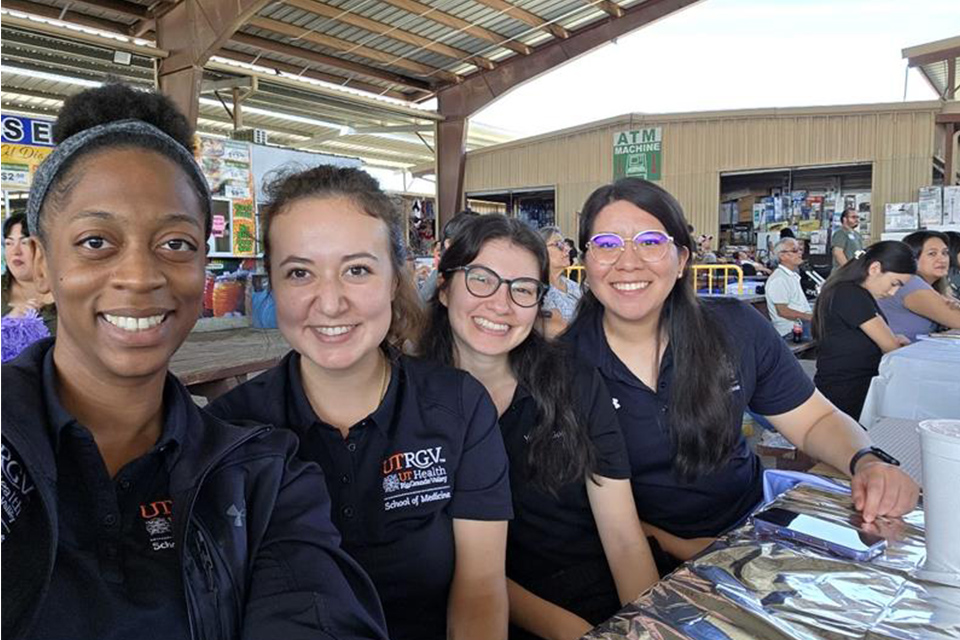
At back-to-school vaccination drives, parents move from table to table while students wait nearby.
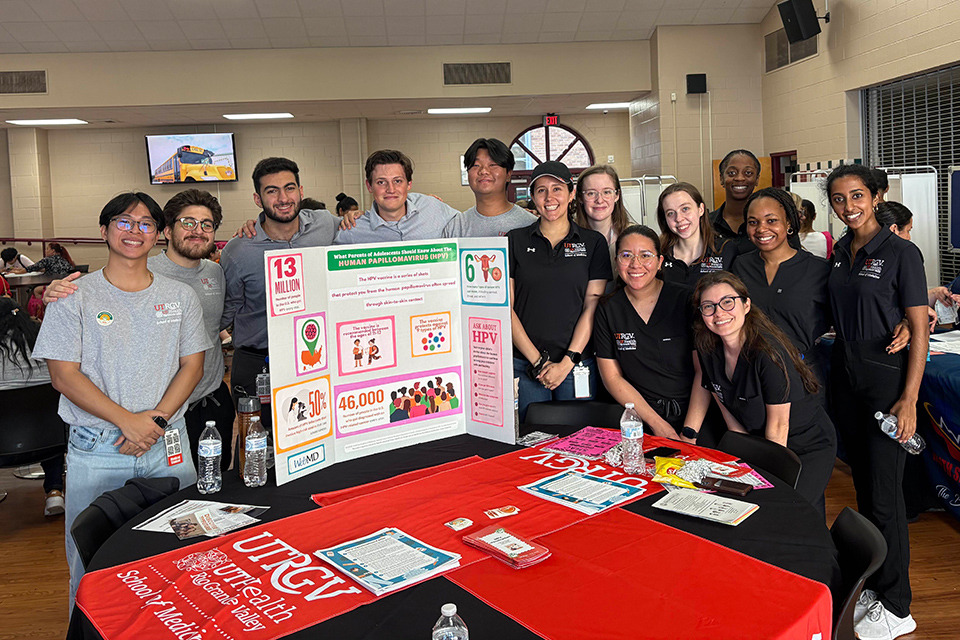
At one booth, a group of UTRGV School of Medicine students answers questions, dispels myths, and explains how a single vaccine can help prevent a cancer that has disproportionately affected women in the Valley.
"This idea first came about after working on a group project focused on researching HPV and cervical cancer rates," said Gonzalez, a fourth-year UTRGV School of Medicine student from Hidalgo. "The Valley specifically has some of the lowest HPV vaccination rates in the country, along with some of the highest cervical cancer rates."
For Gonzalez, who grew up in the Valley, the data reflected what she had seen throughout her life.
"Seeing how in need our community is – and knowing cervical cancer is preventable – inspired our group to create an HPV education initiative to increase vaccination rates in the RGV," she said.
Cervical cancer is most often caused by human papillomavirus (HPV), a common infection that can be prevented through vaccination when administered at a young age.
While many HPV infections resolve on their own, persistent infections can lead to abnormal cell changes that, if left untreated, may develop into cervical cancer over time.
Without regular screening or access to follow-up care, these changes can go undetected until the disease reaches an advanced stage, when treatment options become more limited.
In communities like the Rio Grande Valley, access to care is limited by insurance status, transportation and other barriers, so prevention can be critical.
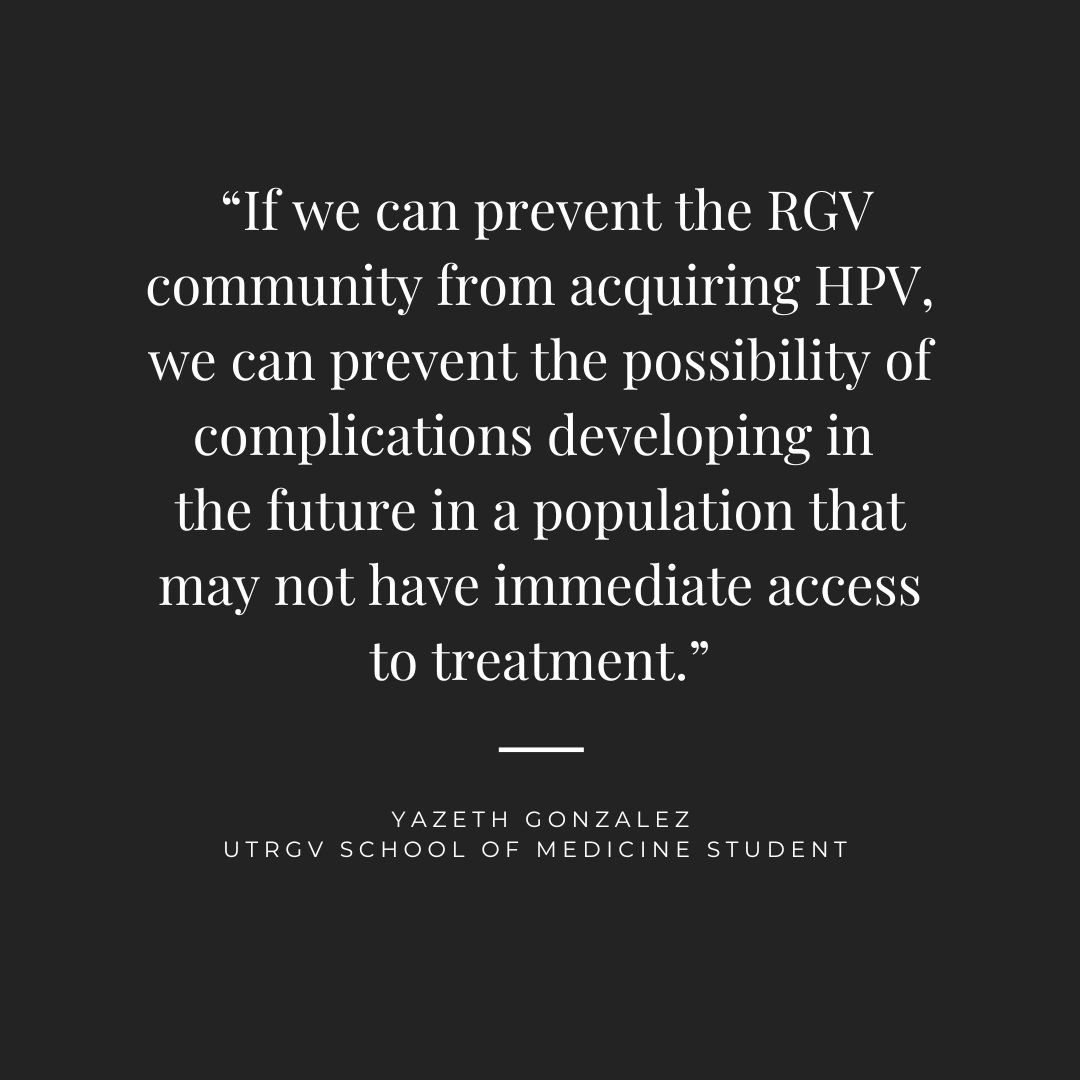
"If we can prevent the RGV community from acquiring HPV, we can prevent the possibility of complications developing in the future in a population that may not have immediate access to treatment," Gonzalez said.
PREVENTION THROUGH EDUCATION
To better understand why vaccination rates remained low, the students partnered with the Edinburg school district, distributing surveys to parents to identify hesitations and barriers to HPV vaccination.
Lozano Bonilla, a fourth-year UTRGV School of Medicine student from Rio Grande City, said those early conversations helped shape the project's approach.
"As we looked at the data, we saw that many of the barriers contributing to low vaccination rates could be addressed through education," she said. "It was important to ensure this information was accessible and available in both English and Spanish."
Using feedback from the parents, the team developed bilingual educational pamphlets and Frequently Asked Question sheets that directly addressed common concerns.
They now distribute these materials during vaccination drives hosted in partnership with the Edinburg, Donna and Brownsville school districts, working alongside the Hidalgo County Health Department and other local health partners.
During each event, the students speak directly with parents, answer questions and inform families that the HPV vaccine is available on-site.
"One of the most meaningful moments for me was when a mother stopped to ask if the vaccine was available for her as well," Lozano Bonilla said. "It showed how education can empower people not only to make decisions for their children, but to advocate for their own health."
Okere, a fourth-year UTRGV School of Medicine student from Houston, said it was important to her to help dispel in conversations with parents the misunderstandings and stigmas associated with the vaccine.
"It’s been a joy to support families in making the best healthcare decisions for their future," she said.
Okere said those conversations have carried over into her clinical training and reinforced her desire to practice primary care in communities in need, like those in the Rio Grande Valley.
"I grew up in neighborhoods that didn’t always have the easiest access to quality healthcare," she said. "I saw the adverse effects that can cause and knew I wanted a career in which I could support and uplift those affected by them. I’m forever grateful to have been trained by an institution like UTRGV that shares this mission."
Gonzalez Tovar, a third-year UTRGV School of Medicine student from McAllen, said the project helped show her the importance of pairing education with access.
The initiative grew out of coursework focused on Healthy People 2030 goals, she said, but it was the opportunity to return to the topic and create tangible change that made the experience so meaningful.
"We wanted to actually do something to address this issue," she said. "It motivated us to move beyond discussion and make a real impact."
FACULTY SUPPORT
Each of the students said the experience helped shape how they view their future roles as physicians, and they credit mentorship from faculty at the UTRGV School of Medicine for helping transform their ideas into a sustained community initiative.
"The faculty guided us in starting the project, helped us reach the right partners and supported us through the approval process," Gonzalez Tovar said. "UTRGV has been vital in helping me pursue my goal of improving preventive care in the Valley."
Dr. Maria de Jesus Muñoz, interim senior associate dean of Student Affairs and Admissions, and assistant dean for Educational Affairs and Clerkships, said the initiative shows the values the UTRGV School of Medicine strives to instill in each student.
"These students recognized a preventable health issue affecting the community and took meaningful action," Muñoz said. "Their leadership, compassion and commitment to service exemplify the type of physicians we are working to train at the UTRGV School of Medicine."
As the initiative continues to expand, Gonzalez Tovar hopes their efforts will help shift the focus from simply treating advanced disease to preventing it altogether.
Meaningful change often can begin long before a patient ever enters a clinic, she said, and initiatives like this can help ensure more families in the Valley have access to information, resources and care when it matters most.
To learn more about the UTRGV School of Medicine, visit www.utrgv.edu/school-of-medicine.
ABOUT UTRGV
Celebrating its 10th anniversary during the 2025-26 academic year, The University of Texas Rio Grande Valley is on a mission to serve the Rio Grande Valley and beyond via an innovative and unique education dedicated to student access and success. As one of the country’s largest Hispanic-Serving Institutions and Seal of Excelencia-certified university, UTRGV has earned national recognition for its academic excellence, social mobility, and student success since opening in fall 2015. Ranked among the Best Colleges for Your Tuition (and Tax) Dollars in 2025 by Washington Monthly (No. 7 nationally; No. 1 in Texas), UTRGV continues to break enrollment records, launch new academic and athletics programs, and progress toward achieving R1 research status. Additionally, UTRGV holds the Carnegie Community Engagement Classification, awarded in 2020 and 2025, reflecting its commitment to strengthening community ties and addressing local challenges.
The only university in Texas with schools of Medicine and Podiatric Medicine, UTRGV’s regional footprint spans South Texas — with locations, teaching sites, and centers established in Edinburg, Brownsville, Rio Grande City, McAllen, Weslaco, Harlingen, Laredo, Port Isabel and South Padre Island.