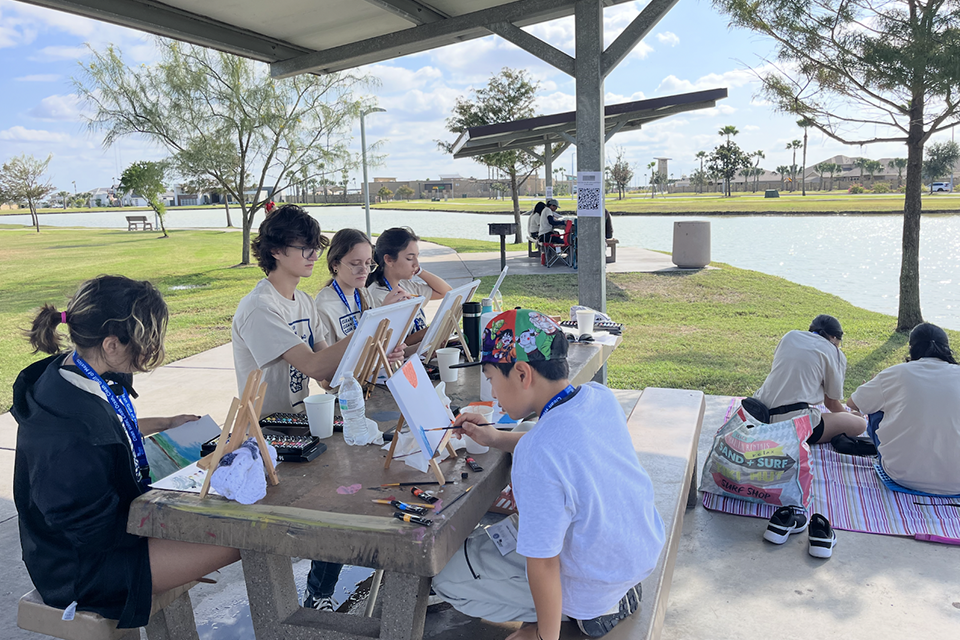
Students participate in the K–12 STEM Art Contest, creating sustainability-themed artwork during an outdoor session hosted by UTRGV as part of the NSF Global Center for Sustainable Bioproducts outreach. (Courtesy photo)

News Release | Awards & Grants
Students participate in the K–12 STEM Art Contest, creating sustainability-themed artwork during an outdoor session hosted by UTRGV as part of the NSF Global Center for Sustainable Bioproducts outreach. (Courtesy photo)
Friday, January 16, 2026
Awards, Community, Accolades, Grants
By Amanda A. Taylor-Uchoa
RIO GRANDE VALLEY, TEXAS – JAN. 16, 2026 –UTRGV has been awarded a $299,999 education-outreach grant to help with a global initiative working to transform agricultural waste into biodegradable materials.
The grant, part of the National Science Foundation’s Global Center for Sustainable Bioproducts (GCSB), is a five-year, $5 million international project that runs through 2029. It brings together researchers, educators and students from six countries – the United States, Korea, Finland, Canada, Japan and the United Kingdom – to build a circular, zero-waste economy.
The collaborative is led by Principal Investigator Dr. Arthur Ragauskas, a Governor’s Chair Professor of Chemical Engineering at the University of Tennessee and an internationally recognized expert in bio-based materials, with co-PIs representing partner institutions across the globe, including UTRGV.
FROM WASTE TO BIO INNOVATION
At UTRGV, the project’s educational direction is guided by Dr. Clara Joungyun Choi, assistant professor of Visual Communication Design and UTRGV’s principal investigator for the GCSB initiative. Choi helps bridge the center’s global sustainability research with opportunities for local students and families.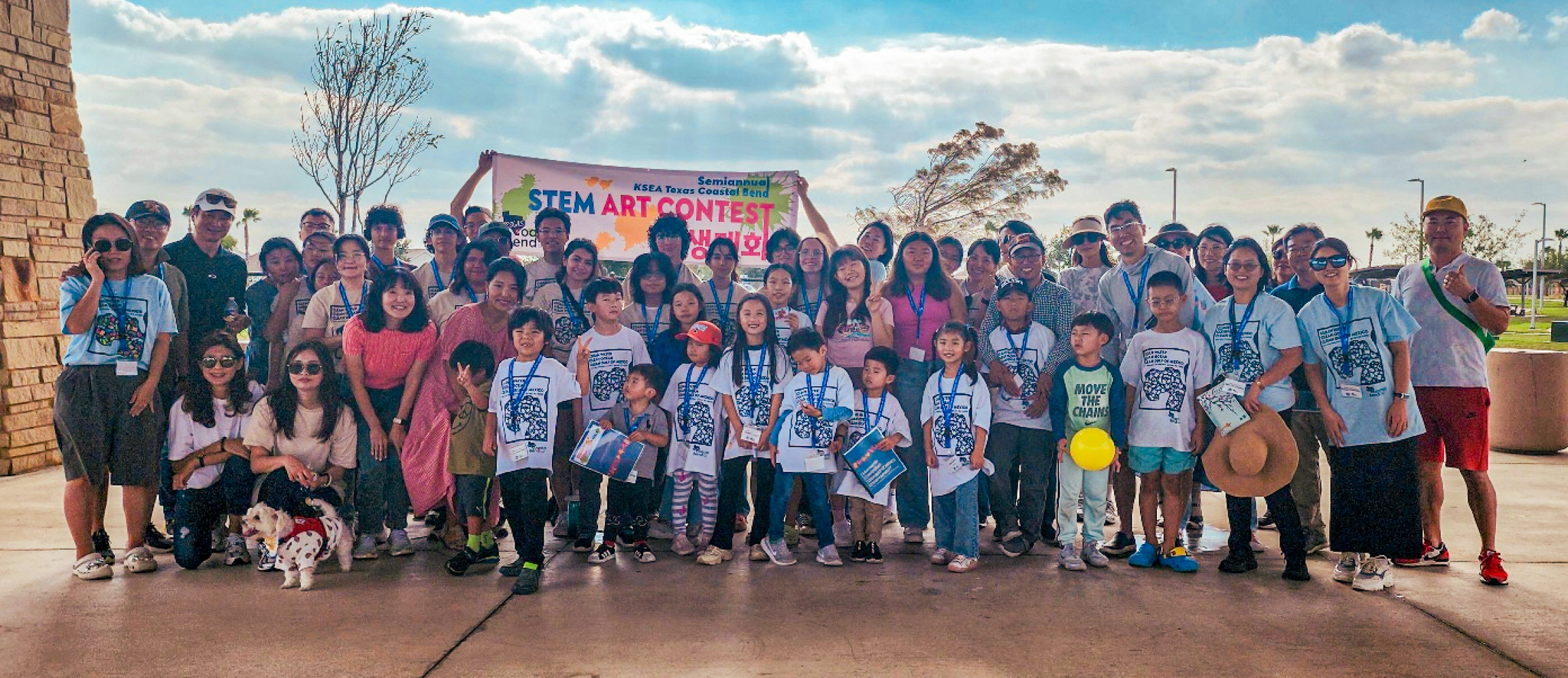 Students and families from the Korean-American Scientists and Engineers Association Texas Coastal Bend chapter join UTRGV for the K–12 STEM Art Contest, reflecting one of the program’s many community partnerships in sustainability education. (Courtesy photo)
“What makes this project exciting is how it brings science, creativity and sustainability together,” Choi said. “Students can see firsthand how environmental challenges can be addressed through innovative materials and design-based problem-solving.”
The NSF center focuses on converting agricultural byproducts – such as corn stalks and rice straw – into environmentally friendly materials that reduce reliance on plastics.
The international team is developing biodegradable plastics, advanced 3D- and 4D-printed materials, and new recycling methods that support a circular, zero-waste economy. The approach blends engineering, science and design thinking to create practical, sustainable bioproducts while preparing the next generation of problem-solvers.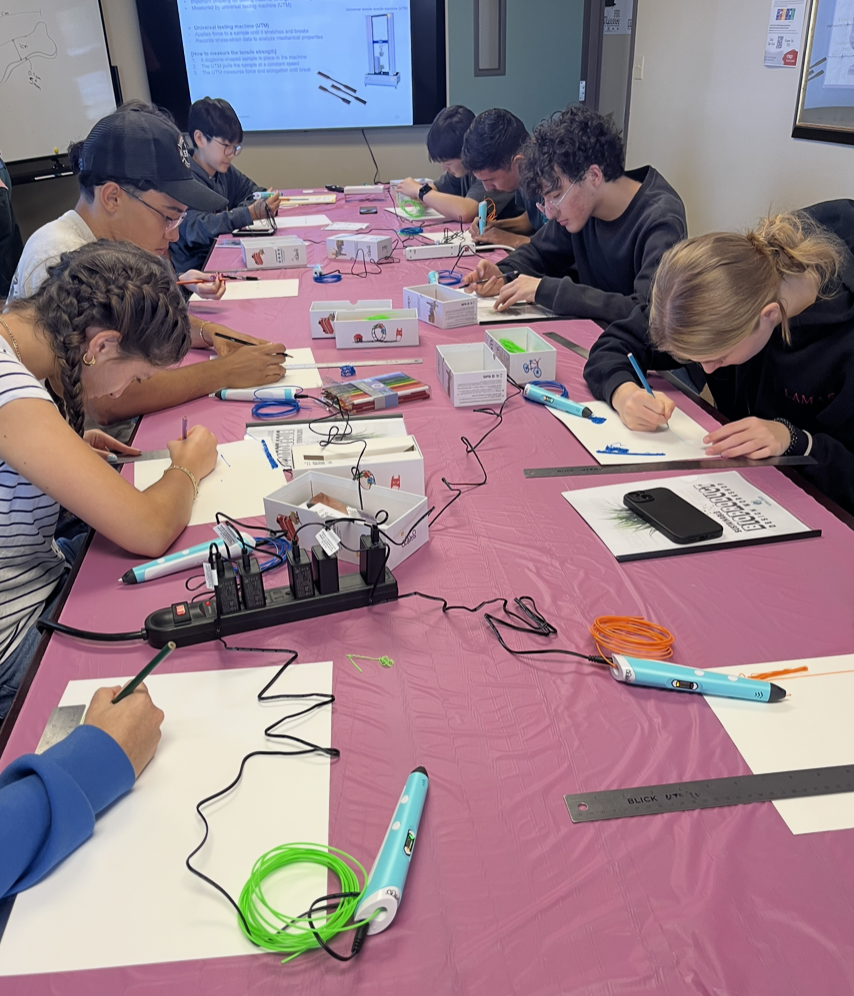 Students take part in a sustainability-themed learning activity using 3D pens during a workshop connected to UTRGV’s education and outreach efforts through the NSF Global Center for Sustainable Bioproducts. (Courtesy photo)
UTRGV serves as the lead institution for the center’s education and workforce development initiatives, and Choi oversees programming that makes sustainability learning accessible from kindergarten through graduate school. The work includes interactive workshops for K–12 classrooms, hands-on laboratory experiences, the study abroad course Design Thinking in Sustainable Science, and international research exchanges that connect UTRGV students with partner institutions.
The university recently completed its first year of workshops, study-abroad activities and community outreach, with more opportunities planned.
LOCAL IMPACT
Through the GCSB, UTRGV students gain access to hands-on sustainability research that strengthens both technical and creative skills. Students learn how agricultural waste can be reimagined as new materials with real-world applications.
The work extends beyond campus: K–12 workshops, art contests and outreach events introduce local families to concepts such as conservation, sustainable design and biodegradable materials –efforts that build a stronger STEM pipeline in the Rio Grande Valley.
“Grants like these don’t just fund research,” Choi said. “They invest in people, places and potential. They empower UTRGV students, uplift local communities and advance a more sustainable and equitable future.” As part of UTRGV’s role in the NSF Global Center for Sustainable Bioproducts, students gain hands-on experience in the lab, studying how plant-based waste materials can be transformed into biodegradable products. (Courtesy photo)
Choi said the GCSB stands out for connecting global collaboration with local impact, and the project highlights how universities can lead sustainability efforts while supporting diverse communities. She hopes students walk away with confidence in their ability to contribute to environmental solutions.
“I want them to know they can contribute meaningfully to environmental challenges,” she said. “Whether they’re in a classroom, lab, or study abroad program, they belong in these spaces.”
ABOUT UTRGV
Celebrating its 10th anniversary during the 2025-26 academic year, The University of Texas Rio Grande Valley is on a mission to serve the Rio Grande Valley and beyond via an innovative and unique education dedicated to student access and success. As one of the country’s largest Hispanic-Serving Institutions and Seal of Excelencia-certified university, UTRGV has earned national recognition for its academic excellence, social mobility, and student success since opening in fall 2015. Ranked among the Best Colleges for Your Tuition (and Tax) Dollars in 2025 by Washington Monthly (No. 7 nationally; No. 1 in Texas), UTRGV continues to break enrollment records, launch new academic and athletics programs, and progress toward achieving R1 research status. Additionally, UTRGV holds the Carnegie Community Engagement Classification, awarded in 2020 and 2025, reflecting its commitment to strengthening community ties and addressing local challenges.
The only university in Texas with schools of Medicine and Podiatric Medicine, UTRGV’s regional footprint spans South Texas — with locations, teaching sites, and centers established in Edinburg, Brownsville, Rio Grande City, McAllen, Weslaco, Harlingen, Laredo, Port Isabel and South Padre Island.