Additive & Convergent Manufacturing
Current manufacturing is in divided in separate silos according to processing methods and materials. Convergent manufacturing (CM) is a concept that support both fundamental research and technology development to bring together disparate manufacturing strategies and classes of materials leading to desired functional materials/structures with enhanced capabilities at point of need at a speed faster than additive processes. Convergent manufacturing combines virtual manufacturing, manufacturing processes including bulk, additive, subtractive, transformative, process monitoring and control, heterogeneous materials in one connected platform to yield functional devices and components.
The division of Additive and Convergent Manufacturing supports the following research project going on at the CAMICs center:

High Deposition Rate AM Process
Defense and Space industries are search for technologies that can further improve the deposition rate of metal AM processes. With a wide stream of existing metal AM principles, the center team is reviewing and evaluating AM process to develop a technology roadmap to significantly increase the deposition rate while maintaining or improving processes accuracy. We are collaborating with America Makes, and other national partners to develop future technologies based on the following processes principles:
- Additive friction-stir manufacturing (AFSM), which uses friction-stir processing (FSP) principles for additive manufacturing (AM) of large metal structures. The AFSM technique has main unique potential like large-scale rapid production and printing of non-weldable metals and alloys. The center works with partners to future improve the vertical resolution of material deposition and incorporate suitable hybrid subtractive and rolling steps for attaining the final shape with better accuracy.
- Collaborative Robot Wire-Arc Additive Manufacturing(WAAM): WAAM offers high deposition rates and quality without size limits. WAAM is considered one of the best alternatives for additive manufacturing of medium-large size parts with high mechanical requirements, such as structural parts in the aeronautical industry. In this project, we consider incorporating multiple robots that collaboratives deposit metal with multiple hatch strategies with a goal to improve the build rate.
- Laser/cold spray transformative process: This is a new project, details can be obtained upon request.
- Laser based Hybrid Manufacturing Process: This is a new project, details can be obtained upon request.
- Pultrusion and DED processed for lightweight composite materials and structures under high temperature.

1. In-Situ Gas Alloying for Nano Synthesis and Dispersion in Metallic Matrices
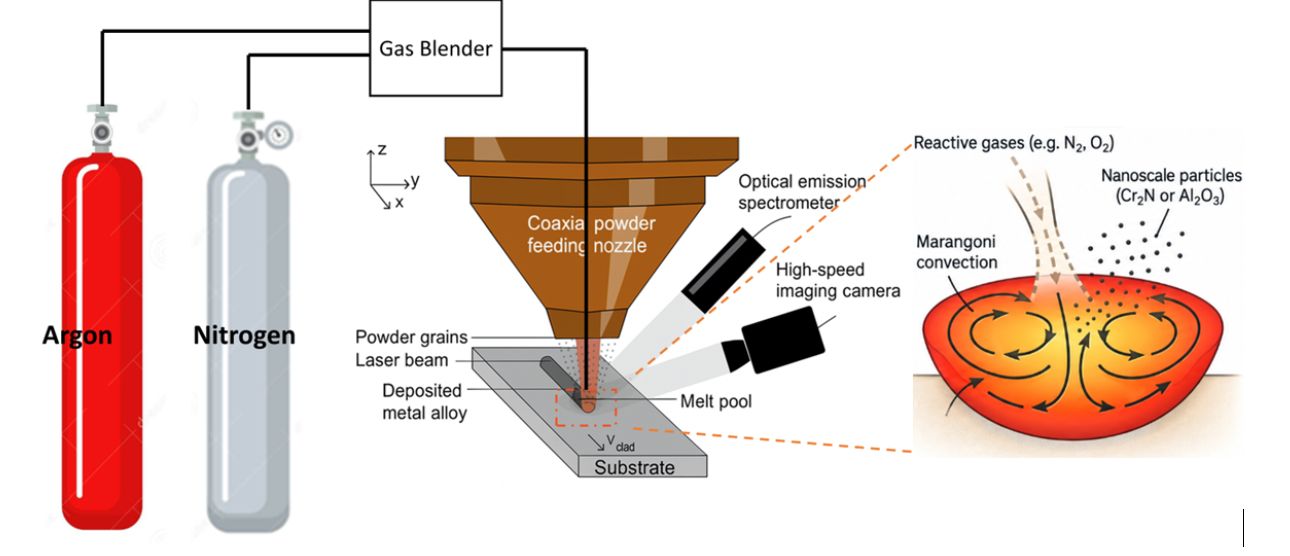
In-Situ Gas Alloying for Nano Synthesis and Dispersion in Metallic Matrices investigates gas–liquid metal reactions in the melt pool during laser directed energy deposition (DED) as a route to in-situ formation of nitride and oxide nanoparticles in printed alloys. Reactive gas species blended into the argon stream are absorbed at the melt-pool surface and form dispersoids in the deposit. The project examines how reactive-gas partial pressure, laser power, and scan speed influence absorption kinetics, solute supersaturation, particle nucleation, and the resulting particle size, number density, and spatial distribution. Its objectives are to establish nanoparticle formation mechanisms during DED, characterize nanoparticle features, and relate them to the microstructure of dispersion-strengthened alloys. The project studies two model systems: SS316/Cr₂N and AlSi10Mg/Al₂O₃. The work combines mass-flow-controlled gas blending, high-speed and thermal melt-pool imaging, coupled thermal-thermodynamic-kinetic modeling, and electron microscopy. The results support single-step DED processing of dispersion-strengthened alloys for aerospace, energy, and defense applications.
Funding Source: This research is supported by the U.S. National Science Foundation (NSF) through the Launching Early-Career Academic Pathways in the Mathematical and Physical Sciences (LEAPS-MPS) program under award number 2532705.
Current Project Team
The current project team.
Shafin Ahmed - Ph.D. Student
Shafin is a Ph.D. student in Materials Science and Engineering at UTRGV and a graduate researcher at IAM. His research focuses on in situ reactive-gas alloying during laser directed energy deposition, including the effects of reactive-gas partial pressure, Sieverts’ law solubility, and interfacial absorption kinetics to predict interstitial content in the printed alloy.

Kingsley Yeboah Gyabaah - Ph.D. Student
Kingsley is a Ph.D. student in Materials Science and Engineering at UTRGV and a graduate researcher at IAM. His research focuses on coupled thermal-thermodynamic-kinetic modeling of nitrogen absorption in stainless steel 316 during reactive-gas DED, combining melt-pool thermal analysis, interstitial uptake, nitride formation, and the resulting microstructure.

2. Direct Energy Deposition Convergent Manufacturing
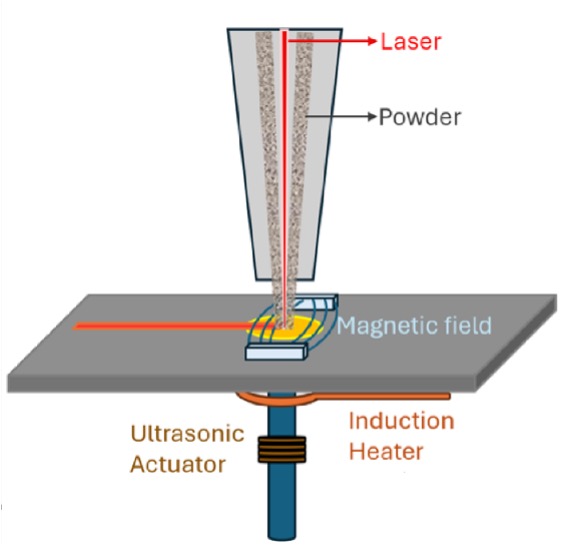
The research goal is to establish a deep understanding of the Direct Energy Deposition thermal environment when multiple energy sources (laser, induction heating, and ultrasound) are simultaneously applied during the AM process. Establish dynamic control of heat input and favorable thermal energy distribution at the process zone by integrating laser (with beam shaping), Induction heating, and ultrasound. Increase material deposition by induction preheating the substrate and on-the-fly powders. Minimize residual stress in the part via in-situ induction heat treatment. Establish an AI-based prediction model for microstructure and defect control.
Funding Source: The Office of Naval Research under Grant Number W911NF-25-1-0106.
Current Project Team
Jorge Barron Jr – Ph.D. student
Jorge Barron Jr is a Ph.D. candidate in Materials Science and Engineering graduate researcher at IAM. His research is focused on the optimization and characterization of parameters in metal additive manufacturing processes.

Ariful Islam – Ph.D. student
Ariful Islam is a Ph.D. candidate in Materials Science and Engineering. He works on external field-assisted additive manufacturing, investigating how applied energy can enhance deposition rate, in-situ alloying, and the performance of the components. His work spans metal additive manufacturing and 3D printed electronics.

Sirajul Karim Anim – Ph.D. student
Sirajul Karim Anim is a Ph.D. student in Materials Science and Engineering at UTRGV and a graduate researcher at IAM. His research focuses on improving laser-directed energy deposition with secondary energy sources with the goal of increasing deposition efficiency while reducing defects and improving microstructure control in additively manufactured metals.

Jose Galarza – Postdoctoral Fellow
Dr. Jose Galarza is a Postdoctoral Fellow at the Institute for Advanced Manufacturing (IAM) at the University of Texas Rio Grande Valley (UTRGV). His research integrates machine learning modeling, statistical analysis, and additive manufacturing, focusing on automated defect detection, mechanical properties characterization, machine learning data simulation, and parameter optimization of the Direct Energy Deposition process.

Publications
- Tusher Ahmed, M., Ahmed, F. and Li, J., 2026. Enhancement of plastic deformation in ultrasound-assisted cold spray of tungsten: a molecular dynamics study. Modelling and Simulation in Materials Science and Engineering, 34(2), p.025006. https://doi.org/10.1088/1361-651X/ae424d
3. Cold Spray Convergent Manufacturing
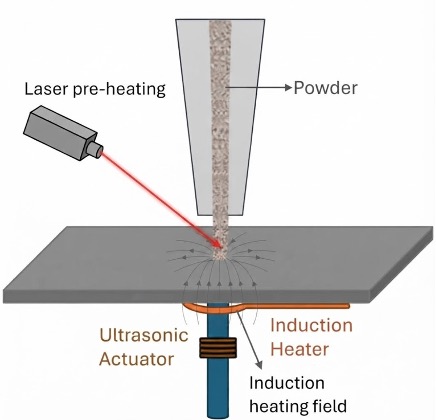
The research goal the material behavior and how defects form with respect to the parameters of the Hybrid cold spray process to improve the quality of the coating. Establish characterization and optimization of the process and secondary energy sources, integrating laser (with beam shaping), Induction heating, and ultrasound. Increase material deposition by induction preheating and ultrasound. Establish an AI-based prediction model for microstructure and defect control.
Funding Source: National Science Foundation (NSF) under Award No. CMMI-2442549.
Current Project Team
Hussein Alizereej – Ph.D. student
Hussein Alizereej is a Ph.D. candidate in Materials Science and Engineering. His research is focused on cold Spray additive manufacturing focusing on combining experimental work with simulation to understand and improve solid-state particle deposition.

Mojtaba Eslami Sabet – Master's student
Mojtaba Eslami Sabet is a Master’s student in Manufacturing Engineering and a graduate researcher at the Advanced Manufacturing Institute (AMI) at UTRGV. His research focuses on cold spray additive manufacturing, including nozzle design and optimization, particle-flow behavior, and the development of functionally graded material deposition using multiple powders.