UTRGV Faculty Excellence Awards
UTRGV Faculty Excellence Awards
The UTRGV Faculty Excellence Awards are our highest tribute to the visionaries who shape the future of education. These awards honor faculty whose innovation, leadership, and impact in teaching, research, and service set the standard for excellence. By showcasing these extraordinary achievements across campus and beyond, we ignite a culture of recognition, pride, and academic distinction that elevates our entire university community.
Award Descriptions
UTRGV Faculty Excellence Awards in Teaching
The UTRGV Faculty Excellence Awards in Teaching are the university's highest honor for outstanding teaching. This award recognizes faculty who have demonstrated a profound commitment to enhancing the quality of education, leading curriculum development, and actively engaging students, thereby contributing significantly to student success at the institution.
There will be up to three (3) awards in this category in which all full-time faculty with at least three years of service at UTRGV are eligible.
Each recipient will receive a $5,000 stipend.
UTRGV Faculty Excellence Awards in Research
The UTRGV Faculty Excellence Awards in Research are the university's highest honors for outstanding faculty research/scholarship/creative work. It celebrates exceptional excellence to knowledge, innovation, and scholarly excellence. Recipients of this award have demonstrated significant impact in their field, advancing the frontiers of research and enhancing the university's reputation for academic excellence. This award acknowledges the dedication, creativity, and scholarly achievements of faculty members who have made remarkable strides in their scholarship endeavors.
There will be up to three (3) awards in this category in which all full-time faculty with at least three years of service at UTRGV are eligible.
Each recipient will receive a $5,000 stipend.
UTRGV Faculty Excellence Awards in Service
The Faculty Excellence Award in Service is the university's highest honor highlighting the individual's enduring commitment to service, underscoring the importance of giving back and making a meaningful difference in the lives of others. The award honors individuals who have demonstrated exceptional dedication and impact through their service to the university, the community, and their profession. This prestigious accolade recognizes those whose contributions have significantly advanced the institution's mission, fostered community engagement, and elevated the standards of their professional field.
There will be three (3) awards in this category in which all full-time faculty with at least three years of service at UTRGV are eligible.
Each recipient will receive a $5,000 stipend.
The UTRGV Distinguished Career Award
The UTRGV Distinguished Career Award honors a senior faculty member (tenured or nontenure track) who has demonstrated exceptional excellence in teaching, service, and scholarly contributions over a distinguished career spanning 20 years (or more) at UTRGV and its legacy institutions. This prestigious accolade particularly celebrates those whose impactful contributions have significantly advanced the success of both students and faculty, setting a benchmark for academic and professional excellence.
One (1) Distinguished Career Award will be presented with a $7,000 stipend.
Nominations, Eligibility Requirements, Guidelines, and Other Details
-
Faculty will be identified for consideration through a nomination process.
-
Nominations must be submitted by the deadline through the portal sent to colleges.
- Any eligible UTRGV faculty member may be nominated by their college during the current award nomination cycle.
- Nominators should check with the nominees prior to putting their names forward to ensure they are willing and eligible to accept the nomination.
- Individuals who are nominated for an award must recuse themselves from all aspects of that category’s review process.
-
Eligibility will be reviewed and confirmed by the Office of Faculty Affairs (OFA).
-
OFA will notify the nominated faculty.
-
Nominees must accept or decline the nomination by the established deadline.
-
Nominees will submit their application through FPT by the established deadline to continue to be eligible for the award.
-
A review committee will conduct the evaluation process and provide their recommendation to the Provost.
-
The Provost will conduct the final review and awardees will be notified shortly after.
- All full-time UTRGV faculty members who, at the time of nomination, have completed at least three consecutive years of full-time service at UTRGV. Part-time faculty and full-time administrators are not eligible for nomination.
- Nominated faculty should NOT have been a recipient of a UTRGV Excellence (or Impact) award in the same category as current nomination within the last five years. See Previous Winners Section for this information.
- Nominated faculty should NOT have been a recipient of any UTRGV Excellence (or Impact) award within the last three years. See Previous Winners Section for this information.
- Distinguished Career Award Eligibility: Faculty nominees must have at least 20 years of service to UTRGV and its legacy institutions as full-time faculty members. (Intermittent administrative service to UTRGV will count toward the 20 years.)
Faculty Excellence Awards in Teaching
Criteria
Applications will be evaluated based on the following:
The nominee demonstrates a documented record of impact in teaching, incorporating innovative practices, and aligning curricular practices with student needs. They are established leaders in their teaching discipline, evidenced by program development, conference presentations, publications, workshops, and/or mentorship. They present an established record of capitalizing on best practices and student and peer feedback to inform them of their pedagogical approach that results in student success. Beyond the classroom, they engage students through efforts such as (not limited to) participation in research and creative activities related to teaching practices, supporting students’ participation in service learning and/or community engagement activities, supervising clinical or field experiences, and mentoring students in career exploration and development. Collectively, the nominee’s teaching portfolio exemplifies a respected professional reputation.
Helpful Tips
• The members of the Committee are likely to be from different disciplines than the nominee, meaning that clear and simple prose (rather than discipline-specific jargon) is helpful.
• Nominees should encourage individuals to write supporting letters clearly identifying their professional status, vantage point, or area of expertise.
• Summaries of the nominee’s student evaluations and peer reviews of their teaching are required.
• Applicants are required to provide materials in their packet that address student learning outcomes assessment.
Application Packet Contents
Applications will be submitted through FPT:
- Number of years in current rank
- Total number of years at UTRGV and legacy institutions
-
Letter of Nomination: Limit two (2) pages
The letter should summarize the nominee’s achievements in the area of the Excellence Award and emphasize their impact on student success. -
Nominee’s Abbreviated Teaching CV: Limit five (5) pages
The abbreviated CV should focus on the nominee’s accomplishments in teaching during the last five years. Areas of attention include courses taught, number of students, teaching awards, publications and conference presentations related to teaching, professional development related to teaching, university, college/school, and national service related to teaching. -
Teaching Philosophy and Student Impact Statement: Limit one (1) page
The nominee should be able to articulate a philosophy of teaching that communicates their approach to education, describes their primary goals as a teacher, and explains the impact of that approach on student success. -
Highlighted Achievements/Activities: Limit three (3) pages
The highlighted list of achievements should only include work done 1) at UTRGV and 2) in the past five years within the award category. Candidates must provide a narrative of no more than three pages highlighting their teaching practices' quality, impact, innovation, assessment, and significance. -
Summary of Peer and Student Course Evaluations: Limit two (2) pages
Provide data from the last 5 years on student course evaluations and peer teaching evaluations. Include the quantitative and relevant qualitative data, including a sampling of student comments supporting teaching philosophy and practices. -
Letters of Endorsement: Limit one (1) page per letter, max four (4) letters
Up to four (4) letters of endorsement may be included per packet. Letters may be written by anyone who can speak to the candidates achievements. At least 1 letter must be from a current student (who cannot be currently enrolled in a course with the applicant) or former students who were advised, mentored, or in prior courses instructed by the faculty nominee. However, those from former students/graduates are appropriate. The role/position of the letter’s author and relationship with the nominee should be clearly identified within the letter.
Faculty Excellence Awards in Research
Criteria
Applications will be evaluated based on the following:
The nominee demonstrates research impact through a robust record of exceptional research/creative work(s) contributions that significantly advance their field, evidenced by outputs such as external grant funding and publications. The nominee's work should showcase innovation and have a measurable impact on their discipline and beyond, as demonstrated by patents, product development, high-impact publications, or widely disseminated creative works through marquee venues. Additionally, the nominee should be recognized for their scholarly leadership by peers and professional organizations, exemplified through awards, conference invitations, editorial roles, leading grant study sections, or organizing workshops that facilitate the success of other faculty and graduate students.
Helpful Tips
•The members of the Committee are likely to be from different disciplines than the nominee, meaning that clear and simple prose (rather than discipline-specific jargon) is helpful.
• Nominees should encourage individuals to write supporting letters clearly identifying their professional status, vantage point, or area of expertise.
• All supporting letters should address the significance and impact of the research/creative work in its theoretical, practical, and/or artistic aspects and how it has advanced/contributed to the knowledge in the field/discipline. Supporting letters from peers outside of UTRGV are especially useful.
Application Packet Contents
Applications will be submitted through FPT
- Number of years in current rank
- Total number of years at UTRGV and legacy institutions
-
Letter of Nomination: Limit two (2) pages
The letter should summarize the nominee’s achievements in the area of the Excellence Award and emphasize their contribution to their respective discipline. -
Nominee’s Abbreviated Research CV: Limit five (5) pages
The abbreviated CV should focus on the nominee’s accomplishments in research/scholarship/creative works during the last five years. Areas of attention include grants, patents, review panels, creative works, editorial boards, research awards, product development, publications, and conference presentations related to research, university, college/school, national, international, and professional service related to their
scholarship. -
Research Impact Statement: Limit one (1) page
The nominee should be able to articulate their research goals and social impact clearly. Briefly describe how your scholarly work advances this purpose. Explain how your research efforts enhance your expertise and help establish you as a leader committed to improving people's lives. -
Highlighted Achievements/Activities: Limit three (3) pages
The highlighted list of achievements should only include work done 1) at UTRGV and 2) in the past five years within the award category. Candidates must provide a narrative of no more than three pages highlighting their scholarship quality, impact, innovation, and significance. -
Letters of Endorsement: Limit one (1) page per letter, max four (4) letters
Up to four (4) letters of endorsement may be included per packet. Letters may be written by anyone who can speak to the candidates achievements. Letters cannot be from students currently enrolled in a course with the applicant. However, those from former students/graduates are appropriate. The role/position of the letter’s author and relationship with the nominee should be clearly identified within the letter.
Faculty Excellence Awards in Service
Criteria
Applications will be evaluated based on the following:
The nominee demonstrates a robust portfolio of service contributions that have advanced the institutional mission. The nominee's service contributions should have a noteworthy impact on the institution and/or region, gaining local, regional, and/or national recognition. The nominee demonstrates leadership roles such as committee chair, program director, and department chair, contributing to the institution's governance and strategic direction. The nominee actively serves the profession and/or community, enhancing the reputation of the institution and the discipline through professional organizations, editorial boards, conference committees, community outreach, and/or partnerships with schools, businesses, or non-profit organizations. The nominee provides mentorship and professional development opportunities for faculty, students, and/or staff, fostering a supportive and collaborative academic environment.
Helpful Tips
-
The members of the Committee are likely to be from different disciplines than the nominee, meaning that clear and simple prose (rather than discipline-specific jargon) is helpful.
-
Nominees should encourage individuals to write supporting letters clearly identifying their professional status, vantage point, or area of expertise.
-
All supporting materials, including letters of endorsement, should clearly articulate the impact or results of the service activities.
-
Highly regarded packets often include letters from both colleagues at UTRGV and individuals in the community who can attest to the impact of the service.
Application Packet Contents
Applications will be submitted through FPT
- Number of years in current rank
- Total number of years at UTRGV and legacy institutions
-
Letter of Nomination: Limit two (2) pages
The letter should summarize the nominee’s achievements in the area of the Excellence Award and emphasize their impact on the institution's mission. -
Nominee’s Abbreviated Service CV: Limit five (5) pages
The abbreviated CV should focus on the nominee’s accomplishments in service during the last five years. Areas of attention include course contributions to committee work, professional service, community engagement, mentorship taught, and institutional leadership. -
Highlight Achievements/Activities: Limit three (3) pages
The highlighted list of achievements should only include work done 1) at UTRGV and 2) in the past five years within the award category. Candidates must provide a narrative of no more than three pages highlighting their service contributions, their role, and the impact of these contributions. -
Letters of Endorsement: Limit one (1) page per letter, max four (4) letters
Up to four (4) letters of endorsement may be included per packet. Letters may be written by anyone who can speak to the candidates achievements. Letters cannot be from students currently enrolled in a course with the applicant. However, those from former students/graduates are appropriate. The role/position of the letter’s author and relationship with the nominee should be clearly identified within the letter.
The UTRGV Distinguished Career Award
Criteria
Applications will be evaluated based on the following:
The evaluation committee seeks an exemplary applicant for a career award who has made significant contributions to UTRGV and its legacy institutions for 20 years or more. The nominee should demonstrate a significant impact on the institution's teaching and/or research/scholarship mission. The impact on teaching should be demonstrated by innovative pedagogy, a positive impact on student success, curriculum development, development and improvement of academic programs, mentorship, and/or recognition through awards, honors, or recognitions from the institution or professional organizations. The impact on research and scholarly contributions should be demonstrated through a robust publication record, securing substantial grants, producing impactful research or training programs, and/or leading collaborative projects that have substantially impacted faculty and student success. Service to the institution and community is also essential, with leadership roles, active participation in professional organizations, community engagement, and mentorship. The nominee's impact on the success of others, including mentorship and the success of alumni and faculty, should be noteworthy, highlighting their long-term influence and commitment to excellence.
Helpful Tips
-
The members of the Committee are likely to be from different disciplines than the nominee, meaning that clear and simple prose (rather than discipline-specific jargon) is helpful
-
Nominees should encourage individuals writing supporting letters to clearly identify their professional role as it relates to the nominee as well as relay their vantage point and area of expertise.
-
The supporting materials should clearly articulate the impact the faculty member has had in multiple areas over the course of their time at UTRGV and its legacy institutions.
-
It is highly recommended applicants provide letters from former students, colleagues, and/or administrators, in addition to current peers/students, that can demonstrate the longevity of excellence.
Application Packet Contents
- Number of years in current rank
- Total number of years at UTRGV and legacyinstitutions
-
Letter of Nomination: Limit two (2) pages
The letter should summarize the nominee’s achievements in the area of the Excellence Award and emphasize their role in institutional tranformative change. -
Nominee’s CV: No limit
The CV should be cumulative for their career and include areas of success in teaching, research, and service. -
Summary Statement of Institutional Impact: Limit two (2) pages
The nominee should be able to articulate their collective impact on the institution with attention to faculty and student success. -
Highlighted Achievements/Activities: Limit six (6) pages
The highlighted list of achievements should include work done at UTRGV and legacy institutions over 20+ years. Candidates must provide a narrative of no more than six pages highlighting their impact on institutional growth in areas of teaching, research, and/or service. -
Summary of Student/Faculty Success: Limit three (3) pages
Provide data from the last 20+ years highlighting student and faculty success. Include examples of (not all 20 years) former students and mentees’ success (i.e., graduate school, professional school, occupation). Also include, if applicable, faculty success data (i.e. Developmental workshops, scholarship produced, policy and procedure implemented contributing to faculty success). -
Letters of Endorsement: Limit one (1) page per letter, max four (4) letters
Up to four (4) letters of endorsement may be included per packet. Letters may be written by anyone who can speak to the candidates achievements. Letters cannot be from a current student currently enrolled in a course with the applicant. However, those from former students/graduates are appropriate. The role/position of the letter’s author and relationship with the nominee should be clearly identified within the letter.
Timeline
|
STEP |
DEADLINE |
|---|---|
|
Institutional Announcement of 2026-2027 FEA Awards |
November 2, 2026 |
|
Solicit Nominations from Colleges |
January 13, 2027 |
|
Accept or Decline Nominations |
February 2, 2027 |
|
Complete Application |
March 11, 2027 |
|
University Committee Review |
April 2, 2027 |
|
Provost Review |
April 16, 2027 |
|
FEA Ceremony |
April 30, 2027 |
Previous Winners
|
CATEGORY |
NAME |
COLLEGE |
|---|---|---|
| Distinguished Career Award |
David Hicks |
College of Sciences |
|
Teaching Award |
Julia Cuevas |
College of Education and P-16 Integration |
| Teaching Award |
Marcus Galle |
College of Liberal Arts |
|
Teaching Award |
Kelsey Baker |
School of Medicine |
|
Research Award |
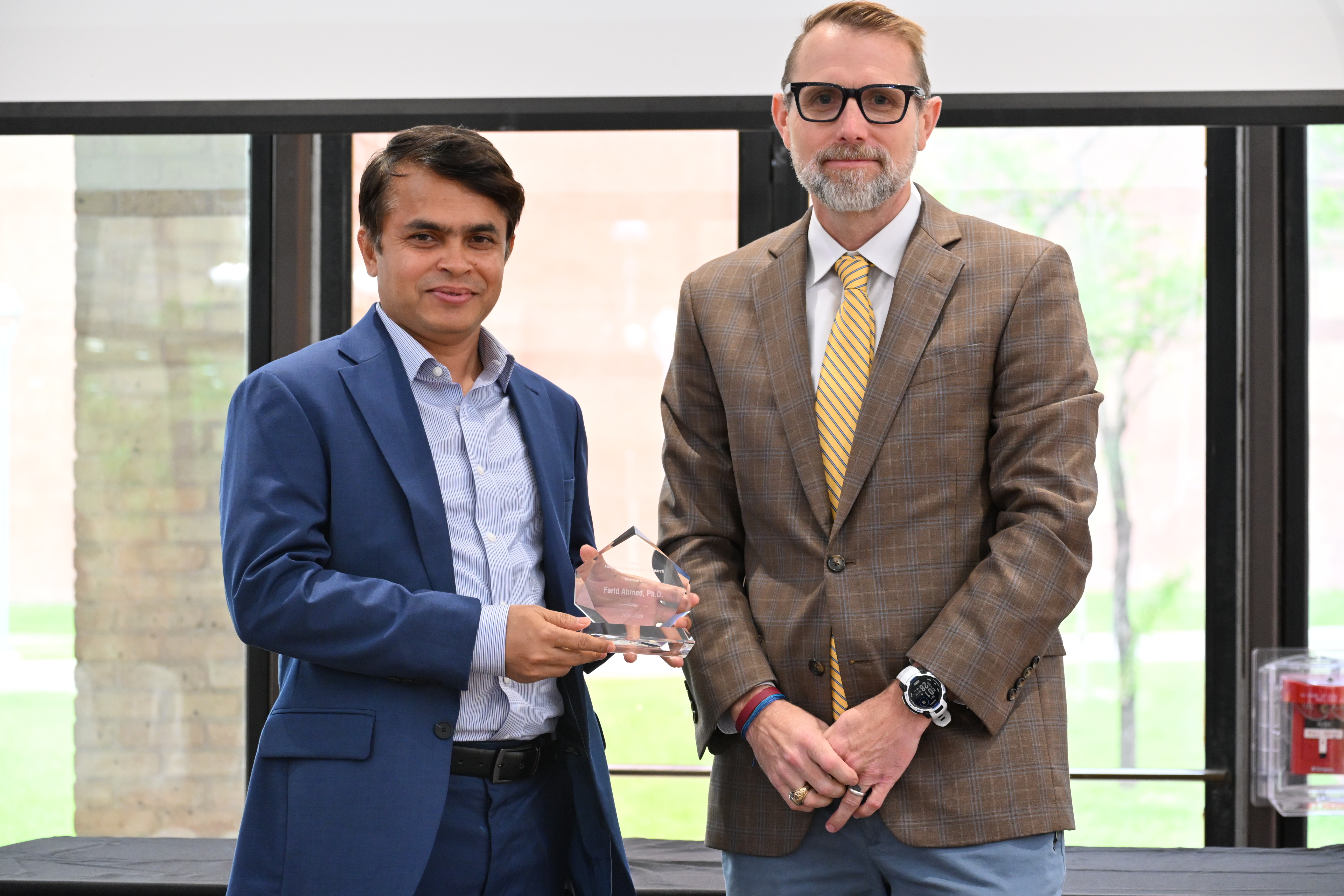
Farid Ahmed |
College of Engineering and Computer Science |
|
Research Award |
Upal Roy |
College of Health Professions |
|
Research Award |
Lin Jiang |
School of Social Work |
|
Service Award |
Candace Robledo |
School of Medicine |
|
Service Award |
Denise A. Longoria |
School of Social Work |
|
Service Award |
Timothy Huber |
College of Sciences |
|
CATEGORY |
NAME |
COLLEGE |
|---|---|---|
| Distinguished Career Award |
Robert Freeman |
College of Engineering and Computer Science |
|
Emerging Scholar Award |
Mohamadhossien Noruzoliaee |
College of Engineering and Computer Science |
| Research/Scholarship Award |
Mataz Alcoutlabi |
College of Engineering and Computer Science |
|
Service Award |
Dumitru Caruntu |
College of Engineering and Computer Science |
|
Teaching Award |
Azucena Herrera |
Robert C. Vackar College of Business and Entrepreneurship |
|
Online Teaching Award |
Tracia Foreman |
College of Health Professions |
|
CATEGORY |
NAME |
COLLEGE |
|---|---|---|
| Distinguished Career Award |
Zhaoshen Feng |
College of Sciences |
|
Emerging Scholar Award |
Nirakar Sahoo |
College of Sciences |
| Research/Scholarship Award |
Elena Venegas |
College of Education and P-16 Integration |
|
Service Award |
Teresa Feria Arroyo |
College of Sciences |
|
Teaching- Non Tenure Track Award |
Eleazar Marquez |
College of Engineering and Computer Science |
|
Online Teaching Award |
Judith Guetzow |
College of Health Professions |
|
Teaching- Tenured/ Tenure Track Award |
Arturo Fuentes |
College of Engineering and Computer Science |
|
Sustainability Education Award |
Debasish Bandyopadhyay |
College of Sciences |
|
Student Mentoring Award |
Constantine Tarawneh |
College of Engineering and Computer Science |
|
Community Engaged Scholarship Award |
Noe Vargas |
College of Engineering and Computer Science |
|
CATEGORY |
NAME |
COLLEGE |
|---|---|---|
| Distinguished Career Award |
Steven Schneider |
College of Fine Arts |
|
Emerging Scholar Award |
Fatemeh Nazari |
College of Engineering and Computer Science |
| Research/Scholarship/ Creative Work Award |
Joanne Curran |
School of Medicine |
|
Service Award |
Bin Wang |
Robert C. Vackar College of Business and Entrepreneurship |
|
Teaching- Non Tenure Track Award |
Satya Kachiraju |
College of Sciences |
|
Online Teaching Award |
Maria Elena Corbeil |
College of Education and P-16 Integration |
|
Teaching- Tenured / Tenure Track Award |
Jean Braithwaite |
College of Fine Arts |
|
Sustainability Education Award |
Maria Leonard |
Robert C. Vackar College of Business and Entrepreneurship |
|
Student Mentoring Award |
Sue Anne Chew |
College of Health Professions |
|
Community Engaged Scholarship Award |
Alexis Racelis |
College of Sciences |
|
CATEGORY |
NAME |
COLLEGE |
|---|---|---|
| Distinguished Career Award |
Mahammed Farooqui |
College of Sciences |
|
Emerging Scholar Award |
Alejandro Lopez-Juarez |
College of Health Professions |
| Research/Scholarship/ Creative Work Award |
Karl Berg |
College of Sciences |
|
Service Award |
Robert Dearth |
College of Sciences |
|
Teaching- Non Tenure Track Award |
Salma Mahmood |
College of Sciences |
|
Online Teaching Award |
Kathryn Perez |
College of Sciences |
|
Teaching- Tenured / Tenure Track Award |
Horacio Vasquez |
College of Engineering and Computer Science |
|
Sustainability Education Award |
Sylvia Robles |
Robert C. Vackar College of Business and Entrepreneurship |
|
Student Mentoring Award |
Pushpa Soti |
College of Sciences |
|
Community Engaged Scholarship Award |
Christopher Vitek |
College of Sciences |
|
CATEGORY |
NAME |
COLLEGE |
|---|---|---|
| Research/Scholarship/ Creative Work Award |
Zhaosheng Feng |
College of Sciences |
|
Service Award |
Karin Lewis |
College of Education and P-16 Integration |
|
Teaching- Non Tenure Track Award |
Lorena Lopez |
College of Health Affairs |
|
Online Teaching Award |
Rene Corbeil |
College of Education and P-16 Integration |
|
Teaching- Tenured / Tenure Track Award |
Dumitru Cauntu |
College of Engineering and Computer Science |
|
Sustainability Education Award |
Bradley Christoffersen |
College of Sciences |
|
Student Mentoring Award |
Karen Lozano |
College of Engineering and Computer Science |
|
Community Engaged Scholarship Award |
Angela Chapman |
College of Education and P-16 Integration |
2025-2026 FIA Ceremony